


Eaton Strainers
In the landscape of industrial fluid handling, the protection of downstream equipment is a primary engineering concern. Industrial strainers serve as the first line of defense, removing unwanted solids from liquid streams to prevent damage to pumps, valves, nozzles, and heat exchangers. Among the most recognized names in this sector are Eaton strainers, which have set industry standards for reliability and design diversity. For engineers and procurement specialists, understanding the technical nuances of these systems—and the critical role of the internal filtration media—is essential for optimizing process uptime and reducing maintenance overhead.
Selecting the right strainer involves more than matching a pipe size. It requires a deep dive into flow dynamics, material compatibility, and the specific geometry of the internal Strainers & Baskets that perform the actual separation. This guide explores the engineering principles behind these systems and the factors that influence their performance in demanding industrial environments.
The Role of Strainers and Baskets in Industrial Processes
Industrial strainers are closed vessels that use a screen or mesh element to remove large particles from a process fluid. Unlike fine filters, which may target sub-micron particles and are often disposable, strainers are typically designed to remove coarser solids and feature cleanable, reusable internal components.
The effectiveness of Eaton strainers is largely dependent on the design of the basket. The basket provides the surface area necessary for filtration while maintaining structural integrity under the pressure of the fluid flow. In applications ranging from chemical processing to water treatment, the choice of strainer configuration—simplex, duplex, or Y-type—dictates how the system handles solids loading and maintenance intervals.
For many facilities, the strainer is a critical safety component. In a hydraulic system, a stray piece of metal can cause catastrophic pump failure. In food and beverage production, a strainer ensures that no foreign debris enters the final packaging stage. By integrating high-quality filtration components, manufacturers can ensure that their Eaton strainers operate at peak efficiency with minimal pressure drop.
Comparing Simplex and Duplex Strainer Configurations
When specifying Eaton strainers, one of the first decisions an engineer must make is whether the application requires a simplex or a duplex design. This choice is primarily driven by the necessity of continuous operation.
Simplex Strainers
Simplex strainers are used in batch processes or in systems where the flow can be interrupted for cleaning. These units consist of a single chamber containing one basket. When the pressure differential across the strainer reaches a predetermined limit, the system must be shut down, the vessel opened, and the basket cleaned or replaced. They are cost-effective and compact, making them ideal for cooling water lines, fuel lines, and chemical transfer where intermittent downtime is acceptable.
Duplex Strainers
For mission-critical applications where the flow cannot be stopped, duplex strainers are the standard. A duplex system consists of two separate strainer chambers connected by a diverter valve. When one basket becomes clogged, the operator can switch the flow to the clean chamber without interrupting the process. This allows for "on-the-fly" maintenance. Duplex Eaton strainers are frequently found in lubrication systems, continuous chemical reactors, and marine engine cooling systems where a shutdown would result in significant financial loss or safety risks.
Technical Specifications: Micron Ratings and Mesh Selection
The performance of any strainer is defined by its ability to capture specific particle sizes while allowing the fluid to pass through with minimal resistance. This is determined by the mesh or perforation size of the internal basket.
Perforated Plate vs. Wire Mesh
Most industrial baskets start with a perforated metal plate for structural strength. For coarser filtration (above 1/32 inch), the perforated plate itself may serve as the filter media. However, for finer filtration requirements, a layer of stainless steel wire mesh is lined or pleated inside the perforated basket.
Engineers must balance the "open area ratio"—the ratio of the total area of the holes to the total area of the basket. A higher open area ratio results in a lower initial pressure drop and longer run times between cleanings. However, if the mesh is too fine for the solids loading of the fluid, the strainer will clog rapidly, leading to frequent maintenance and potential cavitation in downstream pumps.
Understanding Pressure Drop (Delta P)
Pressure drop is the loss of fluid pressure as it passes through the strainer. It is influenced by the fluid’s viscosity, flow velocity, and the cleanliness of the basket. When selecting components for Eaton strainers, it is standard practice to size the unit so that the initial pressure drop does not exceed 2 psi. As debris accumulates, the pressure drop increases. Monitoring this differential is the most reliable way to determine when a basket requires cleaning.
Material Selection for Corrosive and High-Temperature Environments
Material science plays a pivotal role in the longevity of filtration systems. Because strainers are often exposed to aggressive chemicals, high pressures, and extreme temperatures, the housing and the internal components must be selected based on their chemical resistance and mechanical properties.
1. Carbon Steel: Suitable for non-corrosive applications like oil and fuel handling. It is cost-effective but prone to rusting in water-based systems.
2. Stainless Steel (304 and 316): The industry standard for chemical, food, and pharmaceutical applications. 316 stainless steel, in particular, offers superior resistance to chlorides and pitting, making it essential for marine environments and acidic processes.
3. Specialty Alloys: For highly corrosive environments involving sulfuric acid or seawater, materials like Monel, Hastelloy, or Titanium may be required for the internal mesh and baskets.
In addition to the metal type, the construction method of the basket—whether it is welded, silver-soldered, or epoxy-bonded—must be compatible with the process temperature. For high-temperature steam or thermal oil applications, all-welded stainless steel baskets are preferred to prevent structural failure.
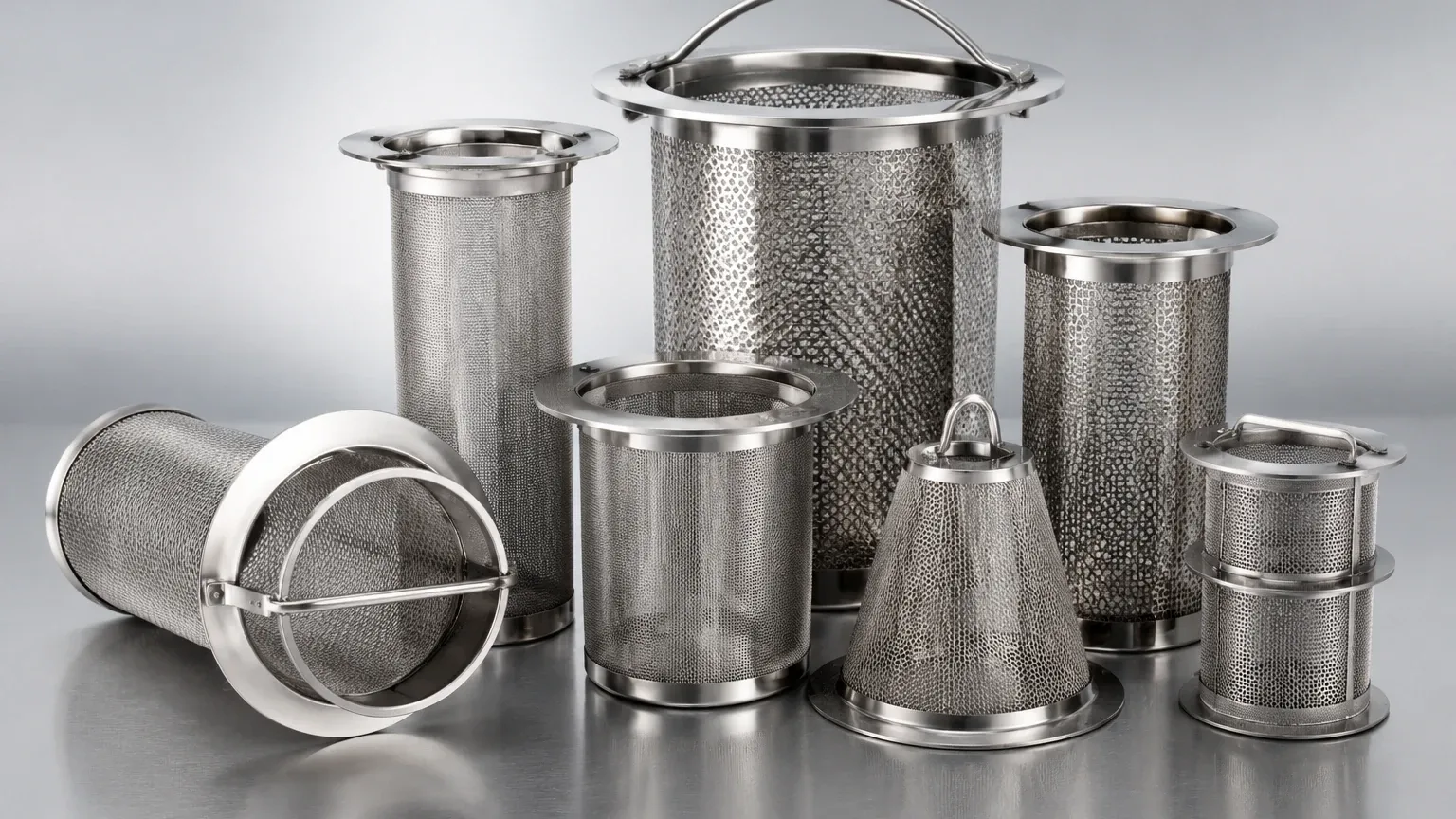
Optimizing Performance through Custom Filter Basket Engineering
While standard Eaton strainers come with factory-specified baskets, many industrial applications benefit from customized internal components. Custom-engineered baskets can address specific challenges that standard parts might miss, such as unusually high solids loading, fragile particles that shouldn't be sheared, or the need for magnetic inserts to capture fine ferrous particles.
Customization allows for the optimization of the filtration surface area. For example, pleating the wire mesh can significantly increase the available surface area within the same footprint, effectively extending the service life of the filter between cleaning cycles. Furthermore, reinforced baskets can be designed to withstand higher collapse pressures, providing an extra layer of safety in the event of a sudden pressure surge.
Manufacturers specializing in precision metal filtration, such as Kaifil, provide the engineering expertise required to produce these high-performance components. By focusing on material integrity and precise mesh weaving, these custom solutions ensure that the strainer housing—whether it is a standard Eaton model or a custom vessel—performs to its maximum potential.
Maintenance Best Practices and Total Cost of Ownership
The total cost of ownership (TCO) of a strainer system is not just the purchase price; it includes the cost of downtime, labor for cleaning, and the replacement of damaged parts. Proper maintenance is the key to minimizing these costs.
* Differential Pressure Monitoring: Installing gauges on the inlet and outlet of the strainer is the most effective way to prevent equipment damage. Relying on a fixed schedule for cleaning often leads to either unnecessary labor or, worse, a ruptured basket due to over-pressurization.
* Correct Cleaning Procedures: Stainless steel baskets should be cleaned using methods that do not damage the mesh. High-pressure water or ultrasonic cleaning is often effective. Abrasive wire brushes should be avoided as they can enlarge the mesh openings or introduce contaminants.
* Spare Parts Inventory: For simplex systems, having a spare basket on hand is critical. This allows for an immediate swap, reducing the time the process is offline. For duplex systems, maintaining a set of replacement seals and diverter valve kits ensures that the switching mechanism remains leak-free.
Conclusion: Selecting the Right Filtration Partner
Eaton strainers are a robust choice for industrial fluid protection, but their success depends on the synergy between the housing design and the internal filtration media. Engineers must carefully evaluate flow rates, particle size distribution, and chemical compatibility to select the appropriate configuration.
Whether you are maintaining an existing system or designing a new process line, the quality of the Strainers & Baskets remains the most significant factor in filtration performance. By focusing on precision-engineered components and high-grade materials like 316L stainless steel, facilities can achieve reliable, long-term protection for their most valuable industrial assets. For those requiring OEM-quality replacements or custom-designed filtration solutions, partnering with a manufacturer that understands the technical demands of industrial environments is the final step in ensuring process integrity.
