


Strainers for Kitchen Sinks
In the context of commercial food service, industrial food processing, and high-volume hospitality environments, strainers for kitchen sinks represent the primary line of defense for wastewater management systems. While often overlooked as a basic plumbing accessory, these components are critical filtration tools that prevent solid waste, organic debris, and particulate matter from entering drainage lines. For engineers, facility managers, and OEM equipment manufacturers, selecting the correct filtration hardware is essential to maintaining operational uptime and avoiding the significant costs associated with plumbing failures and environmental non-compliance.
Industrial-grade filtration solutions, such as those found in the broader category of Strainers & Baskets, must be engineered to withstand rigorous cleaning cycles, corrosive detergents, and constant mechanical stress. This guide examines the technical considerations, material science, and engineering specifications required to select high-performance strainers for demanding professional environments.
The Engineering Role of Sink Strainers in Industrial Environments
In a residential setting, a sink strainer is a simple convenience. In an industrial or commercial kitchen, it is a functional component of a larger fluid handling system. These systems often handle high volumes of water laden with fats, oils, greases (FOG), and solid food particles. Without effective primary filtration at the source, these solids accumulate in grease traps and downstream piping, leading to anaerobic decomposition, odor issues, and eventually, complete blockages.
From an engineering perspective, the strainer must achieve a balance between two competing factors: filtration efficiency and flow rate. A mesh that is too fine will capture more debris but will clog rapidly, requiring constant manual intervention and potentially causing sink overflow. Conversely, a mesh or perforation pattern that is too coarse will allow large solids to pass through, defeating the purpose of the component. Achieving the optimal "open area" ratio is the key to maintaining hydraulic performance while protecting the infrastructure.
Material Selection: The Case for Stainless Steel
Material durability is the most significant factor in the total cost of ownership (TCO) for industrial filtration components. Strainers for kitchen sinks in professional environments are subjected to thermal shock (boiling water followed by cold rinse), chemical exposure (chlorinated sanitizers and high-alkaline detergents), and physical impact from heavy cookware.
304 Stainless Steel
Grade 304 is the industry standard for most commercial kitchen applications. It offers excellent corrosion resistance to most oxidizing acids and is highly durable. For standard food preparation and dishwashing areas, 304 stainless steel provides the necessary structural integrity and longevity without the higher cost of specialized alloys.
316 Stainless Steel
In environments where high-salinity foods are processed or where aggressive chemical cleaning agents are used, Grade 316 stainless steel is preferred. The addition of molybdenum in 316 SS provides superior resistance to pitting and crevice corrosion, particularly in chloride-rich environments. For facilities located in coastal regions or those handling high-acid food processing, upgrading to 316 stainless steel ensures the filtration components do not fail prematurely due to stress corrosion cracking.
Surface Finishes and Hygiene
Beyond the alloy itself, the surface finish of the strainer is critical for hygiene. Electropolishing or high-grit mechanical polishing reduces surface roughness, making it more difficult for bacteria and biofilms to adhere to the metal. This is a vital consideration in pharmaceutical and food-grade applications where sanitation protocols are stringent.
Design Variations in Strainers & Baskets
Industrial filtration requirements vary significantly based on the volume of solids being processed. This has led to several distinct designs within the realm of Strainers & Baskets.
Deep Basket Strainers
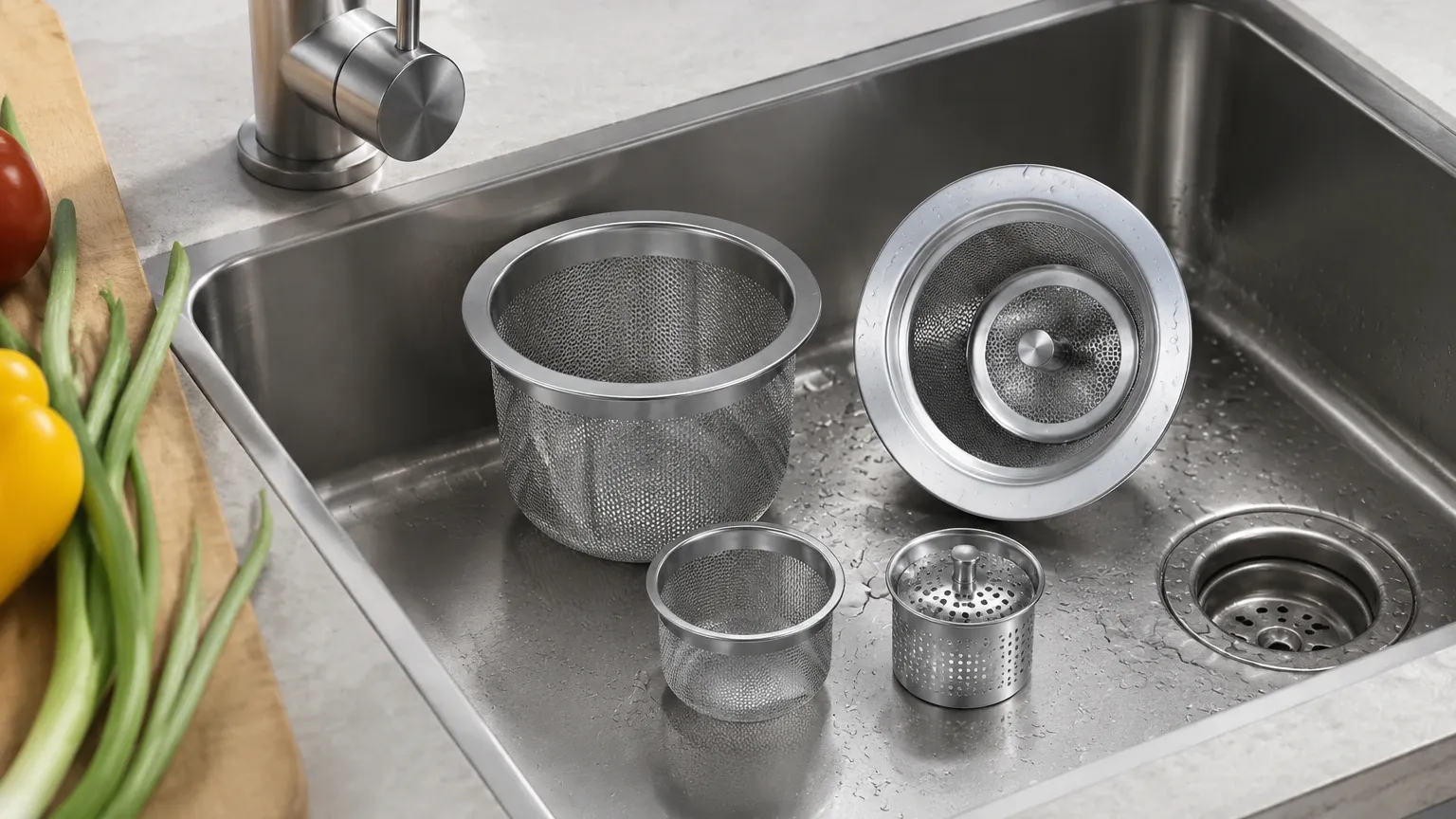
Deep basket designs are utilized in high-volume prep sinks where large amounts of vegetable peelings or food scraps are generated. The increased depth allows for a larger collection volume, extending the time between manual emptying cycles. These baskets often feature a secondary handle or lift-out bar to facilitate easy removal even when the sink is full of water.
Flat or Disc Strainers
Flat strainers are typically used in floor sinks or mop sinks where the primary goal is to catch large debris like mop strings or plastic packaging. These are often made from heavy-gauge perforated metal to withstand being stepped on or having heavy equipment rolled over them.
Dual-Stage Filtration
Some advanced industrial sinks utilize a dual-stage system. The first stage is a coarse perforated basket to catch large solids, while the second stage is a fine wire mesh liner that captures smaller particulates. This tiered approach prevents the fine mesh from being overwhelmed by large debris, ensuring more consistent flow rates.
Technical Specifications: Perforation vs. Mesh
When specifying strainers for kitchen sinks, engineers must choose between perforated metal and woven wire mesh. Each has specific performance characteristics:
1. Perforated Metal: Created by punching holes into a metal sheet. This provides high structural strength and is easier to clean. It is ideal for "coarse" filtration where the goal is to stop items larger than 2mm to 5mm. The hole pattern (staggered vs. straight) and the bridge width between holes determine the overall strength of the basket.
2. Woven Wire Mesh: Created by weaving individual wires together. Mesh allows for much finer filtration (down to micron levels) and provides a higher percentage of open area compared to perforated metal of the same filtration rating. However, wire mesh is more delicate and may require a perforated metal backing (a "support cage") to prevent deformation under the weight of collected solids.
For most commercial kitchen applications, a perforated basket with hole diameters ranging from 1/8" to 1/4" is the standard, providing a robust balance of strength and debris retention.
Engineering Considerations for Installation and Compatibility
Specifying the right strainer requires more than just choosing a material; it requires a detailed understanding of the mechanical interface between the strainer and the sink assembly. Key parameters include:
* Flange Diameter: The outer diameter must match the sink opening precisely to ensure a watertight seal when used with gaskets or plumbers' putty.
* Thread Specification: For strainers that integrate with the drain tailpiece, the thread pitch and diameter must be compatible with standard industrial plumbing fittings (e.g., NPSL or BSP threads).
* Locking Mechanisms: In high-vibration environments or facilities with heavy usage, strainers with heavy-duty brass or stainless steel locknuts are preferred over plastic alternatives, which can crack or loosen over time.
* Seal Integrity: High-quality strainers utilize long-lasting gaskets made from materials like EPDM or Nitrile (Buna-N), which resist degradation from fats and oils.
Maintenance, Replacement Cycles, and TCO
The total cost of ownership for filtration components is not defined by the purchase price, but by the maintenance labor and the cost of failure. A low-quality strainer that bypasses debris can lead to a $1,000+ plumbing bill for hydro-jetting a clogged main line.
Preventive Maintenance
In a commercial setting, strainers should be inspected daily for signs of mechanical wear, such as broken welds or thinning metal. Wire mesh strainers are particularly susceptible to "blinding" (permanent clogging of the pores), which can often be remediated with ultrasonic cleaning or specialized chemical soaks, but eventually requires component replacement.
When to Replace
Signs that a strainer has reached the end of its service life include:
* Deformation: If the basket no longer sits flush in the housing, solids will bypass the filter.
* Corrosion: Any sign of rust on a stainless steel component indicates that the protective oxide layer has been compromised, often due to harsh chemical exposure.
* Reduced Flow: If cleaning no longer restores the original flow rate, the mesh may be physically damaged or permanently blinded.
Custom OEM Solutions for Specialized Equipment
Many manufacturers of industrial dishwashers, food processing machinery, and specialized lab sinks require custom-designed strainers for kitchen sinks that are not available as off-the-shelf components. Customization options typically include:
* Non-Standard Dimensions: Baskets designed to fit proprietary equipment housings.
* Integrated Features: Strainers with built-in overflow tubes or specialized sensors for monitoring flow rates.
* Variable Micron Ratings: Custom mesh configurations to meet specific environmental discharge permits.
* Reinforced Structures: Heavy-duty frames for applications involving high-pressure water jets or heavy mechanical loads.
By working with a specialized manufacturer like Kaifil, engineers can develop bespoke filtration components that are optimized for their specific application, ensuring maximum equipment protection and operational efficiency.
Conclusion
Selecting strainers for kitchen sinks in a B2B or industrial context is a task that demands attention to material science, hydraulic performance, and mechanical durability. By prioritizing high-grade stainless steel, optimized open-area ratios, and robust construction, facilities can significantly reduce the risk of drainage failures and lower their long-term maintenance costs. Whether for a standard commercial kitchen or a specialized industrial process, high-quality Strainers & Baskets serve as an indispensable component of a responsible and efficient waste management strategy.
