


Strainers for Sinks
In industrial and commercial environments, the management of wastewater and process fluids begins at the point of drainage. While often overlooked, the selection of appropriate strainers for sinks is a critical engineering decision that impacts plumbing longevity, environmental compliance, and operational efficiency. Unlike residential components, industrial sink strainers must withstand corrosive chemicals, extreme temperatures, and high-volume throughput without compromising structural integrity.
As a specialized manufacturer of stainless steel filtration solutions, Kaifil provides a range of Strainers & Baskets designed to meet the rigorous demands of chemical processing, food and beverage production, and pharmaceutical laboratory environments. Understanding the technical nuances of these components is essential for procurement teams and facility engineers tasked with maintaining infrastructure performance.
Understanding the Role of Industrial Sink Strainers
The primary function of a sink strainer in an industrial context is the mechanical separation of solids from liquid waste streams. This serves two main purposes: protecting downstream piping from blockages and preventing hazardous or non-compliant materials from entering the municipal sewer system or the facility’s internal water treatment plant.
Industrial strainers for sinks are typically integrated into floor sinks, laboratory cup sinks, or large-scale commercial washing stations. The design must account for the specific types of debris encountered—ranging from organic food waste and fibrous materials to metal shavings or chemical precipitates. Failure to select the correct filtration grade can result in frequent clogging, which increases labor costs for maintenance, or bypass of solids, which leads to expensive plumbing repairs.
Material Selection: The Case for Stainless Steel
Material science plays a pivotal role in the performance of filtration components. In industrial settings, plastic or low-grade plated metals are often insufficient due to their susceptibility to thermal shock and chemical degradation. Stainless steel is the industry standard for high-performance strainers for sinks.
304 Stainless Steel
Grade 304 is the most common stainless steel used in industrial filtration. It offers excellent corrosion resistance to most oxidizing acids and is highly durable. For general-purpose industrial sinks where the primary concern is mechanical debris and standard cleaning agents, 304 stainless steel provides a cost-effective and long-lasting solution.
316 Stainless Steel
In environments involving high chloride concentrations or aggressive chemicals—such as pharmaceutical labs or marine processing facilities—316 stainless steel is preferred. The addition of molybdenum enhances the material's resistance to pitting and crevice corrosion. When specifying Strainers & Baskets for these applications, the increased initial investment in 316 stainless steel is justified by the significantly extended service life and reduced risk of structural failure.
Design Variations: Basket vs. Disc Strainers
The geometry of the strainer determines its holding capacity and flow characteristics. Engineers must choose between various configurations based on the expected volume of solids.
Basket Strainers
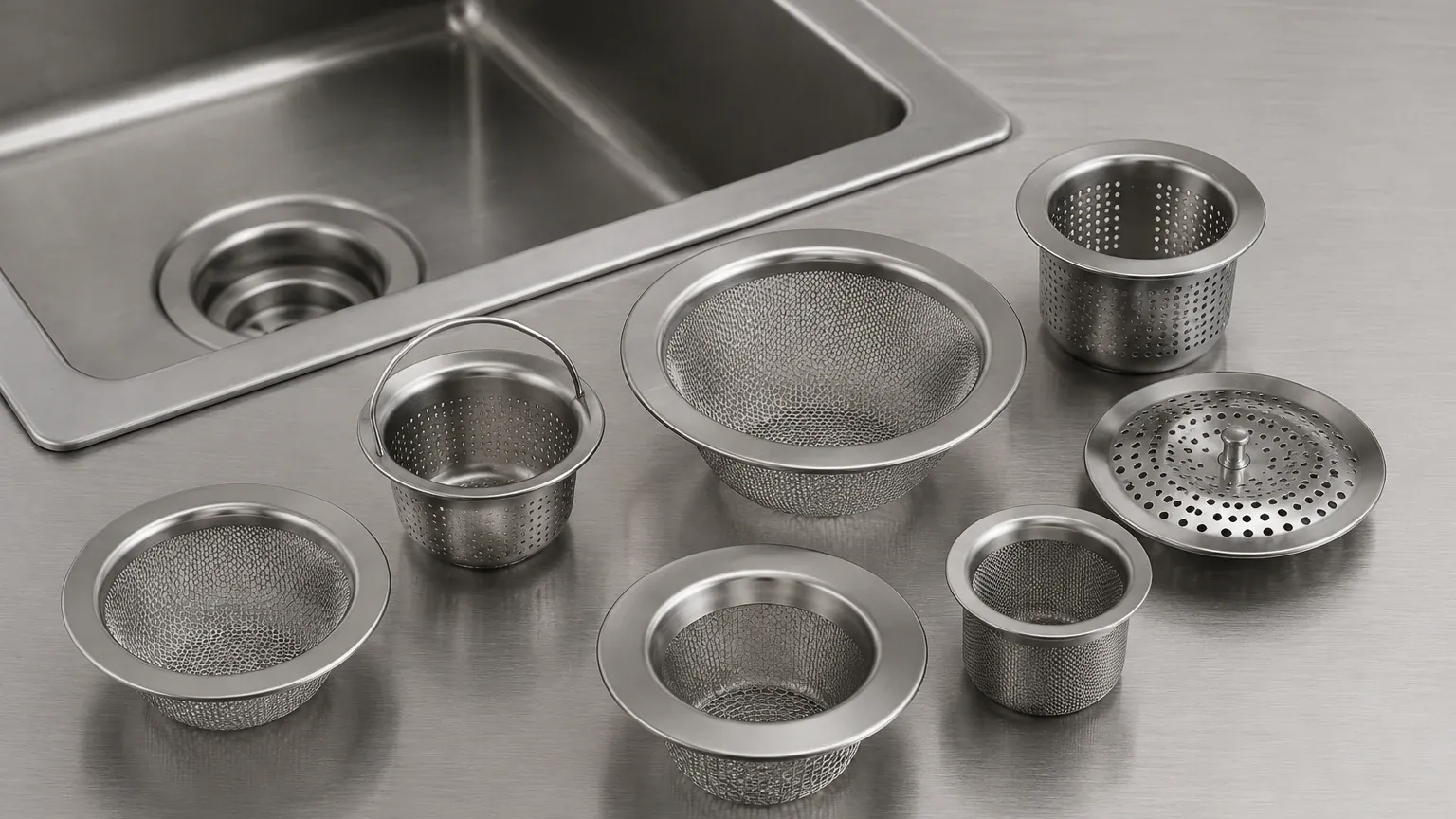
Basket strainers are characterized by their deep, bucket-like shape. This design provides a larger surface area for filtration compared to flat discs, allowing for a higher volume of debris to be captured before the flow is significantly restricted. In industrial kitchens or food processing plants, basket-style strainers for sinks are essential because they can be easily removed, emptied, and cleaned without requiring specialized tools.
Flat and Domed Disc Strainers
For applications where the fluid volume is high but the solid load is low, flat or domed disc strainers may be used. Domed designs are particularly effective in preventing total drainage blockage; even if debris accumulates around the base, the raised center allows fluid to continue passing through. These are often used in floor sinks within manufacturing zones where wash-down procedures occur frequently.
Technical Specifications for Industrial Applications
When evaluating strainers for sinks, engineers must look beyond physical dimensions and consider technical performance metrics.
Perforation and Mesh Size
The "open area" of a strainer is a critical metric. It is the ratio of the total area of the holes to the total area of the strainer surface. A higher open area reduces pressure drop and allows for faster drainage but may compromise the structural strength of the basket.
* Perforated Metal: Typically used for coarse filtration, perforated stainless steel provides high mechanical strength and is suitable for capturing large debris.
* Wire Mesh Liners: For applications requiring the capture of fine particles, a wire mesh liner can be integrated into the basket. Kaifil specializes in custom wire mesh configurations, allowing for precise control over the micron rating of the strainer.
Flow Rate and Pressure Drop
In industrial processes, drainage speed can affect production cycles. A strainer that is too restrictive will cause "ponding" in the sink, which can lead to hygiene issues or safety hazards. Engineers should calculate the maximum expected flow rate and ensure the selected strainer can handle that volume even when it is 50% loaded with debris.
Installation and Maintenance Protocols
The longevity of industrial strainers for sinks is heavily dependent on proper installation and a disciplined maintenance schedule.
Sealing and Fit
A common point of failure in industrial drainage is the seal between the strainer body and the sink flange. In chemical environments, standard rubber gaskets may perish. Specifying PTFE or Viton gaskets ensures a leak-proof seal that can withstand chemical exposure. Furthermore, the fit must be precise; any gap between the strainer and the drain allows bypass, defeating the purpose of the filtration component.
Cleaning Cycles
Unlike residential units, industrial strainers should be cleaned based on a scheduled protocol rather than waiting for a visible backup. For high-load environments, such as meat processing or textile manufacturing, this may involve cleaning at the end of every shift. Stainless steel's ability to withstand high-pressure washing and steam sterilization (autoclaving) makes it ideal for these rigorous cleaning cycles.
Customization and OEM Solutions
Many industrial facilities operate with non-standard equipment or unique process requirements. Standard off-the-shelf strainers for sinks may not provide the necessary fit or filtration accuracy. This is where OEM (Original Equipment Manufacturer) capabilities become vital.
Customization options often include:
* Handle Modifications: Adding heavy-duty handles or specialized lifting eyes for easy removal in deep sinks.
* Variable Micron Ratings: Utilizing multi-layer mesh sintering to achieve fine filtration while maintaining the strength of a perforated basket.
* Reinforced Structures: For high-vibration environments or sinks that handle heavy slurry, reinforcing the base and walls of the basket prevents deformation.
Kaifil works closely with engineering teams to develop bespoke Strainers & Baskets that integrate seamlessly into existing industrial workflows, ensuring that the filtration solution is optimized for the specific particle size and fluid chemistry of the application.
Evaluating Total Cost of Ownership (TCO)
When purchasing strainers for sinks for an industrial facility, the initial purchase price is only one component of the total cost of ownership. Procurement professionals should consider:
1. Durability: A low-cost strainer that requires replacement every six months is more expensive over a five-year period than a high-quality stainless steel unit that lasts a decade.
2. Labor Costs: Strainers that are difficult to clean or prone to clogging increase the man-hours required for facility maintenance.
3. Downstream Protection: The cost of a high-quality strainer is negligible compared to the cost of clearing a main sewer line blockage or repairing a damaged industrial pump that was fouled by escaped debris.
4. Compliance: In many jurisdictions, failing to capture certain solids before they enter the waste stream can result in significant environmental fines.
Conclusion
Selecting the right strainers for sinks is a fundamental aspect of industrial facility management. By focusing on material quality, specific design configurations, and technical performance metrics, engineers can ensure efficient drainage and robust protection of their plumbing infrastructure. Stainless steel remains the material of choice for its hygiene, durability, and resistance to the harsh conditions typical of industrial processing.
Whether you are designing a new pharmaceutical lab or upgrading a food processing plant, choosing high-performance filtration components is an investment in operational continuity. For more information on technical specifications and custom manufacturing options, review the available Strainers & Baskets to find the solution that best fits your industrial requirements.
