


Gutter Strainers
In industrial and commercial infrastructure, the management of fluid runoff and the protection of downstream piping systems are critical to operational continuity. Gutter strainers, often categorized within the broader family of Strainers & Baskets, serve as the primary line of defense against large-scale particulate contamination. Unlike residential components, industrial-grade gutter strainers must withstand corrosive environments, extreme weather conditions, and high-velocity flow rates while maintaining structural integrity.
For engineers and facility managers, selecting the appropriate strainer involves more than matching a diameter. It requires a technical understanding of material science, fluid dynamics, and mechanical design to ensure that the filtration component does not become a point of failure. This guide examines the engineering considerations and performance expectations for high-performance gutter strainers in industrial applications.
The Role of Gutter Strainers in Industrial Infrastructure
Industrial gutter strainers are designed to intercept debris—such as gravel, leaves, plastic waste, and organic matter—before it enters the primary drainage or processing system. In a B2B context, these components are frequently utilized in large-scale manufacturing plants, chemical processing facilities, and water treatment works where rooftop or surface runoff is collected for processing or discharge.
The primary function of these strainers is to protect downstream equipment. Pumps, valves, and secondary filtration stages (such as fine wire mesh filters) are highly susceptible to damage or clogging from large solids. By implementing robust gutter strainers at the point of entry, facilities can significantly reduce the frequency of emergency maintenance and extend the service life of more expensive mechanical assets.
Beyond simple debris management, these components are often integrated into rainwater harvesting systems. In these applications, the strainer must provide a specific level of filtration accuracy to ensure the water is suitable for initial storage tanks before undergoing more rigorous purification processes.
Material Selection: The Case for Stainless Steel
One of the most critical decisions in the procurement of gutter strainers is the choice of material. While plastic or galvanized steel options exist, industrial environments typically demand the superior properties of stainless steel. As a specialized manufacturer, Kaifil emphasizes the use of high-grade alloys to meet the rigors of industrial service.
Corrosion Resistance
Industrial runoff often contains more than just rainwater. In chemical plants or coastal facilities, the liquid passing through the strainer may carry corrosive agents or salt spray. Stainless steel 304 and 316 are the industry standards for these applications:
* Type 304 Stainless Steel: Offers excellent resistance to oxidation and is suitable for most general industrial applications where moisture is the primary concern.
* Type 316 Stainless Steel: Contains molybdenum, which provides enhanced resistance to chlorides and industrial chemicals. This is the preferred choice for pharmaceutical, chemical processing, and marine-adjacent facilities.
Mechanical Strength and Thermal Stability
Industrial gutters may be subject to high-pressure washdowns or extreme temperature fluctuations. Stainless steel maintains its mechanical properties across a wide temperature range, preventing the warping or embrittlement often seen in polymer-based strainers. Furthermore, the high strength-to-weight ratio of stainless steel allows for the design of strainers with thinner profiles that do not sacrifice durability, maximizing the available flow area.
Engineering Design and Customization
Standard off-the-shelf strainers rarely meet the specific requirements of complex industrial drainage systems. Customization is often necessary to account for unique pipe geometries, flow requirements, and debris types. Professional manufacturers provide OEM solutions that tailor the strainer to the specific application.
Basket Geometry and Structural Support
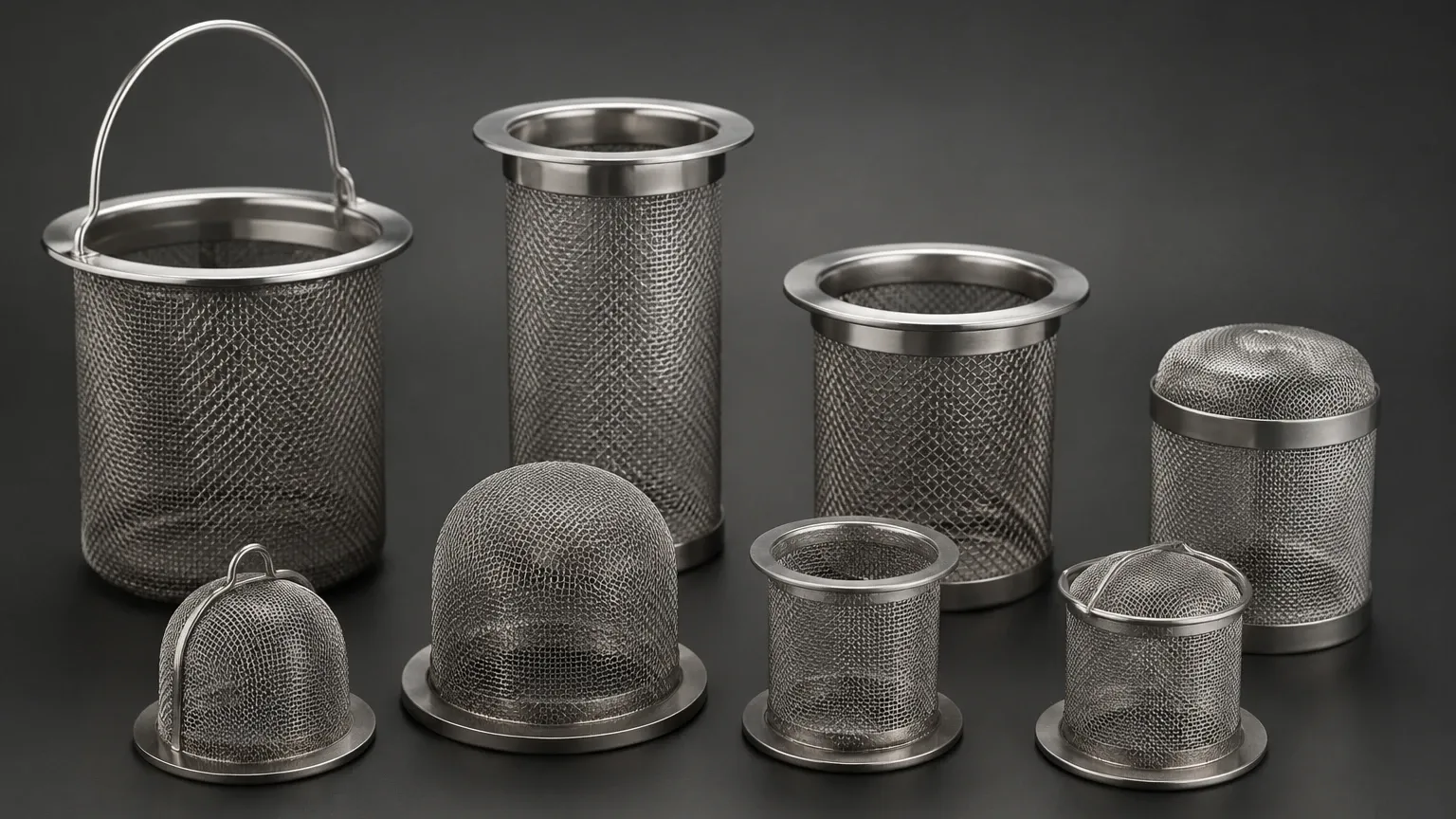
The shape of the strainer—whether it is a dome, a flat basket, or a tapered cylinder—affects how debris accumulates. A dome-style gutter strainer is often preferred because it allows water to continue flowing around the base even if the top becomes covered with debris.
For larger applications, the strainer must be reinforced. This often involves a multi-layer construction where a fine stainless steel wire mesh is bonded to a heavier perforated metal backup. This design provides the necessary filtration accuracy while ensuring the mesh does not collapse under the weight of accumulated debris or the force of high-velocity water.
OEM and Bespoke Manufacturing
Customization extends to the mounting mechanisms. Depending on the installation site, strainers may need to be secured via friction fits, flange mountings, or bolt-down configurations. Working with a manufacturer like Kaifil allows engineers to specify exact tolerances, ensuring a seamless fit that prevents "bypass"—where unfiltered liquid escapes around the edges of the strainer.
Technical Specifications: Flow Rate and Filtration Accuracy
When evaluating gutter strainers, engineers must balance the need for particulate removal with the requirement for unimpeded flow. This balance is determined by two main factors: the aperture size and the open area ratio.
Aperture Size and Mesh Selection
The aperture size (the size of the openings in the strainer) must be smaller than the smallest piece of debris that could potentially damage downstream equipment. However, choosing a mesh that is too fine will lead to rapid clogging and excessive maintenance. In industrial gutter applications, the goal is typically to remove large solids, so apertures often range from 1mm to 10mm, depending on the specific vulnerability of the downstream system.
Open Area Ratio (OAR)
The Open Area Ratio is the total area of the holes divided by the total area of the strainer surface. A high OAR is essential for maintaining a low pressure drop. If the OAR is too low, the strainer will act as a bottleneck, causing water to back up in the gutter system, which can lead to structural damage or flooding. Industrial-grade strainers are engineered to provide an OAR that exceeds the cross-sectional area of the drainage pipe, providing a safety margin even as debris begins to collect.
Maintenance and Total Cost of Ownership (TCO)
While the initial purchase price of a strainer is a factor, the total cost of ownership is driven by durability and ease of maintenance. In a B2B environment, labor costs for cleaning and the potential costs of system downtime far outweigh the price of the filtration component itself.
Cleaning Cycles and Accessibility
Industrial gutter strainers should be designed for rapid inspection and cleaning. Self-cleaning designs or those with quick-release mechanisms can significantly reduce maintenance hours. Because stainless steel is non-porous and resistant to biological growth, it is much easier to clean than plastic or rough-cast metals, as debris is less likely to adhere to the surface.
Replacement Cycles
A high-quality stainless steel strainer can last for decades if properly specified. In contrast, cheaper materials may require replacement every few years due to UV degradation, corrosion, or mechanical failure. By investing in precision-engineered stainless steel components, purchasing teams can reduce the long-term capital expenditure associated with system repairs and part replacements.
Critical Selection Criteria for Engineers
Before finalizing a specification for gutter strainers, technical professionals should confirm several key variables with their supplier to ensure the component is fit for purpose:
1. Chemical Compatibility: Identify all potential chemicals, including cleaning agents, that may pass through the gutter system to select the correct stainless steel grade.
2. Peak Flow Requirements: Ensure the strainer can handle the maximum expected flow rate (e.g., during a 100-year storm event) without causing significant backup.
3. Debris Profile: Characterize the type of debris most common at the site. Is it fibrous, granular, or large and irregular? This informs the choice between wire mesh and perforated metal.
4. Structural Load: Determine if the strainer will be subjected to physical impact or the weight of heavy snow and ice, which may necessitate internal ribbing or thicker gauge materials.
5. Installation Constraints: Confirm the exact internal diameter of the drain and the available clearance above the drain to ensure the strainer geometry does not interfere with other infrastructure.
Conclusion
Gutter strainers are an essential, though often overlooked, component of industrial fluid management. By preventing large-scale contamination from entering sensitive systems, they play a vital role in protecting equipment and maintaining operational efficiency. For B2B applications, the transition from standard hardware to engineered Strainers & Baskets ensures that these components can withstand the specific stresses of an industrial environment.
Choosing a partner with deep expertise in stainless steel fabrication and custom filtration allows engineering teams to develop solutions that are precisely matched to their application. Whether the requirement is for a standard OEM part or a highly customized filtration basket, focusing on material quality, flow dynamics, and structural durability will result in a more reliable and cost-effective drainage system.
