


Strainer Gasket
In industrial filtration, the efficiency of a system is often judged by its micron rating or flow capacity. However, for engineers and maintenance professionals, the integrity of that system frequently rests on a single, often overlooked component: the strainer gasket. This critical sealing element ensures that the fluid being processed actually passes through the filtration media rather than bypassing it through gaps in the housing or basket assembly. Without a properly specified and maintained strainer gasket, even the most advanced Strainers & Baskets cannot perform to their design specifications.
A strainer gasket serves two primary roles. First, it seals the cover of the strainer housing to prevent external leaks, which is essential for safety and environmental compliance. Second, it often acts as the internal seal for the basket or element, ensuring a tight fit against the housing seat to prevent "bypass"—the phenomenon where unfiltered fluid escapes around the edges of the filter element. This article examines the technical nuances of gasket selection, material science, and engineering considerations necessary for optimizing industrial filtration performance.
The Critical Function of a Strainer Gasket
The primary objective of any filtration process is the removal of particulate matter from a liquid or gas stream. In high-pressure or high-flow environments, the mechanical stress on the filtration hardware is significant. The strainer gasket must maintain a resilient seal under these conditions to ensure that 100% of the process fluid is directed through the mesh or perforated metal of the basket.
In many Strainers & Baskets configurations, the gasket is located at the interface between the basket flange and the housing body. If this seal fails, the resulting bypass can lead to downstream contamination, damaged pumps, or clogged heat exchangers. Furthermore, an external seal failure at the housing cover can result in costly product loss and hazardous working conditions, particularly in chemical processing or high-temperature steam applications.
Material Selection: Matching Polymer to Process
Selecting the correct material for a strainer gasket is not a matter of convenience; it is a matter of chemical and thermal compatibility. The wrong material can swell, degrade, or become brittle, leading to catastrophic seal failure. Engineers must evaluate several material options based on the specific process media.
EPDM (Ethylene Propylene Diene Monomer)
EPDM is a versatile elastomer widely used in water treatment and general industrial applications. It offers excellent resistance to heat, ozone, and weather. However, it is not suitable for applications involving petroleum-based oils or hydrocarbons, which cause the material to swell and lose its structural integrity.
Viton™ (FKM)
For high-temperature applications or those involving aggressive chemicals, Viton is often the standard choice. It provides superior resistance to oils, fuels, and many mineral acids. In the context of Strainers & Baskets used in oil and gas or petrochemical refining, Viton gaskets are essential for maintaining long-term reliability in harsh environments.
Buna-N (Nitrile)
Nitrile is the most common material for general-purpose oil and solvent resistance. It is cost-effective and provides good mechanical properties, including abrasion resistance. It is frequently found in hydraulic systems and fuel filtration, though its temperature range is more limited compared to Viton.
PTFE (Polytetrafluoroethylene)
When chemical inertness is the highest priority, PTFE gaskets are utilized. PTFE is nearly universal in its chemical resistance and can withstand extreme temperatures. However, because PTFE is a thermoplastic rather than an elastomer, it lacks the "memory" or resiliency of rubber. It may require specific housing designs or the use of encapsulated O-rings to ensure a consistent seal over time.
Engineering Considerations: Pressure, Temperature, and Media
When specifying a strainer gasket for industrial Strainers & Baskets, engineers must look beyond the material name and consider the operational parameters of the system.
Pressure Ratings and Compression Set
The gasket must be able to withstand the maximum operating pressure of the system without extruding from the seal groove. Furthermore, the "compression set"—the ability of the elastomer to return to its original thickness after being compressed—is vital. A gasket with a poor compression set will eventually lose its sealing force, leading to leaks after several thermal or pressure cycles.
Thermal Cycling
In many industrial processes, temperatures fluctuate. As the metal housing and the strainer gasket expand and contract at different rates, the seal must remain flexible. If a gasket becomes hard or "heat-aged," it will crack during these cycles. This is particularly relevant in food and beverage processing where Clean-in-Place (CIP) cycles involve rapid shifts from ambient temperatures to high-temperature caustic washes.
Chemical Concentration and Permeation
It is not enough to know that a fluid is "acidic." The concentration and temperature of the acid significantly impact the rate of chemical attack on the gasket. Additionally, some gases or highly volatile liquids can permeate through certain elastomers. Engineers must verify that the strainer gasket material is impermeable to the specific media being handled to prevent degradation of the seal's internal structure.
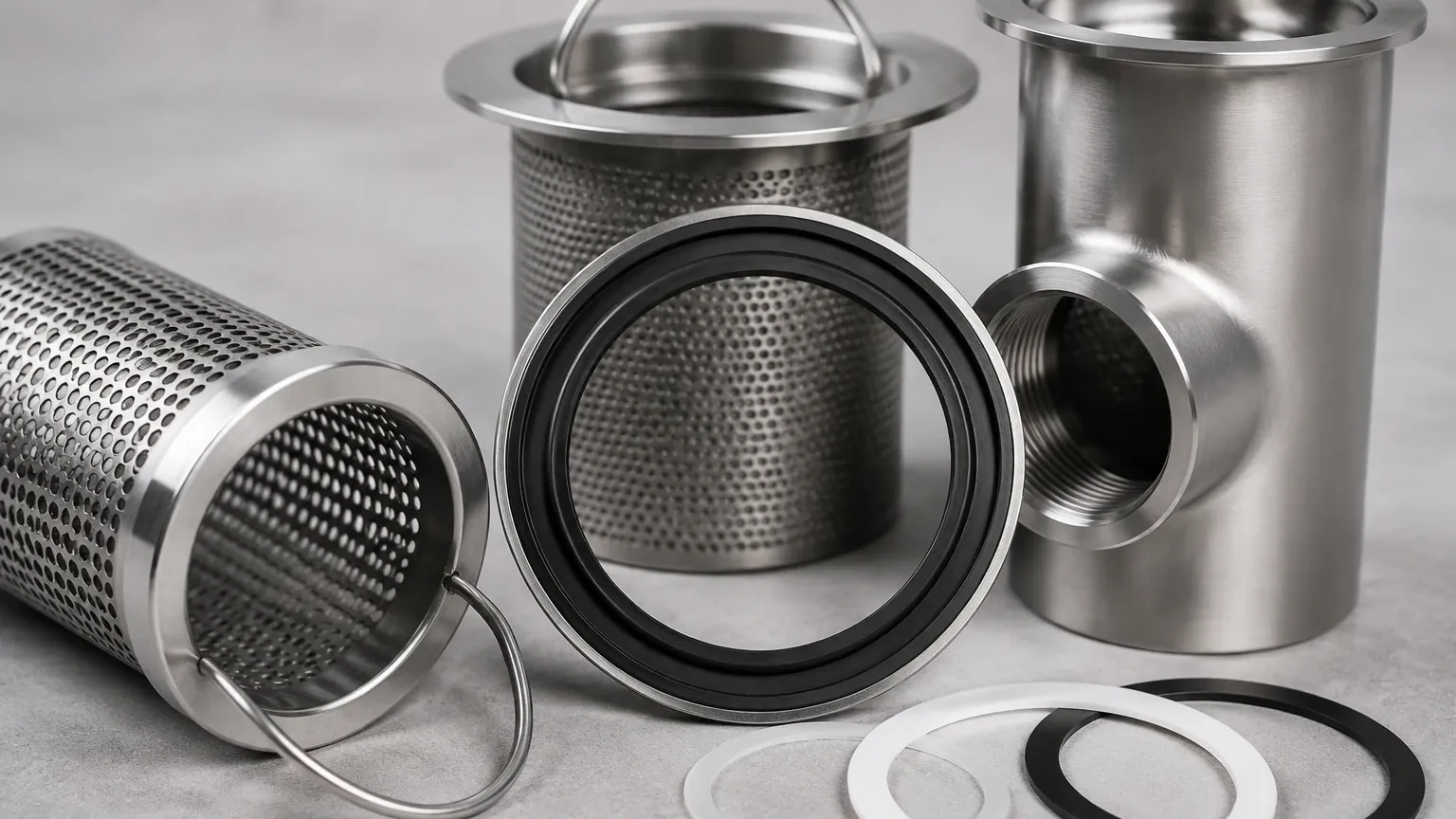
Mechanical Design: O-Rings vs. Flat Gaskets
The physical form of the strainer gasket is dictated by the design of the Strainers & Baskets housing. There are two primary configurations used in industrial filtration:
1. Flat Gaskets: These are typically used in flanged connections or under the covers of large basket strainers. They provide a large surface area for sealing but require significant bolt torque to achieve the necessary seating stress. Flat gaskets are often used when the mating surfaces are not perfectly machined or when a specific thickness is required to space the basket correctly within the housing.
2. O-Rings: Many modern high-performance strainers utilize O-ring seals. These are seated in a machined groove, which allows for a "self-sealing" effect. As system pressure increases, the O-ring is pushed against the side of the groove, actually increasing the sealing force. This design is highly efficient and typically requires less manual force to close the housing cover compared to flat gaskets.
Installation Best Practices and Torque Management
Even the highest quality strainer gasket will fail if installed incorrectly. For B2B operations, maintenance downtime is a significant cost driver, and improper gasket installation is a common cause of rework.
* Surface Preparation: Before installing a new gasket, the sealing surfaces of the Strainers & Baskets must be cleaned of all debris, old gasket residue, and corrosion. Any pitting or scratching on the metal surface can create a leak path that the gasket may not be able to bridge.
* Alignment: The basket must be perfectly centered within the housing. If the basket is tilted, the strainer gasket may be pinched or may not seat fully, leading to immediate bypass.
* Uniform Torquing: For strainers with bolted covers, a star-pattern torquing sequence should be followed. This ensures that the pressure is applied evenly across the gasket. Uneven torque can cause the gasket to "bunch" or create a gap on the side with lower tension.
* Lubrication: In many cases, a light coating of a compatible lubricant can help an O-ring or gasket seat properly without twisting. However, the lubricant must be chemically compatible with both the elastomer and the process fluid.
Troubleshooting Gasket Failure in Industrial Systems
When a strainer gasket fails prematurely, it is essential to perform a root cause analysis to prevent recurrence. Common failure modes include:
* Chemical Attack: The gasket appears swollen, charred, or has become gummy. This indicates that the material is incompatible with the process fluid or a cleaning agent.
* Extrusion: The gasket material is squeezed out of the seal area. This usually indicates that the system pressure exceeds the material's hardness rating or that the gap between the metal components is too large.
* Compression Set: The gasket remains flat even after the load is removed. This is often caused by excessive heat or over-tightening of the cover bolts.
* Abrasive Wear: If the process fluid contains highly abrasive solids, the gasket may be eroded over time, especially if it is located in a high-velocity flow path.
Customization and OEM Requirements
Standard off-the-shelf gaskets do not always meet the needs of specialized industrial applications. For unique Strainers & Baskets designs, custom-engineered gaskets may be required. This includes custom thicknesses to adjust basket seating depth, specialized materials like metal-detectable elastomers for the food industry, or USP Class VI compliant materials for pharmaceutical manufacturing.
Manufacturers like Kaifil work closely with engineering teams to provide customized filtration components where the gasket and the filter media are designed as an integrated system. This holistic approach ensures that the filtration accuracy is maintained throughout the entire lifecycle of the equipment.
Conclusion: Ensuring System Integrity
The strainer gasket is the final line of defense in ensuring that an industrial filtration system operates as intended. By selecting the correct material, adhering to precise engineering tolerances, and following rigorous installation protocols, facilities can significantly reduce the risk of bypass and external leakage.
When evaluating Strainers & Baskets for your next project, it is vital to confirm the gasket specifications with your supplier. Ask about chemical compatibility charts, pressure-temperature ratings, and the availability of replacement seals to ensure long-term operational success. Investing in high-quality sealing components is a cost-effective strategy for protecting downstream equipment and maintaining the purity of your process stream.
