


Strainers in Plumbing
In industrial and commercial fluid handling, the integrity of a system often depends on the smallest components. Strainers in plumbing serve as the primary line of defense against particulate matter that can compromise the performance of pumps, valves, meters, and other sensitive downstream equipment. While often overlooked, the selection of appropriate Strainers & Baskets is a critical engineering decision that affects the longevity, maintenance costs, and operational efficiency of the entire plumbing infrastructure.
This guide examines the technical aspects of industrial strainers, exploring their design, material considerations, and the specific factors engineers must evaluate to ensure optimal filtration performance.
The Role of Strainers in Plumbing Systems
Strainers in plumbing are mechanical devices used to remove unwanted solids from liquid, gas, or steam lines by means of a perforated or wire mesh straining element. Unlike filters, which are typically designed to remove particles in the sub-micron range and are often disposable, strainers are generally used to remove larger particles and are designed for reuse through cleaning.
In industrial plumbing, debris such as pipe scale, rust, jointing compound, and metal shavings can enter the system during installation or through the natural degradation of piping materials. If left unmanaged, these contaminants can cause:
* Erosion and Abrasion: High-velocity particles can wear down valve seats and pump impellers.
* Clogging: Small orifices in spray nozzles or heat exchangers can become blocked, leading to system failure.
* Inaccurate Metering: Debris can interfere with the moving parts of flow meters, resulting in incorrect data.
* Product Contamination: In industries such as food and beverage or pharmaceuticals, particulate matter can ruin entire batches of product.
By integrating robust strainers and baskets into the system design, engineers can effectively trap these solids, protecting the capital-intensive components of the plumbing network.
Common Types of Strainers and Baskets
The configuration of a strainer is dictated by the flow rate, the nature of the fluid, and the frequency of cleaning required. There are several primary designs used in industrial plumbing applications.
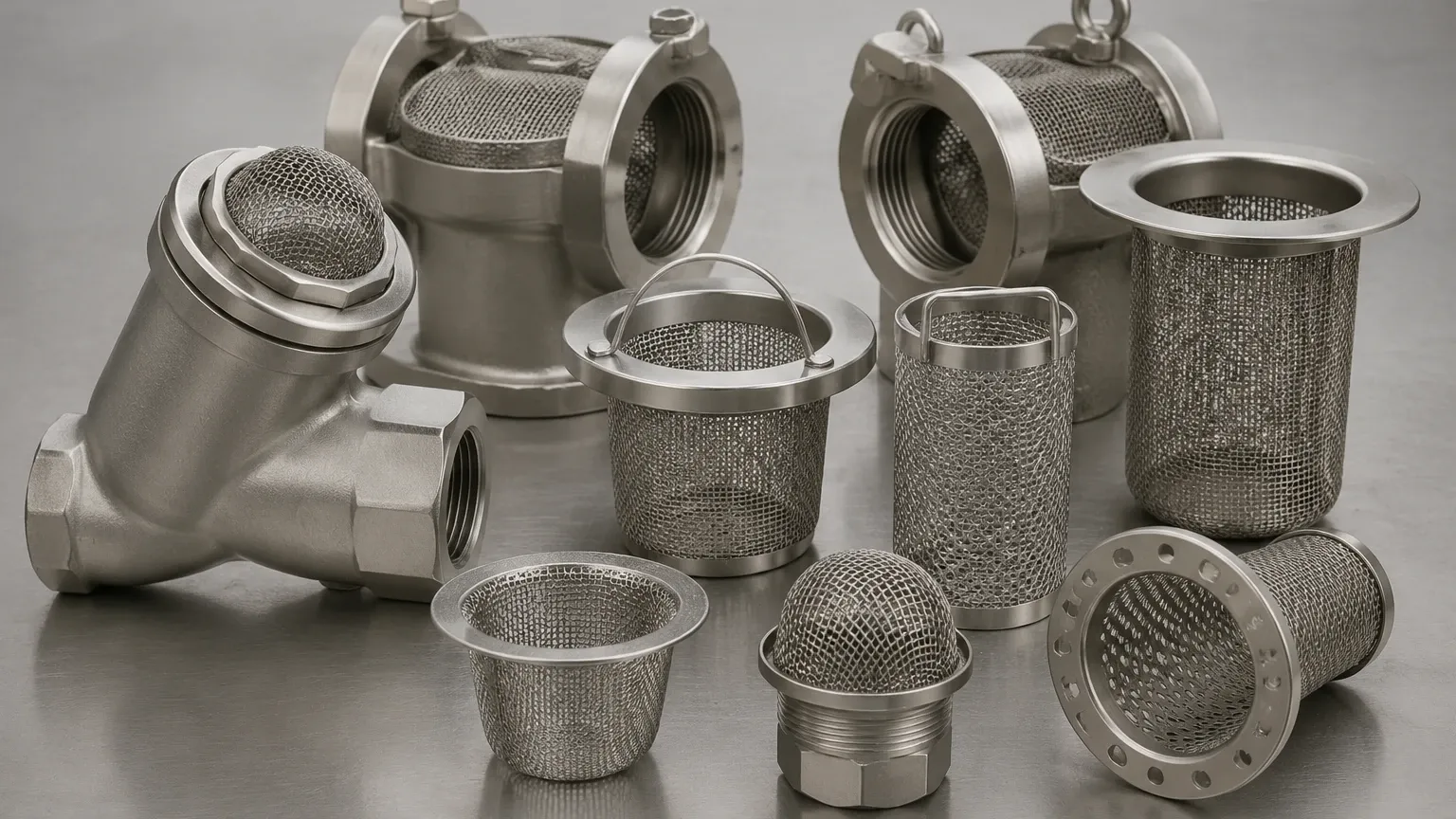
Y-Strainers
Named for their shape, Y-strainers are the most common choice for high-pressure systems. They are compact and can be installed in either horizontal or vertical positions, provided the "leg" of the Y points downward to trap debris. Y-strainers are typically used where the amount of material to be removed is relatively small, as they have a lower dirt-holding capacity compared to basket designs.
Basket (Simplex) Strainers
Basket strainers are designed for applications where higher flow rates and a larger dirt-holding capacity are required. The straining element is shaped like a basket, which is easily accessible by removing the top cover. Because the basket can hold more debris, the pressure drop across the unit increases more slowly than in a Y-strainer. These are ideal for suction-side applications where protecting a pump is the primary goal.
Duplex Strainers
In systems where the flow cannot be shut down for cleaning, duplex strainers are utilized. These consist of two separate strainer chambers connected by a diverting valve. When one basket becomes full, the flow is switched to the second chamber, allowing the operator to clean the first basket without interrupting the process. This is essential in continuous chemical processing or cooling water systems.
Material Selection and Engineering Considerations
The durability of strainers in plumbing is largely determined by the materials used for both the housing and the internal straining element. Stainless steel is the industry standard for demanding environments due to its superior corrosion resistance and mechanical strength.
Stainless Steel 304 vs. 316
* SS 304: Suitable for general-purpose applications, providing good resistance to atmospheric corrosion and many organic and inorganic chemicals. It is commonly used in water treatment and general industrial plumbing.
* SS 316: Contains molybdenum, which provides enhanced resistance to pitting and crevice corrosion, especially in chloride-rich environments. This is the preferred choice for chemical processing, marine applications, and food-grade systems where aggressive cleaning agents are used.
Structural Integrity
Beyond material chemistry, the mechanical design of the strainer must account for the maximum operating pressure and temperature of the system. Engineers must ensure that the housing can withstand hydraulic shock (water hammer) and that the internal baskets are reinforced to prevent collapsing under high differential pressure (ΔP).
Evaluating Filtration Performance: Mesh and Micron Ratings
The effectiveness of strainers and baskets is defined by the size of the openings in the straining element. Selecting the correct mesh size is a balance between protection and system efficiency.
Understanding Mesh Count
Mesh count refers to the number of openings per linear inch. A higher mesh count indicates smaller openings and finer filtration. For example, a 20-mesh screen has larger openings than a 100-mesh screen. When specifying strainers in plumbing, engineers must identify the smallest particle size that could damage downstream equipment and select a mesh size slightly smaller than that particle.
The Impact on Pressure Drop
Every strainer introduces a restriction to the flow, resulting in a pressure drop. As the strainer collects debris, the pressure drop increases. If the mesh is too fine for the application, the strainer will clog rapidly, leading to frequent maintenance and potential cavitation in pumps. It is a common engineering practice to size the strainer so that the initial pressure drop does not exceed 2 PSI under clean conditions.
Maintenance, Cleaning, and Replacement Cycles
The total cost of ownership for strainers in plumbing is heavily influenced by maintenance requirements. A strainer that is difficult to clean or requires frequent replacement of internal components will quickly become a liability.
Monitoring Differential Pressure
To optimize maintenance cycles, industrial systems should be equipped with pressure gauges upstream and downstream of the strainer. By monitoring the differential pressure, operators can determine exactly when a basket needs cleaning. Cleaning based on actual performance data, rather than a fixed schedule, prevents unnecessary downtime and ensures the system always operates within its design parameters.
Cleaning Procedures
For Y-strainers, a blow-down valve can often be installed on the drain port, allowing the screen to be flushed without opening the housing. For basket strainers, the basket must be removed. Stainless steel baskets manufactured by specialists like Kaifil are designed to be robust enough for repeated ultrasonic cleaning or high-pressure washing, extending the service life of the component significantly.
Customization and OEM Solutions for Complex Systems
Off-the-shelf strainers may not always meet the specific requirements of specialized industrial processes. In many cases, custom-engineered solutions are necessary to address unique challenges such as limited installation space, extremely high flow rates, or highly corrosive fluids.
Customization options often include:
* Variable Connection Types: Flanged, threaded, or socket-weld connections to match existing piping standards.
* Reinforced Baskets: For applications with high viscosity fluids or high-pressure differentials.
* Specialized Coatings: Additional linings or coatings for extreme chemical resistance.
* Custom Dimensions: Tailoring the length or width of the strainer housing to fit into tight mechanical rooms.
Working with a manufacturer that understands the nuances of stainless steel fabrication allows engineers to develop Strainers & Baskets that are perfectly aligned with the technical demands of their specific application.
Key Information for Selection and Procurement
Before finalizing a purchase for industrial plumbing strainers, technical professionals should confirm the following data points to ensure compatibility and performance:
1. Fluid Characteristics: What is the viscosity, temperature, and chemical composition of the fluid?
2. Flow Rate: What are the minimum, normal, and maximum flow rates expected in the system?
3. Particle Load: What is the nature and concentration of the solids being removed? Is the debris abrasive or fibrous?
4. Allowable Pressure Drop: What is the maximum ΔP the system can tolerate before performance is affected?
5. Installation Constraints: Are there space limitations or specific orientation requirements for the piping?
By addressing these factors during the design phase, engineers can select a filtration solution that provides reliable protection with minimal operational interference.
Conclusion: Optimizing Plumbing System Longevity
Strainers in plumbing are vital components for maintaining the health of industrial fluid systems. From protecting high-value pumps to ensuring the purity of a final product, the role of these mechanical separators cannot be overstated. By focusing on high-quality materials like stainless steel and selecting the appropriate design—whether it be a Y-strainer for high-pressure steam or a large-capacity basket strainer for water intake—facilities can significantly reduce downtime and repair costs.
As industrial processes become more complex and equipment tolerances become tighter, the precision and durability of filtration components become even more critical. Investing in well-engineered strainers and baskets is not just a maintenance precaution; it is a fundamental strategy for operational excellence.
