


Strainers Images
In the procurement and engineering of industrial filtration systems, visual documentation plays a critical role in verifying technical specifications and ensuring compatibility with existing infrastructure. While data sheets provide the numerical parameters—such as flow rates, pressure ratings, and micron levels—reviewing detailed strainers images allows engineers to evaluate the physical construction, welding quality, and structural integrity of the components. For technical professionals, these images are more than just marketing assets; they are essential tools for assessing how a specific strainer or basket will integrate into a complex piping system.
At Kaifil, we understand that the precision of a stainless steel filter is often reflected in its visual details. From the uniformity of the weave in a wire mesh basket to the cleanliness of the TIG welds on a heavy-duty strainer, visual inspection remains a primary step in quality assurance and selection. This guide examines the technical nuances that engineers should look for when evaluating industrial filtration components through visual and technical documentation.
The Role of Visual Data in Filter Selection
When searching for strainers images, procurement teams are typically looking for more than just a general representation of the product. They are seeking evidence of manufacturing precision. In high-stakes industries like pharmaceutical manufacturing or chemical processing, the physical configuration of a strainer determines its efficiency and ease of maintenance.
Visual data helps in identifying several key factors:
* Connection Types: Images clearly show whether a strainer features flanged, threaded, or socket-weld connections, which is vital for ensuring a leak-proof fit within the pipeline.
* Housing Configuration: Whether the application requires a Y-strainer, a Simplex basket strainer, or a Duplex system for continuous flow, visual references confirm the orientation of the inlet and outlet ports.
* Closure Mechanisms: Engineers can evaluate the type of cover used—such as bolted covers for high-pressure applications or quick-opening swing bolts for systems requiring frequent cleaning.
By analyzing high-resolution images, technical teams can pre-screen suppliers based on the apparent build quality before moving to the prototyping or bulk ordering phase.
Structural Anatomy of Industrial Strainers & Baskets
The efficiency of any filtration system depends heavily on the internal component: the basket. Strainers & Baskets are designed to capture solid contaminants while allowing the fluid to pass through with minimal pressure drop. When reviewing technical images of these components, several structural elements should be scrutinized.
Perforated Metal vs. Wire Mesh
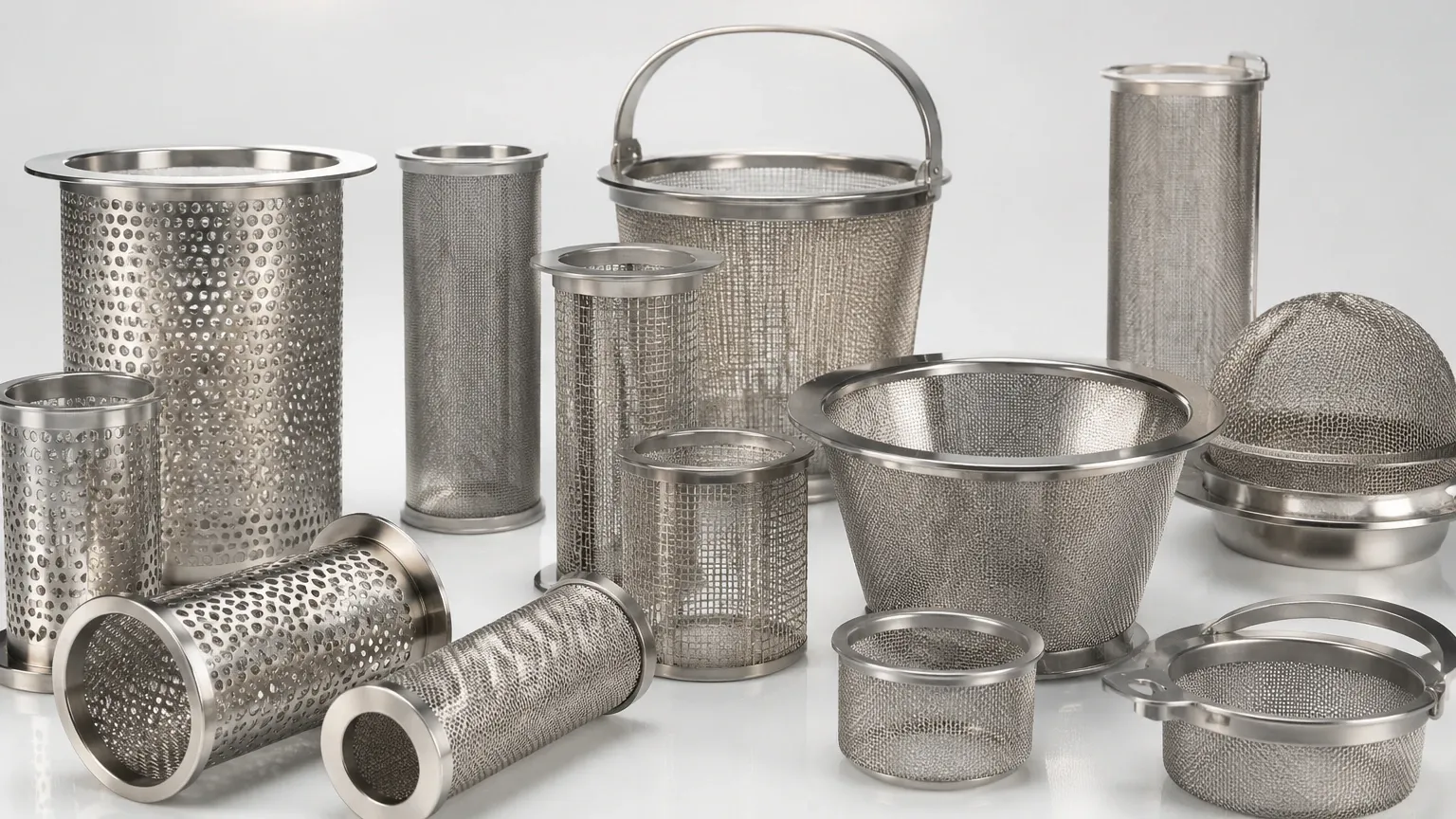
Industrial baskets are generally constructed using either perforated metal or woven wire mesh, and often a combination of both. A common configuration involves a perforated metal cylinder that provides structural rigidity, lined with a fine wire mesh for precise filtration. Images should show a clean interface between these layers, with no gaps or loose wires that could lead to bypass or media migration.
Reinforcement and Support
For high-viscosity fluids or high-pressure systems, baskets must be reinforced. Visual indicators of high-quality reinforcement include longitudinal support bars, heavy-duty bottom plates, and reinforced top rings. These features prevent the basket from collapsing or deforming under the weight of collected debris or the force of the fluid flow.
Material Integrity and Surface Finishes
Material selection is paramount in industrial filtration, particularly when dealing with corrosive chemicals or sanitary food and beverage applications. Most high-performance strainers are manufactured from 304 or 316L stainless steel. While a photograph cannot confirm the chemical composition of the metal, it can reveal the quality of the surface treatment.
Identifying Quality Finishes
In the food, beverage, and pharmaceutical sectors, the surface finish of a strainer is a critical hygiene factor. Engineers should look for images that demonstrate:
1. Electropolishing: This process removes surface impurities and creates a mirror-like finish that resists bacterial growth and makes cleaning more effective.
2. Pickling and Passivation: For chemical applications, this treatment ensures the protective oxide layer of the stainless steel is intact, preventing premature corrosion.
3. Smooth Welds: In sanitary applications, welds must be ground smooth to eliminate "dead zones" where material can accumulate and ferment or contaminate subsequent batches.
If strainers images show discoloration around weld joints (often referred to as heat tint), it may indicate that the material's corrosion resistance has been compromised during the manufacturing process, necessitating further inquiry into the supplier’s welding procedures.
Evaluating Filtration Media and Micron Ratings
The primary function of a strainer is to remove particles of a specific size. This is achieved through the selection of the correct mesh count or perforation size. When viewing images of filtration media, engineers should check for uniformity.
Mesh Uniformity
In a woven wire mesh strainer, the spacing between the wires must be perfectly consistent. Any deviation in the weave—such as bunched wires or irregular openings—indicates a failure in the manufacturing process. This inconsistency leads to unpredictable filtration performance, where larger-than-intended particles may pass through the wider gaps.
Open Area Ratio
The "open area" is the total area of the holes in the strainer media divided by the total area of the media. A higher open area results in a lower initial pressure drop and longer service life between cleanings. Detailed images allow engineers to visually estimate the density of the perforations and compare different designs to optimize flow efficiency.
Customization and OEM Capabilities
Standard off-the-shelf strainers often fail to meet the specific needs of specialized industrial equipment. This is where customization becomes essential. When evaluating a manufacturer's capabilities, it is helpful to look at images of their previous custom projects.
Customization options often include:
* Bespoke Dimensions: Baskets designed to fit non-standard housings or to provide extra-large dirt-holding capacity.
* Specialized Handles: Some applications require slanted handles, heavy-duty lifting lugs, or even magnetic inserts to capture fine ferrous particles that might otherwise pass through the mesh.
* Multi-Stage Filtration: Images of dual-stage baskets, where a coarse outer screen protects a fine inner mesh, demonstrate a manufacturer's ability to handle complex filtration requirements.
Kaifil specializes in these types of tailored solutions, providing OEM services that align with the specific engineering drawings and performance goals of our global partners.
Maintenance Cues and Replacement Indicators
Beyond the initial purchase, visual documentation is vital for maintenance and troubleshooting. Understanding what a "healthy" strainer looks like helps plant operators identify when a component needs to be replaced.
Common visual signs of wear or failure in strainers include:
* Erosion of the Mesh: In high-velocity systems, the abrasive action of particles can thin the wires of the mesh over time.
* Stress Cracking: Often visible near the weld points or where the basket attaches to the support ring, indicating mechanical fatigue.
* Permanent Deformation: If a basket appears "bowed" or crushed in an image taken during a maintenance check, it is a sign that the differential pressure exceeded the basket's structural limits.
By maintaining a library of images showing both new and used components, maintenance teams can better predict replacement cycles and prevent catastrophic filter failure that could lead to downstream equipment damage.
Technical Confirmation Before Procurement
While strainers images provide an excellent starting point, they should always be used in conjunction with technical drawings and material certifications (MTRs). Before finalizing a purchase, engineers should confirm the following with their supplier:
1. Dimensional Accuracy: Ensure that the flange-to-flange length and the basket clearance match the installation site.
2. Pressure Drop Calculations: Request clean pressure drop curves for the specific fluid viscosity and flow rate of the application.
3. Chemical Compatibility: Verify that the housing, basket, and gasket materials (such as EPDM, Viton, or PTFE) are compatible with the process fluid.
In conclusion, the visual inspection of industrial filtration components is a sophisticated part of the engineering process. High-quality images reveal the manufacturing standards, material finishes, and structural designs that define a reliable filtration solution. Whether you are replacing an existing basket or designing a new system from the ground up, focusing on these visual and technical details ensures that your filtration system performs efficiently and durably in demanding industrial environments.
