


Inline Strainers
In industrial fluid handling, the integrity of downstream equipment—such as pumps, meters, spray nozzles, and heat exchangers—is contingent upon the removal of unwanted solids from the process stream. Inline strainers serve as the primary mechanical defense mechanism in piping systems, designed to capture debris, scale, and particulate matter that could otherwise lead to mechanical failure or product contamination. Unlike fine filtration systems that target sub-micron particles, inline strainers are engineered for high-flow efficiency and the removal of larger macroscopic solids.
For engineers and procurement teams, selecting the appropriate configuration of Strainers & Baskets requires a deep understanding of fluid dynamics, material science, and the specific mechanical constraints of the application. As a specialized manufacturer, Kaifil provides precision-engineered stainless steel components that address these technical requirements across the chemical, pharmaceutical, and food processing sectors.
The Engineering Role of Inline Strainers in Process Piping
Inline strainers are integrated directly into the pipeline, facilitating the continuous flow of liquids or gases while trapping solids within a removable mesh or perforated metal element. The "inline" designation typically refers to the orientation of the inlet and outlet ports, which are often aligned to minimize piping complexity and footprint.
From a technical perspective, the primary function of an inline strainer is to protect high-value assets. For example, in a hydraulic system, even a small fragment of metal can cause catastrophic pump cavitation or seal damage. In cooling water loops, organic debris can clog heat exchanger plates, leading to thermal inefficiency. By positioning a strainer immediately upstream of these components, operators ensure system longevity and reduce the frequency of unscheduled maintenance.
Technical Criteria for Evaluating Inline Strainers
When specifying inline strainers for industrial use, several engineering variables must be analyzed to ensure the component performs reliably under operational stress. Failure to account for these factors can result in excessive pressure drops, bypass leakage, or structural failure of the strainer element.
1. Pressure Drop (ΔP) and Flow Velocity
Every component added to a piping system introduces a degree of resistance. The pressure drop across an inline strainer is a function of the fluid's velocity, viscosity, and the "open area ratio" (OAR) of the internal basket. A well-designed strainer should typically offer an OAR of at least 4:1 or 6:1 relative to the cross-sectional area of the pipe. This ensures that even as the strainer begins to collect debris, the increase in resistance does not immediately compromise the system's flow requirements.
2. Micron Rating and Perforation Geometry
The selection of the internal element is the most critical decision in the specification process. Engineers must balance the need for fine particle removal with the desire for low maintenance. Common options include:
* Perforated Metal: Suitable for heavy-duty applications where large debris (stones, weld slag) is the primary concern. Hole sizes typically range from 1/32" to 1/4".
* Wire Mesh: Used for finer straining requirements. Stainless steel wire mesh can be layered over a perforated backup tube to provide structural rigidity while achieving filtration levels down to 40 microns or less.
3. Connection Types and Sealing
Inline strainers must be compatible with existing piping standards. Common connection methods include NPT (National Pipe Thread) for smaller diameters, flanged connections (ANSI/ASME) for high-pressure industrial lines, and Tri-Clamp fittings for hygienic applications in the food and pharmaceutical industries. The internal seal—often a high-performance O-ring or gasket made of EPDM, Viton, or PTFE—must be chemically compatible with the process fluid to prevent bypass.
Material Selection: The Advantages of Stainless Steel
In demanding industrial environments, the material of construction determines the service life of the strainer. While cast iron or plastic strainers may be suitable for low-pressure water utility lines, stainless steel is the standard for chemical processing and high-temperature applications.
* Type 304 Stainless Steel: Offers excellent strength and basic corrosion resistance, making it suitable for most general industrial applications, including water treatment and non-corrosive chemical handling.
* Type 316L Stainless Steel: Contains molybdenum, which provides superior resistance to chlorides and pitting. This is the preferred material for marine environments, pharmaceutical manufacturing, and acidic chemical processes.
Kaifil specializes in utilizing these high-grade alloys to manufacture durable inline strainers that withstand both mechanical wear and chemical erosion, ensuring that the filtration element does not become a source of contamination itself.
Comparison of Inline Strainer Configurations
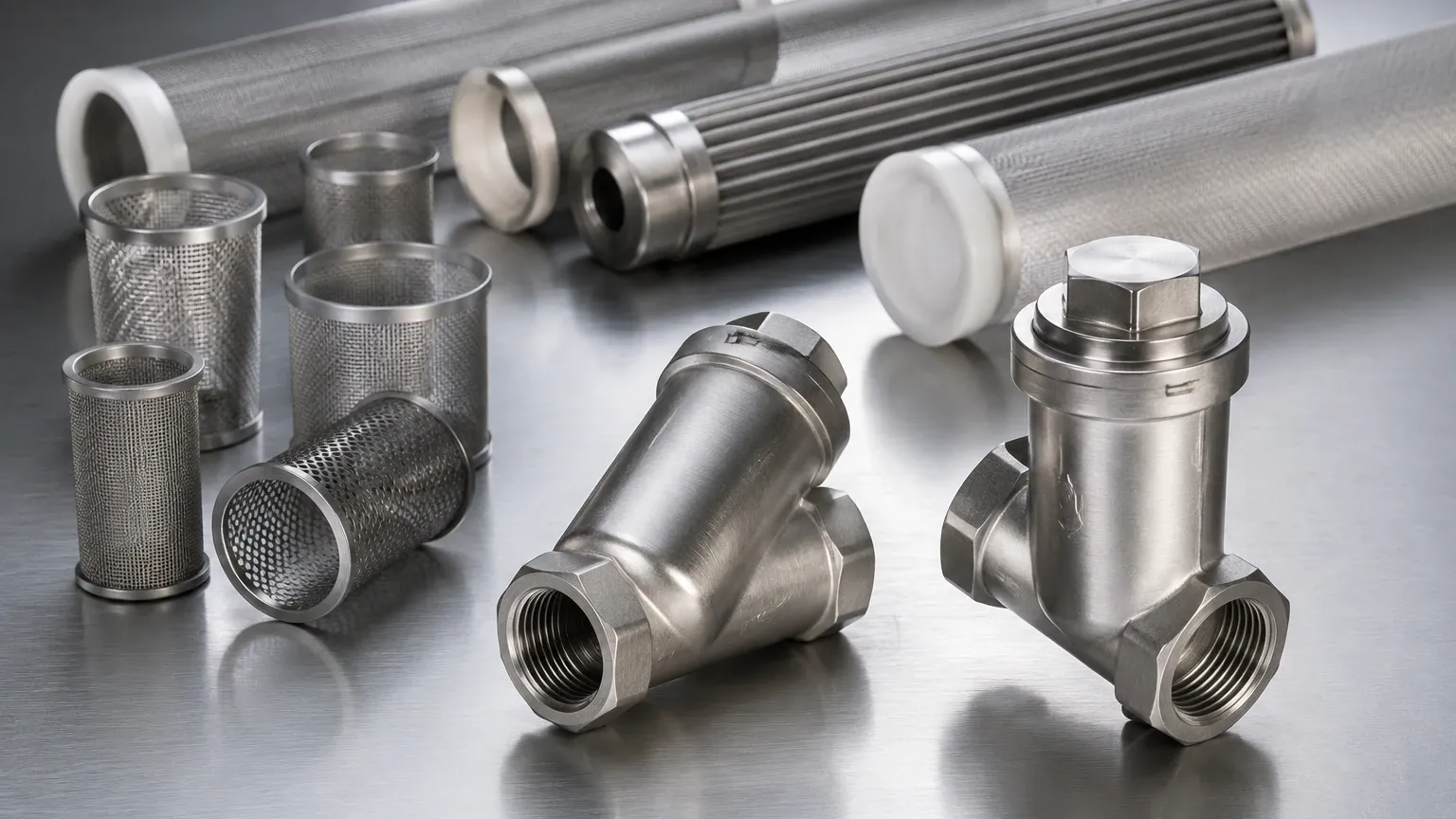
While the term "inline" covers a broad category, the specific geometry of the housing impacts how the strainer is maintained and how it handles flow. The two most common configurations found in industrial settings are Y-strainers and T-strainers.
Y-Strainers
Y-strainers are the most common type of inline strainer for steam, gas, and liquid applications. The "Y" shape allows the strainer element to be positioned at an angle to the main flow path. This design is compact and can be installed in either horizontal or vertical orientations (provided the "leg" points downward to collect debris). However, Y-strainers generally have a smaller dirt-holding capacity compared to basket-style strainers and are best suited for applications with low concentrations of solids.
T-Strainers (Basket Strainers)
T-strainers, often referred to as inline basket strainers, feature a larger housing that allows for a much greater OAR. The flow enters the side of the housing, passes through a vertically oriented basket, and exits through the opposite side. Because the basket is larger, these strainers can hold significantly more debris before requiring cleaning. They are ideal for high-flow rate systems where downtime for cleaning must be minimized.
Operational Maintenance and Risk Mitigation
The performance of inline strainers is not a "set and forget" metric. Effective operation requires a proactive maintenance strategy centered on differential pressure monitoring.
Monitoring Differential Pressure
Installing pressure gauges on both the upstream and downstream sides of the strainer is the most effective way to determine when the internal basket requires cleaning. As debris accumulates, the pressure on the downstream side will drop. Most industrial protocols recommend cleaning or replacing the element when the differential pressure reaches a predetermined limit (e.g., 5–10 psi), as exceeding this can lead to "blinding" of the mesh or, in extreme cases, the collapse of the strainer basket.
Common Risks in Strainer Operation
* Bypass: If the internal basket is not seated correctly or the seals are degraded, fluid will bypass the mesh, allowing contaminants to reach downstream equipment.
* Corrosion/Erosion: High-velocity fluids containing abrasive particles can erode the wire mesh over time. Regular inspection of the mesh integrity is essential.
* Thermal Shock: In high-temperature applications, rapid changes in fluid temperature can cause expansion and contraction of the housing and internal components. Specifying materials with appropriate thermal properties is vital for system safety.
Custom OEM Solutions for Specialized Applications
Off-the-shelf inline strainers often fail to meet the unique requirements of specialized industrial processes. For instance, a pharmaceutical line may require a custom-polished interior surface to prevent bacterial growth, or a high-pressure hydraulic system may require a reinforced basket design to prevent deformation under surge loads.
Kaifil provides comprehensive OEM capabilities, allowing engineers to customize every aspect of the strainer design, from the micron rating of the mesh to the specific dimensions of the housing. By working closely with a manufacturer that understands the nuances of stainless steel fabrication, purchasing teams can ensure that their Strainers & Baskets are optimized for the total cost of ownership, balancing initial acquisition costs with long-term durability and ease of maintenance.
Application-Specific Considerations
Food and Beverage Industry
In food processing, inline strainers must adhere to strict hygienic standards (such as 3-A or EHEDG). This requires the use of 316L stainless steel, smooth surface finishes (Ra < 0.8 µm), and the absence of "dead legs" where product could stagnate and spoil. These strainers are often used to remove pulp from juices, seeds from preserves, or clumps from dairy products.
Chemical and Petrochemical Processing
Chemical compatibility is the primary concern here. Strainers must be able to withstand aggressive solvents, acids, and bases. Furthermore, in hazardous environments, the strainer housing must be rated for the appropriate pressure and temperature according to ASME Section VIII standards.
Water Treatment and Desalination
Large-scale water treatment facilities utilize inline strainers to protect membrane filtration systems and UV sterilizers. In desalination, the high chloride content of seawater necessitates the use of high-grade stainless steel or duplex alloys to prevent rapid pitting and stress corrosion cracking.
Conclusion
Inline strainers are a fundamental component of modern industrial infrastructure. By effectively removing solids from process streams, they safeguard expensive machinery and ensure product quality. However, the effectiveness of an inline strainer is entirely dependent on correct specification—matching the material, mesh size, and housing configuration to the specific demands of the application. For technical professionals, partnering with an experienced manufacturer like Kaifil ensures access to the engineering expertise and high-quality stainless steel components necessary to maintain efficient, reliable, and cost-effective filtration performance.
