


Strainer Lababo
In industrial and commercial environments, the management of wastewater and the prevention of debris entering drainage systems are critical for operational efficiency and regulatory compliance. The term "strainer lababo," which refers to sink strainers used in wash stations and processing areas, represents a fundamental component in fluid handling and filtration. While the term is often associated with domestic applications, the industrial-grade version of these components must meet significantly higher standards for durability, chemical resistance, and filtration precision.
For engineers and procurement professionals, selecting the right strainer lababo involves more than choosing a simple mesh insert. It requires an understanding of material science, fluid dynamics, and the specific demands of the facility. High-performance Strainers & Baskets are engineered to withstand corrosive environments, high-temperature effluents, and heavy-duty use in sectors ranging from food processing to pharmaceutical manufacturing.
The Role of Industrial Strainers in Facility Management
In a professional setting, a sink or "lababo" serves as a primary collection point for various types of waste. Without an effective straining mechanism, solid particles, fibrous materials, and heavy debris can enter the plumbing system, leading to several costly issues:
1. System Clogging: Accumulation of solids in pipes leads to flow restrictions and eventual total blockages, necessitating expensive hydro-jetting or mechanical clearing.
2. Pump Damage: In facilities where wastewater is pumped to a treatment plant, bypass debris can cause catastrophic failure of pump impellers and seals.
3. Environmental Non-Compliance: Many jurisdictions have strict limits on the size and type of solids that can be discharged into municipal sewers. A precision-engineered strainer lababo ensures these limits are respected.
4. Hygienic Control: In food and beverage production, standing water caused by slow drainage is a major risk factor for microbial growth. High-flow strainers ensure rapid drainage while capturing necessary solids.
Engineering Specifications for Industrial Strainer Lababo
When transitioning from consumer-grade products to industrial solutions, the technical specifications become the primary differentiator. An industrial strainer lababo is typically part of a broader category of filtration components designed for longevity and reliability.
Material Selection: SS304 vs. SS316
Material integrity is the most important factor in industrial filtration. Most high-quality strainers are manufactured from stainless steel due to its inherent strength and resistance to oxidation.
* Stainless Steel 304: This is the standard for most commercial kitchen and general industrial applications. It offers excellent corrosion resistance to common cleaning chemicals and organic acids found in food.
* Stainless Steel 316: For environments involving high salinity, chlorides, or aggressive chemical processing, SS316 is required. The addition of molybdenum provides superior pitting resistance, making it the preferred choice for pharmaceutical and chemical laboratories.
Filtration Media: Perforated Metal vs. Wire Mesh
The internal structure of the strainer lababo determines its filtration efficiency. Industrial designs often utilize a combination of media:
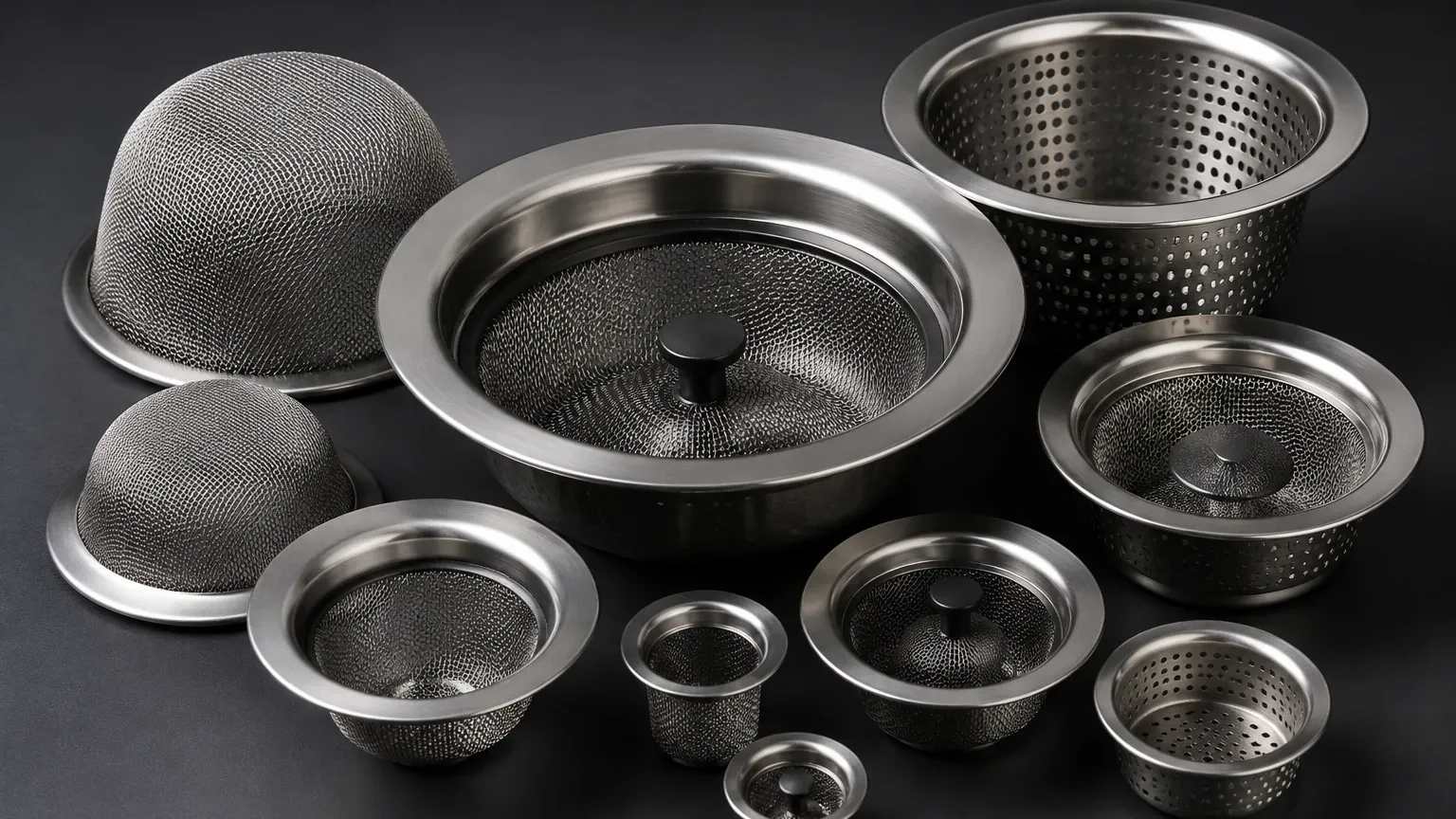
* Perforated Plate: Provides structural rigidity. Large holes allow for high flow rates while capturing bulky debris. This is often used as the outer "basket" in heavy-duty applications.
* Fine Wire Mesh: For applications requiring the capture of smaller particulates, a fine stainless steel wire mesh is sintered or welded to the perforated support. This allows for precise micron ratings, ensuring that even sand-like particles are prevented from entering the drain.
Technical Considerations for Flow Rate and Pressure
One of the most common mistakes in specifying a strainer lababo is failing to account for the "open area" ratio. The open area is the total surface area of the holes divided by the total area of the strainer material.
In industrial wash-down stations, the volume of water can be significant. If the strainer does not have a sufficient open area, water will back up into the sink, slowing down operations. Engineers must calculate the expected flow rate (GPM or L/min) and ensure the strainer’s mesh configuration can handle that volume even when it is 50% full of debris. This is why many industrial baskets feature a deep-draw design, providing more surface area for filtration than a flat disc strainer.
Applications Across Diverse Industrial Sectors
The requirement for a robust strainer lababo spans multiple industries, each with unique challenges.
Food and Beverage Processing
In this sector, sanitation is paramount. Strainers must be designed with "sanitary" welds—smooth, crevice-free joints that do not allow bacteria to accumulate. These strainers are frequently removed for cleaning and must withstand rigorous CIP (Clean-In-Place) or COP (Clean-Out-of-Place) cycles involving high-pressure steam and caustic detergents.
Pharmaceutical and Laboratory Environments
Precision is the priority here. Lab sinks often handle sensitive chemical compounds or small components that must not be lost down the drain. A customized strainer lababo with a specific micron mesh can act as a recovery tool for expensive materials while protecting the facility's specialized chemical drainage systems.
Heavy Manufacturing and Workshops
In automotive or aerospace workshops, wash stations are used to clean parts covered in metal shavings, grit, and oils. A standard strainer would fail under the weight and abrasive nature of these materials. Industrial-grade Strainers & Baskets used in these environments feature thickened gauge walls and reinforced handles to allow for the manual removal of heavy, metal-laden waste.
Comparing Standard vs. Industrial Strainers & Baskets
It is helpful to understand the structural differences that justify the investment in industrial-grade components.
| Feature | Standard Strainer Lababo | Industrial Strainer/Basket |
| :— | :— | :— |
| Material Thickness | 0.5mm – 0.8mm | 1.2mm – 3.0mm |
| Welding Method | Spot welding or crimping | TIG welding or Plasma welding |
| Load Capacity | Low (deforms under weight) | High (structural integrity maintained) |
| Chemical Resistance | Limited to household soaps | High (acids, bases, and solvents) |
| Customization | Fixed sizes | Fully customizable dimensions and mesh |
By utilizing professional Strainers & Baskets, facilities reduce the Total Cost of Ownership (TCO). While the initial purchase price is higher than a consumer alternative, the reduction in plumbing repairs and the extended lifespan of the component provide a significantly better return on investment.
Selection Criteria for Procurement and Engineering Teams
When sourcing a strainer lababo for a project, the following checklist should be used to ensure the component is fit for purpose:
1. Dimensional Accuracy: Confirm the flange diameter, basket depth, and the diameter of the drain opening. A poor fit allows bypass, where water and debris flow around the strainer rather than through it.
2. Micron Rating: Define the smallest particle size that needs to be captured. This will dictate whether a simple perforated plate is sufficient or if a secondary fine mesh layer is required.
3. Handle Design: In industrial settings, strainers are emptied frequently. Ergonomic, heavy-duty handles that stay above the water line or are easy to grip with gloves are essential for worker safety and efficiency.
4. Connection Type: Determine if the strainer is a drop-in style or if it needs to be integrated into a threaded or flanged housing for pressurized systems.
5. Regulatory Compliance: Ensure the materials used are FDA-compliant if the application involves food contact or pharmaceutical processing.
Maintenance and Longevity in Demanding Environments
The lifespan of an industrial strainer lababo is heavily dependent on maintenance protocols. Unlike disposable plastic strainers, stainless steel baskets are designed to be cleaned and reused for years.
Cleaning Protocols
In high-grease environments, such as commercial kitchens or meat processing plants, organic matter can blind the mesh. Regular ultrasonic cleaning or soaking in degreasing agents is recommended to restore the open area. For mineral scale build-up, a mild acid wash (compatible with the stainless steel grade) can be used.
Inspection for Wear
Engineers should periodically inspect strainers for "wire draw" or thinning of the mesh, especially in abrasive applications. If the mesh begins to fray, it can release metal fragments into the fluid stream, which is a major contamination risk in food and pharma sectors. High-quality TIG-welded seams should also be checked for stress cracks if the strainer is subjected to extreme thermal cycling.
Customization: Solving Unique Filtration Challenges
Off-the-shelf solutions often fail to meet the specific needs of specialized industrial equipment. Custom manufacturing allows for the creation of a strainer lababo that fits unique sink geometries or integrates specific features such as magnetic inserts to capture ferrous metal particles.
Customization also extends to the filtration performance. By varying the pitch and pattern of perforations or layering different mesh counts, manufacturers can create a multi-stage filtration effect within a single basket. This is particularly useful in applications where a wide range of particle sizes must be managed simultaneously.
Conclusion: Investing in Quality Filtration
The humble strainer lababo is a vital line of defense in any industrial fluid management system. By moving away from generic hardware and toward engineered Strainers & Baskets, companies can protect their infrastructure, ensure process purity, and maintain high safety standards.
Whether the application is a simple wash-down station in a food plant or a complex chemical recovery sink in a laboratory, the choice of strainer impacts the entire facility's efficiency. Focusing on material grade, flow capacity, and structural durability ensures that the filtration system remains a reliable asset rather than a maintenance liability. For engineers, the goal is to specify a solution that "fits and forgets," providing consistent performance under the most demanding industrial conditions.
