


Metal Tea Strainers
In the context of industrial food and beverage processing, the term "metal tea strainers" often refers to high-precision filtration components designed to manage botanical solids within large-scale production lines. While a consumer might view a tea strainer as a simple kitchen tool, for engineers and procurement professionals in the beverage, pharmaceutical, and nutraceutical sectors, these components are critical elements of the Strainers & Baskets category. They must meet rigorous standards for material purity, filtration accuracy, and structural durability to ensure product consistency and equipment safety.
Selecting the right industrial-grade filtration solution requires a deep understanding of fluid dynamics, material science, and the specific characteristics of the media being processed. This guide examines the technical considerations essential for integrating metal tea strainers into professional industrial environments.
The Role of Metal Tea Strainers in Industrial Processing
Industrial metal tea strainers serve as the primary defense against particulate contamination and are essential for achieving the desired clarity and flavor profile in mass-produced beverages. Unlike consumer-grade alternatives, industrial versions are engineered to withstand continuous flow, high pressures, and aggressive cleaning cycles.
In a commercial extraction or infusion process, these strainers are typically integrated into larger housing units or used as standalone basket inserts. Their primary functions include:
* Solid-Liquid Separation: Effectively removing tea leaves, herbs, and botanical fragments from the liquid extract.
* Equipment Protection: Preventing fine particles from entering downstream equipment such as pumps, heat exchangers, and filling valves, which could lead to mechanical wear or blockages.
* Quality Standardization: Ensuring that every batch meets specific clarity and sediment-level requirements, which is vital for brand reputation and regulatory compliance.
Material Selection: Why Stainless Steel is the Engineering Standard
For B2B applications, material selection is the most critical factor in determining the lifespan and safety of a strainer. Metal tea strainers used in industrial settings are almost exclusively manufactured from stainless steel due to its inert nature and resistance to corrosion.
304 Stainless Steel
Grade 304 is the most common material for general food and beverage applications. It offers excellent corrosion resistance and is cost-effective for environments where the acidity levels are moderate and chloride exposure is low. It is suitable for most standard tea and herbal infusion processes.
316/316L Stainless Steel
For more demanding applications, such as those involving high-tannin concentrations, acidic fruit blends, or rigorous Clean-in-Place (CIP) protocols using caustic chemicals, 316L stainless steel is preferred. The addition of molybdenum enhances its resistance to pitting and crevice corrosion. 316L (the low-carbon version) is also superior for components requiring extensive welding, as it minimizes the risk of intergranular corrosion in the heat-affected zone of the weld.
Understanding Mesh Count and Filtration Precision
The performance of metal tea strainers is defined by their mesh count and wire diameter. These factors determine the micron rating—the size of the smallest particle the strainer can reliably capture.
* Mesh Count: This refers to the number of openings per linear inch. A higher mesh count indicates a finer filtration level. For example, a 100-mesh screen has much smaller openings than a 20-mesh screen.
* Wire Diameter: The thickness of the wire used in the weave. Thicker wires provide greater structural strength but reduce the "open area," which can increase pressure drop across the filter.
* Open Area Percentage: This is the ratio of the total area of the holes to the total area of the mesh. In industrial tea processing, engineers must balance the need for fine filtration (high mesh count) with the need for high flow rates (high open area). If the open area is too low, the system will experience a significant pressure drop, reducing overall process efficiency.
Design Variations in Industrial Strainers and Baskets
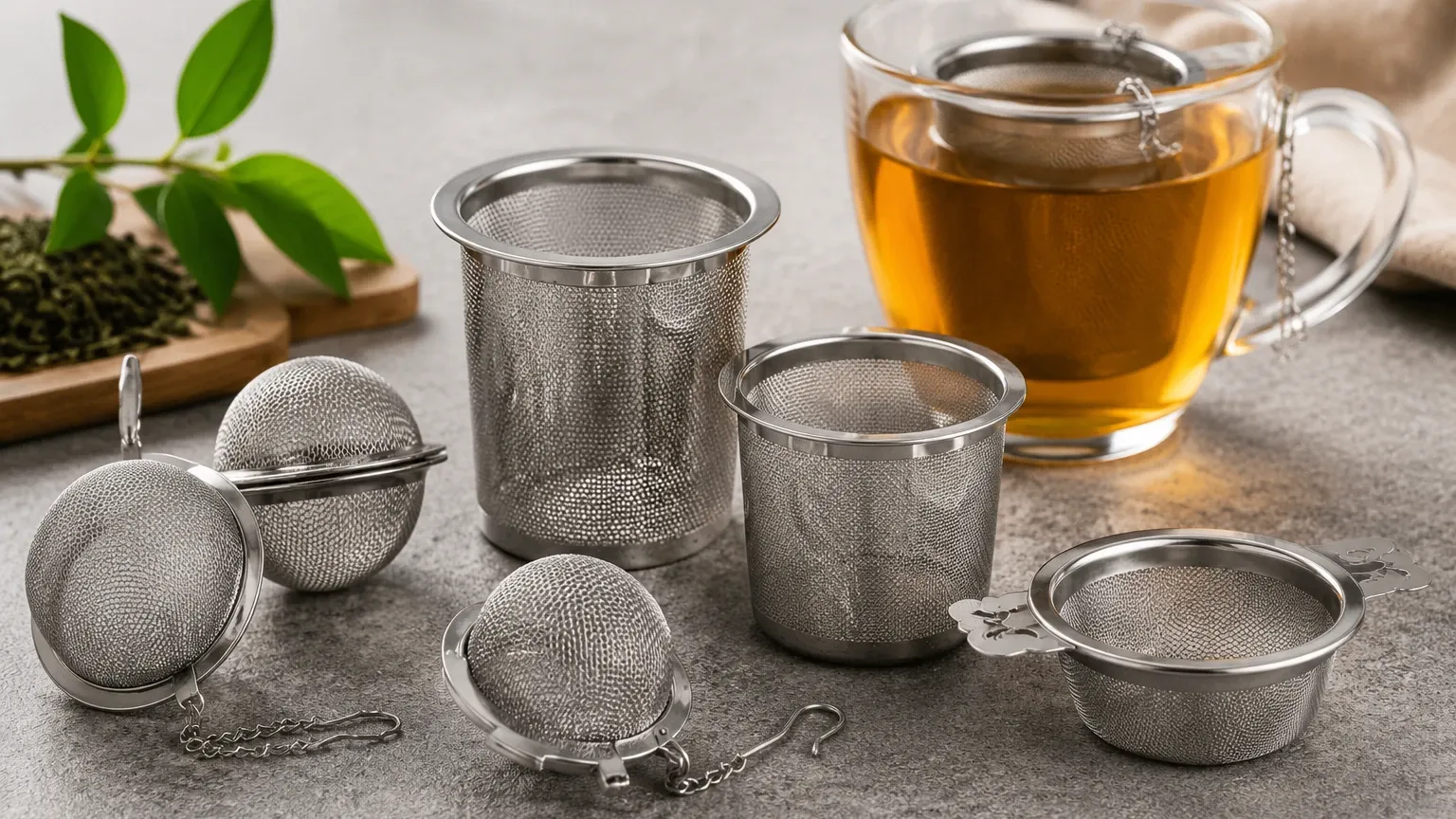
Depending on the specific installation point in a production line, metal tea strainers can take several geometric forms. Each design is optimized for different flow characteristics and solids-loading capacities.
Basket Strainers
Basket strainers are designed for systems where the flow is redirected through a removable basket. This design allows for a large surface area, which is ideal for high-volume tea brewing where a significant amount of leaf material must be retained without clogging the system quickly. They are often used in batch processing where the basket can be easily removed and cleaned between cycles.
Conical and Hat Strainers
Conical strainers, often referred to as temporary strainers, are shaped like a cone and are typically installed between flanges in a piping system. While they offer less surface area than a basket, they are excellent for protecting downstream equipment during the initial startup of a plant or for processes with lower solids concentrations.
Custom Cylindrical Filters
In automated continuous extraction systems, custom-designed cylindrical metal tea strainers are often used. These may feature internal or external reinforcement (such as a perforated metal core) to prevent the mesh from collapsing under high differential pressure.
Key Evaluation Criteria for B2B Procurement
When purchasing metal tea strainers for industrial use, procurement teams and engineers should evaluate potential suppliers based on specific technical benchmarks rather than price alone.
1. Weld Integrity: In food-grade applications, welds must be smooth and free of pits or crevices. Rough welds can harbor bacteria and are difficult to sanitize. Techniques such as TIG (Tungsten Inert Gas) welding or resistance welding are preferred for their precision and cleanliness.
2. Structural Support: Fine mesh is inherently delicate. For industrial use, the mesh should be supported by a heavier perforated metal plate or a rigid frame to ensure it can withstand the mechanical stress of high-pressure flow and manual handling during cleaning.
3. Ease of Sanitization: The design should facilitate thorough cleaning. Components that are compatible with ultrasonic cleaning or high-temperature CIP cycles are essential for maintaining hygiene standards in pharmaceutical and food production.
4. Tolerances and Fit: Precision in manufacturing ensures that the strainer fits perfectly within its housing. Even a small gap between the strainer frame and the housing wall can allow "bypass," where unfiltered liquid escapes around the edges of the filter, compromising the entire batch.
Common Risks in Low-Quality Filtration Components
Opting for non-industrial grade metal tea strainers or sourcing from unverified manufacturers introduces several risks into a production environment:
* Material Migration: Low-quality stainless steel or non-compliant alloys may leach heavy metals into the product, especially when exposed to heat and acidic liquids.
* Mesh Failure: Under pressure, poorly supported mesh can tear or deform. If the mesh fails, the retained solids will enter the downstream system, potentially damaging expensive machinery and necessitating a full product recall.
* Contamination from Manufacturing Residues: Industrial filters must be properly degreased and cleaned post-production. Residual oils or polishing compounds from the manufacturing process can contaminate the food or beverage product if not strictly controlled.
Customization and OEM Solutions
Standard off-the-shelf strainers rarely meet the exact needs of a specialized industrial process. Customization is often necessary to optimize filtration performance. B2B buyers should look for manufacturers capable of providing OEM solutions tailored to specific parameters:
* Custom Dimensions: Tailoring the diameter, length, and flange size to fit existing infrastructure.
* Layered Configurations: Using multiple layers of different mesh sizes (e.g., a coarse outer mesh for strength and a fine inner mesh for filtration) to create a durable, high-precision component.
* Specific Certifications: Ensuring the materials and manufacturing processes comply with FDA, 3-A Sanitary Standards, or other industry-specific regulations.
Conclusion: Confirming Technical Requirements
Before proceeding with a purchase of metal tea strainers or larger Strainers & Baskets, technical professionals should confirm the following data points with their supplier:
* The specific grade of stainless steel and availability of material mill certificates.
* The required micron rating based on the smallest particle size that must be removed.
* The maximum operating pressure and temperature the component will encounter.
* The cleaning protocol to ensure the strainer’s design and materials are compatible with the intended chemicals and temperatures.
By focusing on these engineering fundamentals, organizations can ensure they implement a filtration solution that enhances product quality, protects infrastructure, and delivers a low total cost of ownership through durability and reliability. For those seeking specialized designs, working with a manufacturer that understands the nuances of precision metal filtration is the most effective way to achieve optimized process results.
