


Strainer Noodles
In the landscape of industrial filtration, the term "strainer noodles" often surfaces in two distinct contexts: the processing of food products and the management of elongated, strand-like debris in chemical or polymer manufacturing. Regardless of whether the "noodles" are the intended product or a problematic byproduct of an extrusion process, the engineering challenge remains the same: how to efficiently separate elongated solids from a liquid stream without causing premature clogging, pressure spikes, or mechanical failure of the filtration media.
For engineers and procurement teams, selecting the correct Strainers & Baskets is critical to maintaining system uptime. Elongated materials present unique hydraulic behaviors compared to spherical or granular particles. This article examines the technical considerations for managing these materials, focusing on mesh selection, basket geometry, and material durability in demanding industrial environments.
Understanding the Role of Strainers & Baskets in Fiber and Strand Filtration
Industrial strainers are generally categorized as coarse filtration components, typically positioned upstream of pumps, valves, and fine filter cartridges. Their primary function is to protect downstream equipment from large solids. When dealing with "noodles"—whether they are actual pasta strands in a food processing plant or polymer extrusions in a chemical facility—the strainer must act as a high-capacity reservoir.
Unlike standard particulate filtration, where the goal is to capture small grains, strand filtration requires a focus on "bridging" and "stapling." Bridging occurs when multiple elongated pieces interlock across an opening, creating a secondary filter cake that can rapidly increase differential pressure. Stapling occurs when a single strand bends and hooks through the mesh, making it difficult to remove during cleaning cycles.
Kaifil’s heavy-duty basket strainers are engineered to mitigate these risks by utilizing specific interior geometries that encourage the settling of solids at the bottom of the basket, keeping the vertical walls clear for continued flow. This design is essential for high-viscosity fluids or systems with a high volume of suspended solids.
Engineering Considerations for Handling Elongated Debris
When specifying a strainer for "noodle-like" debris, engineers must look beyond simple micron ratings. The physical dimensions of the debris—specifically the length-to-diameter ratio—dictate the necessary aperture shape and size.
Aperture Shape: Perforated vs. Wire Mesh
For many industrial applications involving strands, perforated metal is preferred over woven wire mesh. Perforated holes provide a smooth, snag-free surface that reduces the likelihood of stapling. In contrast, the "over-under" weave of wire mesh creates tiny crevices where fibers can become wedged. However, if fine filtration is required (below 500 microns), a wire mesh liner supported by a perforated basket is the standard configuration. In these cases, the mesh must be securely bonded to the support structure to prevent bypass.
The 6:1 Open Area Ratio
A critical metric in strainer design is the ratio of the basket’s open area to the internal cross-sectional area of the inlet pipe. For standard applications, a 4:1 ratio is often sufficient. However, when filtering strainer noodles or high-load fibrous materials, a 6:1 or even 8:1 ratio is recommended. This higher ratio ensures that even as the bottom of the basket fills with debris, there remains enough unobstructed surface area to maintain flow without a significant pressure drop.
Material Selection and Durability for Industrial Strainers
Industrial filtration environments are often corrosive, abrasive, or subject to strict hygienic standards. The choice of material for the strainer basket directly impacts the total cost of ownership and the replacement cycle.
1. Stainless Steel 304: The industry standard for general-purpose applications. It offers excellent strength and good corrosion resistance for water treatment and non-acidic chemical processes.
2. Stainless Steel 316L: Preferred for food and beverage applications (such as pasta processing) and pharmaceutical environments. The addition of molybdenum provides superior resistance to chlorides and organic acids.
3. Surface Finishes: For applications involving sticky or cohesive "noodles," surface treatments like electropolishing or PTFE coating can be applied. Electropolishing reduces surface roughness at a microscopic level, preventing debris from adhering to the metal and facilitating faster cleaning cycles.
In food-grade applications, the strainer must comply with FDA or EU regulations. This involves ensuring that all welds are smooth and free of pits (sanitary welds) where bacteria could proliferate. Kaifil’s manufacturing process emphasizes these precision details to ensure that the filtration components meet the highest safety standards.
Performance Metrics: Flow Rates and Pressure Drop
In any B2B industrial setting, the efficiency of a filtration system is measured by its impact on the overall process flow. A strainer that is too restrictive will force pumps to work harder, increasing energy costs and potentially leading to cavitation.
Differential Pressure (ΔP)
Engineers must monitor the clean pressure drop across the strainer. When filtering elongated strands, the ΔP can rise non-linearly. As the first layer of "noodles" covers the mesh, the effective open area drops, which increases the velocity of the fluid through the remaining openings. This higher velocity can then pull more debris into the mesh, accelerating the clogging process.
To manage this, industrial systems should be equipped with differential pressure gauges. A common practice is to clean or replace the basket when the ΔP reaches 10-15 psi, although this varies based on the pump’s curve and the system’s pressure rating.
Flow Velocity
The velocity of the fluid entering the strainer should generally be kept below 10 feet per second (fps) for liquids. High velocity can cause elongated debris to "needle" through the openings, allowing solids to pass downstream that would otherwise be captured at lower velocities.
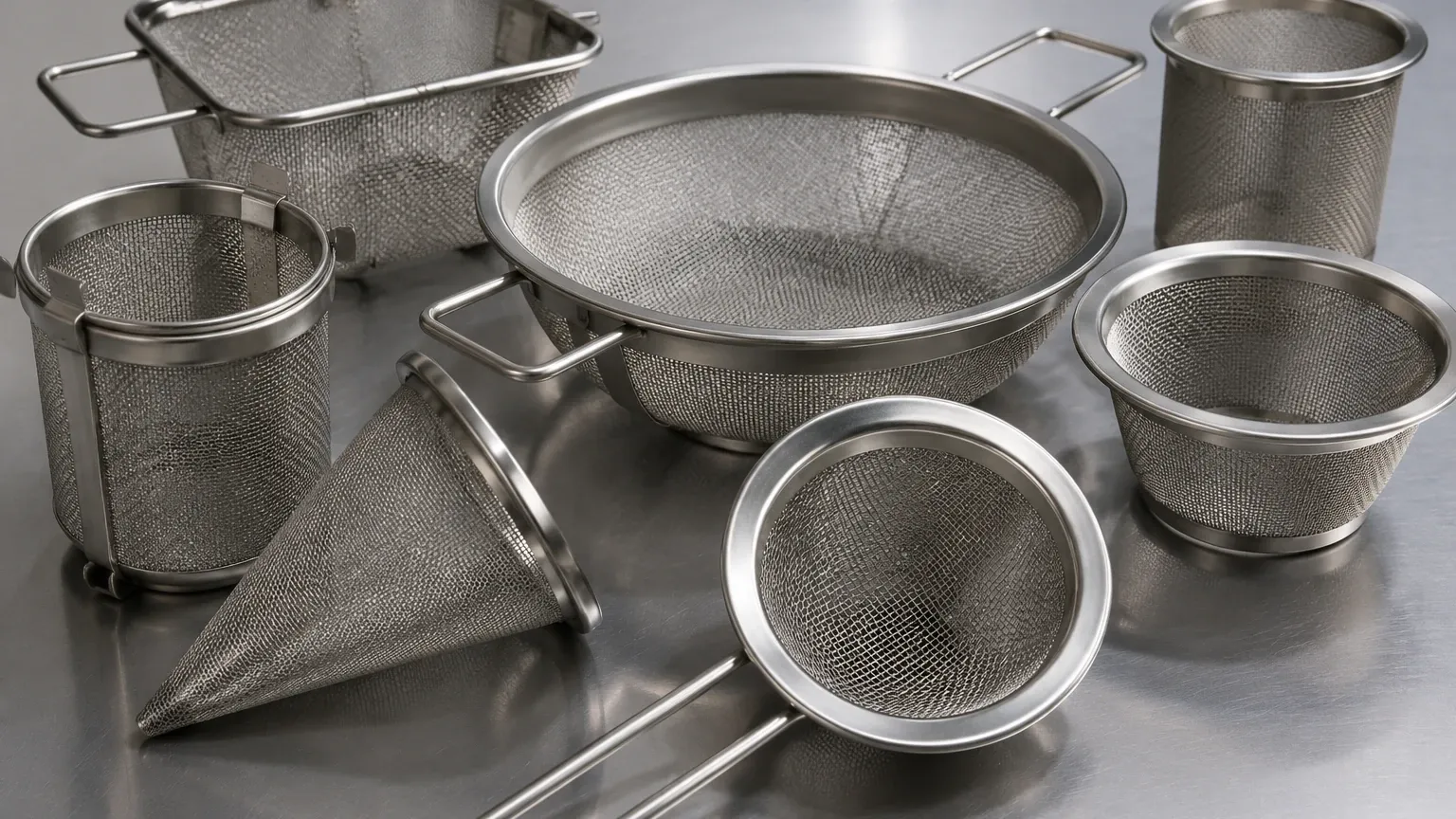
Customization Options for Specific Industrial Applications
Standard off-the-shelf strainers rarely meet the specific needs of complex industrial processes. Customization is often required to integrate the strainer into existing piping or to handle unique debris profiles.
* Basket Handles: For large-scale strainers used in chemical processing, the weight of a debris-filled basket can be significant. Custom handles, including slanted or ergonomic grips, allow for safer manual removal.
* Reinforcement Cages: In high-pressure systems, the force of the fluid can collapse a standard mesh basket. Reinforcing the basket with an outer cage or internal ribs ensures structural integrity under heavy loading.
* Multi-Basket Designs: For continuous processes where downtime is not an option, duplex strainers or multi-basket housings allow one side to be cleaned while the other remains in operation. This is particularly useful in "strainer noodles" applications where the volume of solids might require frequent cleaning.
Kaifil specializes in these custom configurations, working with engineering teams to develop filtration solutions that fit specific spatial constraints and performance requirements.
Maintenance and Cleaning Protocols for Basket Strainers
The longevity of a stainless steel strainer is largely dependent on proper maintenance. Because elongated strands and fibers are prone to entanglement, cleaning requires a systematic approach.
Manual Cleaning
The most common method involves removing the basket and using a high-pressure water jet or steam to dislodge debris from the outside-in. This "back-washing" action pushes the strands out of the apertures they entered. It is vital to avoid using wire brushes or abrasive tools on fine mesh liners, as this can distort the pore size and compromise filtration accuracy.
Ultrasonic Cleaning
For baskets used in pharmaceutical or precision chemical applications, ultrasonic cleaning is the most effective way to remove microscopic residues trapped in the mesh intersections. This method uses high-frequency sound waves to create cavitation bubbles that lift contaminants away without mechanical damage to the metal.
Replacement Cycles
While stainless steel baskets are designed for long-term use, they are eventually subject to metal fatigue or erosion. Regularly inspecting the mesh for signs of fraying, broken wires, or bypassed seals is essential. Implementing a preventative maintenance schedule based on the volume of "strainer noodles" processed will prevent catastrophic downstream equipment failure.
Conclusion: Selecting the Right Filtration Partner
Successfully managing elongated debris like strainer noodles requires more than just a bucket with holes. It demands a deep understanding of fluid dynamics, material science, and mechanical engineering. By selecting high-quality Strainers & Baskets, industrial operators can ensure their systems run efficiently, protect their expensive downstream assets, and maintain the purity of their end products.
When evaluating a filtration provider, engineers should prioritize manufacturers who offer technical transparency, material traceability, and customization capabilities. Kaifil’s commitment to precision manufacturing and industrial-grade durability makes them a reliable partner for those facing the unique challenges of strand and fiber filtration. Whether you are dealing with food processing byproducts or industrial polymer strands, the right strainer configuration is the first line of defense in a productive and cost-effective operation.
