


Nibco Strainers
In industrial fluid handling and piping systems, the protection of downstream equipment is a critical engineering priority. Debris, scale, and foreign particles can cause catastrophic failure in pumps, meters, and control valves. Among the most recognized names in flow control components are nibco strainers, which serve as a primary line of defense in commercial and industrial plumbing, HVAC, and process piping systems.
Understanding the technical nuances of these components, from housing materials to the internal Strainers & Baskets, is essential for engineers and procurement teams who must balance initial capital expenditure with long-term operational reliability. This guide examines the engineering considerations, selection criteria, and maintenance requirements for industrial strainers, with a focus on how high-quality internal components impact system performance.
Understanding the Role of Strainers in Industrial Flow Control
A strainer is a closed vessel with a cleanable screen element designed to remove and retain foreign particles from a flowing fluid. Unlike filters, which typically remove particles measured in microns and are often disposable, strainers are generally designed to remove larger, visible particles and feature reusable internal elements.
In systems utilizing nibco strainers, the primary objective is to safeguard expensive mechanical components. For example, in a chilled water system, a strainer installed upstream of a pump prevents weld slag or pipe scale from damaging the impellers or mechanical seals. In steam applications, strainers protect sensitive pressure-reducing valves from erosion caused by high-velocity particulates. The effectiveness of this protection is entirely dependent on the integrity of the internal mesh and the appropriateness of the housing design for the specific flow conditions.
Technical Specifications and Material Considerations
When specifying strainers for industrial environments, material compatibility is the first hurdle. Nibco strainers are available in several configurations, including cast iron, ductile iron, bronze, and stainless steel. Each material offers distinct advantages based on the temperature, pressure, and chemical composition of the fluid.
1. Cast Iron and Ductile Iron: Commonly used for water and non-corrosive fluid applications. Ductile iron provides higher impact and fatigue resistance compared to standard gray iron, making it suitable for systems where thermal shock or mechanical stress is a concern.
2. Bronze: Preferred for marine applications and potable water systems due to its resistance to dezincification and corrosion in saline environments.
3. Stainless Steel: For pharmaceutical, food processing, and aggressive chemical environments, stainless steel housings are the standard. They offer maximum resistance to corrosion and ensure that the fluid remains uncontaminated by the housing material itself.
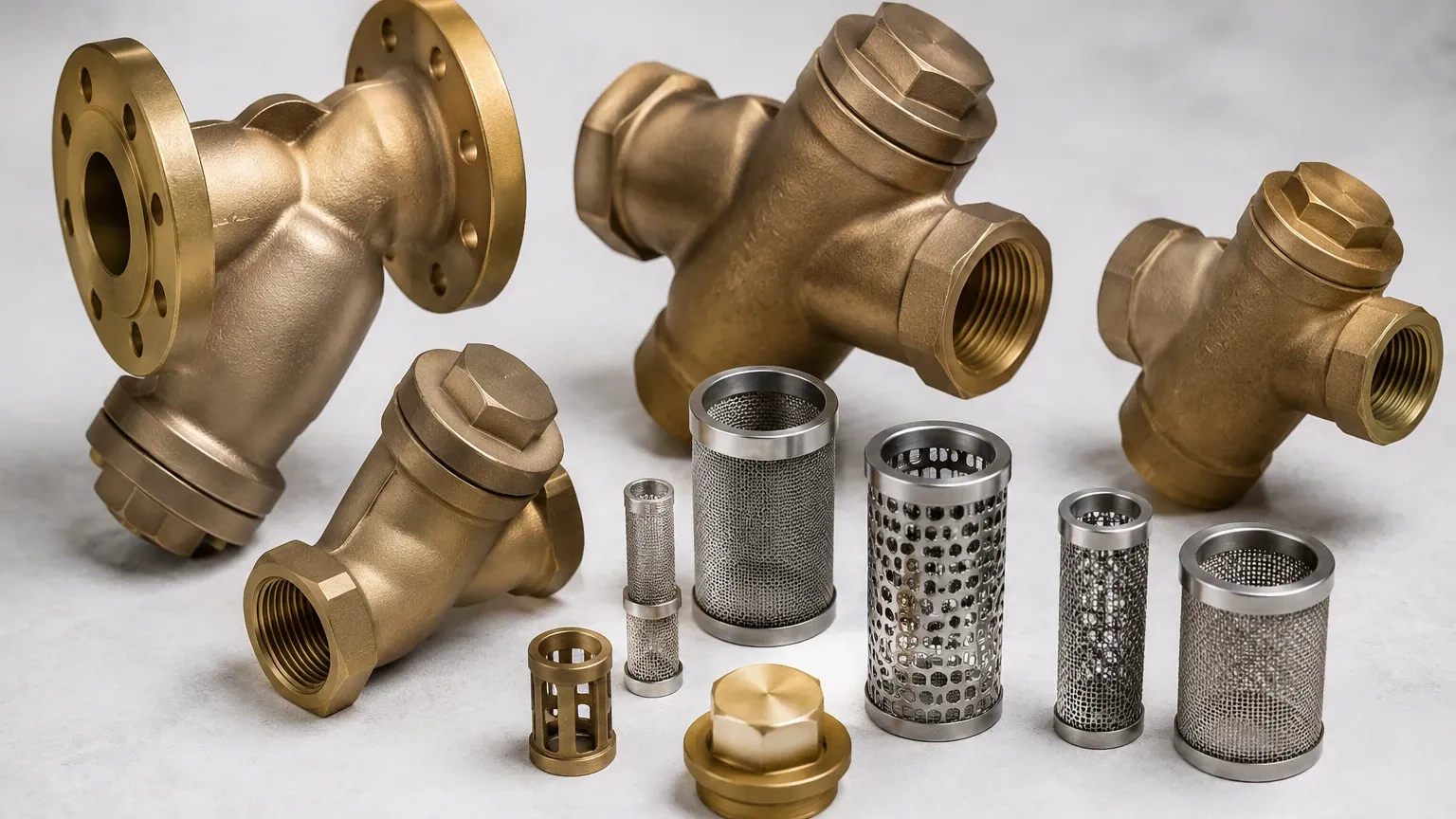
Beyond the housing, the engineering focus shifts to the internal Strainers & Baskets. While the housing provides the structural pressure boundary, the internal element performs the actual work of filtration. These are almost exclusively manufactured from stainless steel (typically Type 304 or 316) to ensure they can withstand the differential pressure generated as debris accumulates without collapsing or corroding.
Comparing Y-Strainers and Basket Strainers for System Efficiency
Industrial strainers generally fall into two categories: Y-type and Basket-type. Choosing between them requires an analysis of the flow rate, the expected debris load, and the allowable pressure drop.
Y-Strainers
Named for their shape, Y-strainers are typically used in high-pressure applications where the amount of debris to be removed is relatively small. They are compact and can be installed in either horizontal or vertical piping runs. In steam lines, the "leg" of the Y-strainer must point downward to prevent condensate from pooling, which could otherwise lead to water hammer and equipment damage. Because they have a smaller holding capacity for debris, Y-strainers are best suited for systems that are relatively clean or where frequent blow-down cleaning is possible.
Basket Strainers
Basket strainers feature a larger internal chamber and a vertical cylinder that houses a removable basket. These are designed for liquid applications where the debris load is higher. The primary advantage of a basket strainer is its significantly larger surface area, which results in a lower initial pressure drop and longer intervals between cleanings. However, basket strainers are generally limited to horizontal piping installations. For critical processes that cannot be shut down for cleaning, duplex basket strainers—which consist of two separate chambers with a diverting valve—allow one side to be cleaned while the other remains in service.
Customization and Replacement of Internal Components
One of the most frequent challenges engineers face is the inadequacy of standard, off-the-shelf strainer screens. While nibco strainers come with standard perforation sizes, specific industrial processes often require custom filtration levels. This is where the expertise of a specialized manufacturer like Kaifil becomes invaluable.
Standard screens are often perforated metal with holes ranging from 1/32" to 1/4". However, if the process requires the removal of finer particulates, a stainless steel wire mesh liner must be added to the internal basket. Kaifil specializes in producing custom-engineered Strainers & Baskets that fit precisely into existing housings while meeting specific micron ratings.
Customization options include:
* Reinforced Baskets: For high-viscosity fluids or high-pressure systems where standard baskets might buckle.
* Magnetic Inserts: Used to capture fine ferrous particles that might otherwise pass through a standard mesh.
* Specialty Alloys: Utilizing Monel, Hastelloy, or 316L stainless steel for extreme chemical resistance.
Engineering Evaluation: Pressure Drop and Filtration Accuracy
The selection of a strainer is a trade-off between filtration efficiency and energy consumption. A finer mesh will capture more debris but will also create a higher pressure drop across the unit. Engineers use the Flow Coefficient (Cv) to calculate the pressure drop (ΔP) at a given flow rate.
As debris accumulates on the internal screen, the effective open area decreases, and the pressure drop increases. It is a standard engineering practice to design systems so that the "clean" pressure drop does not exceed 2 PSI. When the pressure drop reaches 5-10 PSI (depending on the housing's structural limits), the strainer must be cleaned.
To optimize this, engineers must consider the Ratio of Open Area. A well-designed basket should have an open area ratio of at least 6:1 relative to the cross-sectional area of the inlet pipe. This ensures that even when the basket is 50% clogged, the pressure drop remains within acceptable limits. Utilizing precision-manufactured wire mesh from Kaifil allows for a higher percentage of open area while maintaining the structural integrity required for industrial service.
Installation and Maintenance Best Practices
Even the highest quality nibco strainers will fail to perform if installed or maintained incorrectly. Proper installation begins with ensuring there is sufficient clearance to remove the basket or screen for cleaning.
Installation Checklist:
* Orientation: Ensure the flow arrow on the housing matches the actual fluid direction.
* Support: Large basket strainers can be heavy, especially when full of fluid and debris; ensure the piping is adequately supported to prevent flange stress.
* Pressure Gauges: Installing pressure gauges upstream and downstream of the strainer is the only reliable way to monitor the condition of the internal element. A differential pressure switch can also be integrated into a SCADA system to alert operators when cleaning is required.
Maintenance Protocols:
Maintenance personnel should never open a strainer under pressure. The system must be isolated and vented. When cleaning the internal Strainers & Baskets, it is important to inspect the mesh for signs of "blinded" areas (where particles are wedged permanently) or broken wires. A damaged screen allows debris to bypass the strainer, defeating its entire purpose. Replacement elements should be kept on-site to minimize downtime during scheduled maintenance.
Selecting the Right Solution for Demanding Applications
When evaluating nibco strainers or any industrial filtration component, the total cost of ownership (TCO) should be the primary metric. TCO includes the initial purchase price, installation costs, energy costs associated with pressure drop, and the cost of replacement parts.
In many cases, upgrading the internal components to a more durable, custom-engineered solution from Kaifil can significantly extend the service life of the strainer and reduce the frequency of maintenance. Whether dealing with high-temperature steam in a power plant or delicate fluid processing in a pharmaceutical facility, the precision of the filtration element is what ultimately determines the safety and efficiency of the system.
For engineers looking to optimize their flow control systems, the combination of robust housings and high-performance internal components provides the most reliable path forward. By focusing on material science, hydraulic calculations, and proper maintenance, facilities can ensure that their investment in strainers provides the necessary protection for years to come.
To explore high-performance internal components or custom replacement solutions for your industrial housings, Review product options and application support to find the exact configuration required for your specific operational environment.
