


Strainers on Sale
In industrial fluid handling systems, the protection of downstream equipment such as pumps, valves, and instrumentation is paramount. Strainers and baskets serve as the primary line of defense, removing coarse particles and debris that could otherwise cause mechanical failure or process contamination. For procurement teams and maintenance engineers, finding high-quality strainers on sale or at competitive price points is a strategic objective. However, in the context of industrial filtration, "on sale" must be evaluated through the lens of technical compliance, material integrity, and long-term operational reliability.
Selecting the right Strainers & Baskets involves more than identifying a low purchase price. It requires a deep understanding of flow dynamics, pressure ratings, and the specific chemical compatibility of the materials involved. This guide examines the engineering considerations and selection criteria that should govern the purchase of industrial strainers, ensuring that cost-saving measures do not compromise system safety or efficiency.
The Engineering Role of Industrial Strainers and Baskets
Industrial strainers are essentially closed vessels with a removable screen or basket designed to trap solids from a flowing fluid. Unlike fine filters, which are often measured in sub-micron levels and may require frequent element changes, strainers are typically used for coarser filtration (20 mesh to 325 mesh) and are designed for high-flow, high-solids loading environments.
Protection of Capital Equipment
The primary function of a strainer is the protection of expensive capital equipment. For example, in a hydraulic system or a chemical processing line, a single piece of weld slag or a stray bolt can destroy a high-speed pump impeller or seize a control valve. By integrating robust baskets into the piping layout, engineers create a sacrificial point of collection that is easy to clean and maintain, preventing catastrophic system downtime.
Flow Dynamics and Pressure Drop
Every strainer introduced into a system creates a pressure drop (Delta P). Engineers must calculate the "clean" pressure drop and the "dirty" pressure drop to ensure the system's pump capacity remains adequate. When evaluating strainers on sale, it is critical to verify the open area ratio. A high-quality basket should offer an open area significantly larger than the cross-sectional area of the pipe (often a 4:1 or 6:1 ratio) to minimize flow resistance and extend the time between cleaning cycles.
Material Selection: Beyond the Surface
When browsing for strainers on sale, the material of construction is the most significant factor affecting both price and performance. Stainless steel is the industry standard for its durability and resistance to a wide range of process fluids.
SS304 vs. SS316L
* Stainless Steel 304: Suitable for general industrial applications, water treatment, and non-corrosive food processing. It offers excellent structural strength and is generally more cost-effective.
* Stainless Steel 316/316L: Contains molybdenum, which provides superior resistance to chlorides and pitting. This is essential for pharmaceutical, marine, and aggressive chemical environments.
Using a lower grade of steel to save on initial costs can lead to premature failure due to stress corrosion cracking or localized pitting. Professional manufacturers like Kaifil emphasize that the metallurgical integrity of the wire mesh and the housing must meet the specific requirements of the application environment.
Evaluating "On Sale" Opportunities in B2B Procurement
The term "strainers on sale" in a B2B context often refers to inventory clearance, bulk purchasing discounts, or standardized OEM components that are produced in high volumes. While these offer cost advantages, technical professionals must perform due diligence before acquisition.
Technical Compliance and Certification
A discounted price should never come at the expense of certification. Engineers should confirm that the strainers meet relevant standards, such as ASME (American Society of Mechanical Engineers) pressure vessel codes or specific industry certifications for food and beverage (FDA/3A) and pharmaceutical (USP Class VI) applications.
Assessing Structural Integrity
Inexpensive or poorly manufactured strainers often fail at the weld points or where the mesh is joined to the support structure. A high-performance basket should feature precision-welded seams and a reinforced handle or flange to withstand the mechanical stresses of high-velocity flow and the physical handling required during cleaning. If a strainer is on sale because it uses a lighter gauge of mesh or thinner housing walls, the total cost of ownership will likely exceed the initial savings due to frequent replacements.
Types of Strainers and Their Applications
Understanding the different configurations of Strainers & Baskets is vital for selecting the most efficient solution for a specific piping layout.
Y-Strainers
Named for their shape, Y-strainers are typically used for steam, gas, or liquid applications where the amount of debris is relatively small. They are compact and can be installed in either horizontal or vertical positions. Because they have a smaller holding capacity than basket strainers, they are often found in high-pressure systems where the housing must be exceptionally strong.
Simplex Basket Strainers
These are used in lines where the flow can be interrupted for cleaning. They feature a top-loading design that allows for easy removal of the basket. Because the basket is larger than the screen in a Y-strainer, it can hold more debris, making it suitable for high-solids applications like cooling water intake or crude oil filtration.
Duplex (Twin) Strainers
For processes that cannot be shut down, duplex strainers utilize two separate baskets with a diversion valve. This allows one basket to be cleaned while the other remains in service. While these are rarely found in simple "clearance" sales due to their complexity, finding a reliable OEM supplier for the internal baskets can significantly reduce maintenance costs.
Customization vs. Standardized Components
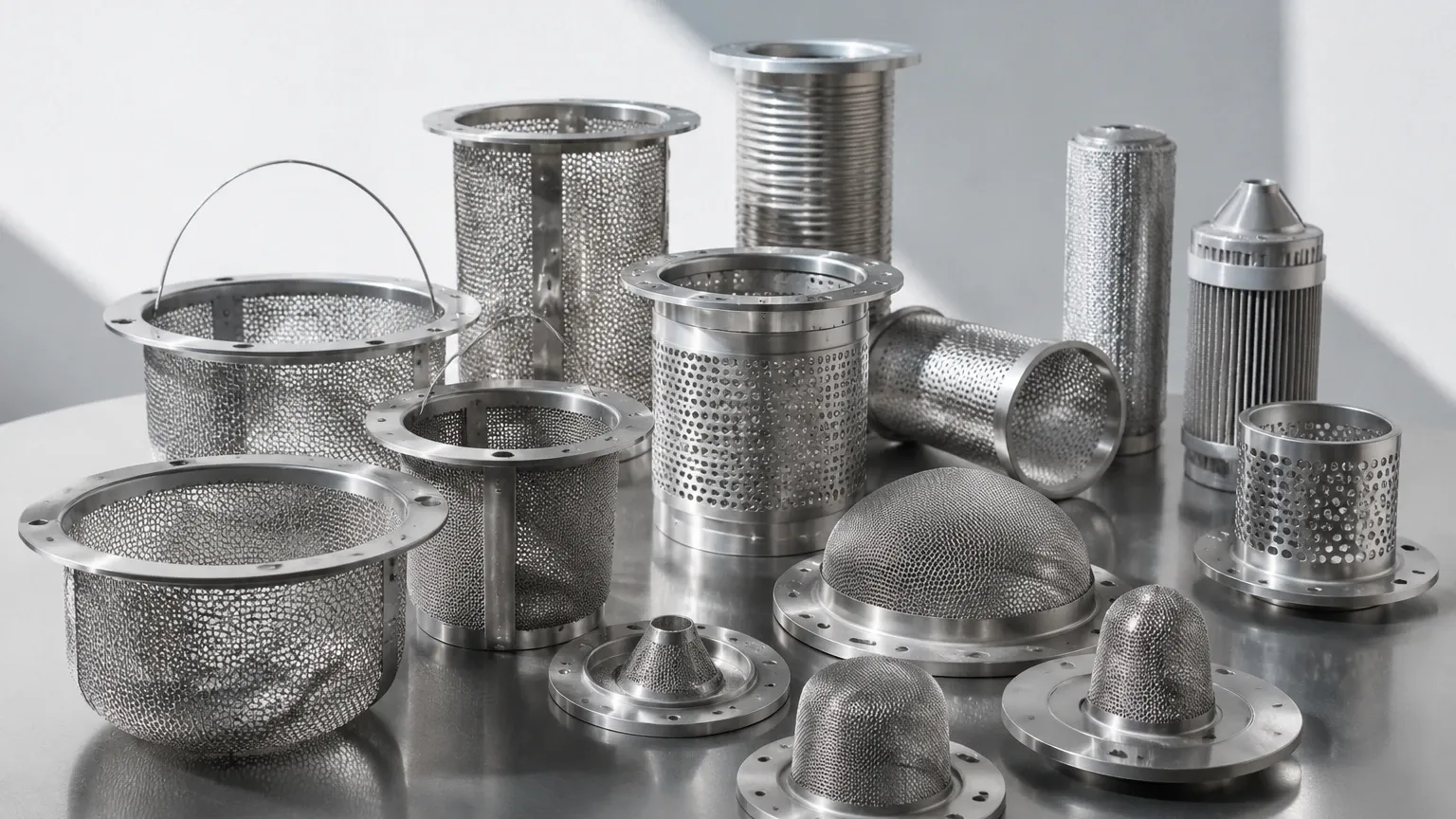
While standardized strainers on sale are suitable for many utility applications, specialized industrial processes often require customized filtration components. Customization allows engineers to specify the exact mesh weave, support perforation size, and overall dimensions to fit existing housings or unique flow requirements.
Mesh Selection and Micron Ratings
The "mesh count" refers to the number of openings per linear inch. A higher mesh count indicates finer filtration. However, finer mesh is also more delicate. In many industrial baskets, a fine mesh liner is supported by a heavier perforated metal cylinder. This "multi-layer" construction provides both the necessary filtration accuracy and the structural strength to resist collapsing under high differential pressure.
OEM Capabilities
Working with a manufacturer that offers OEM services allows for the development of bespoke strainers that address specific challenges, such as high-viscosity fluids or non-standard flange connections. Custom-engineered solutions often provide better long-term value than off-the-shelf items by optimizing the cleaning intervals and maximizing the protection of downstream assets.
Total Cost of Ownership (TCO) Considerations
A technical buyer must look beyond the unit price of strainers on sale and calculate the Total Cost of Ownership. TCO includes the initial purchase price, installation costs, maintenance labor, and the cost of potential system downtime.
1. Durability: A stainless steel basket that lasts five years is significantly cheaper than a lower-quality version that requires replacement every 12 months, regardless of the initial discount.
2. Ease of Cleaning: Baskets designed with ergonomic handles and quick-release covers reduce the labor time required for maintenance.
3. Filtration Efficiency: If a strainer allows bypass or fails to capture the targeted particle size, the resulting damage to downstream pumps can cost tens of thousands of dollars in repairs and lost production.
Maintenance and Replacement Cycles
To maintain the efficiency of Strainers & Baskets, a rigorous maintenance schedule is required. The most common indicator that a strainer needs cleaning is an increase in differential pressure.
* Monitoring: Installing pressure gauges upstream and downstream of the strainer is the most effective way to monitor performance. A typical threshold for cleaning is a pressure drop of 5-10 psi over the clean baseline.
* Cleaning Protocols: Stainless steel baskets are generally reusable. They should be cleaned using methods compatible with the material, such as ultrasonic cleaning, high-pressure water jets, or chemical baths, depending on the nature of the contaminants.
* Inspection for Wear: During every cleaning cycle, the mesh should be inspected for signs of fraying, corrosion, or mechanical deformation. If the structural integrity of the basket is compromised, it should be replaced immediately to prevent debris from bypassing the filter.
Conclusion for Technical Buyers
Procuring strainers on sale can be an effective way to manage maintenance budgets, provided that the technical specifications of the product align perfectly with the application's demands. In the industrial sector, the quality of materials—specifically the grade of stainless steel and the precision of the mesh weave—determines the success of the filtration process.
When evaluating options, engineers should prioritize manufacturers who demonstrate technical expertise in fluid dynamics and material science. By focusing on the open area ratio, pressure ratings, and structural reinforcement, purchasing teams can secure high-performance Strainers & Baskets that provide reliable protection and long-term value. Ultimately, the goal is to achieve a balance where cost-efficiency meets engineering excellence, ensuring that the "sale" price reflects a genuine value rather than a compromise in system integrity.
