


Strainers on a Boat
In the marine industry, the reliability of onboard systems is directly tied to the quality of fluid management. Whether for a commercial vessel, an industrial workboat, or a specialized marine platform, the presence of effective strainers on a boat is a fundamental requirement for protecting high-value machinery. These components serve as the first line of defense, preventing debris from entering critical systems such as engine cooling loops, HVAC units, bilge pumps, and desalination plants.
For engineers and procurement professionals, selecting the right Strainers & Baskets involves more than just matching a pipe diameter. It requires a deep understanding of material science, fluid dynamics, and the specific environmental challenges posed by saltwater and brackish conditions. This guide examines the technical considerations for marine filtration, focusing on how high-performance stainless steel components ensure operational uptime.
The Critical Role of Raw Water Strainers
Most vessels rely on "raw water"—the water in which the boat is floating—for various cooling and processing tasks. This water is rarely clean; it contains seaweed, sand, shells, plastic debris, and biological growth. Without a robust strainer system, these contaminants would quickly clog the narrow passages of heat exchangers or erode the impellers of centrifugal pumps.
Raw water strainers are typically installed between the seacock (the valve that lets water into the hull) and the pump. Their primary function is to decelerate the incoming water and pass it through a removable basket. This basket traps solids while allowing the liquid to continue to the engine or auxiliary equipment. In industrial marine applications, a failure in this simple component can lead to engine overheating, which in turn causes thermal expansion of pistons, cracked heads, and potentially thousands of dollars in emergency repairs and lost charter time.
Engineering the Internal Basket: Material and Structure
The most critical part of any strainer is the internal basket. While the housing provides the pressure vessel, the basket determines the filtration efficiency and the maintenance interval. For industrial-grade strainers on a boat, stainless steel 316 or 316L is the industry standard due to its superior resistance to pitting and crevice corrosion.
Perforated vs. Mesh Baskets
There are two primary types of basket constructions used in marine environments:
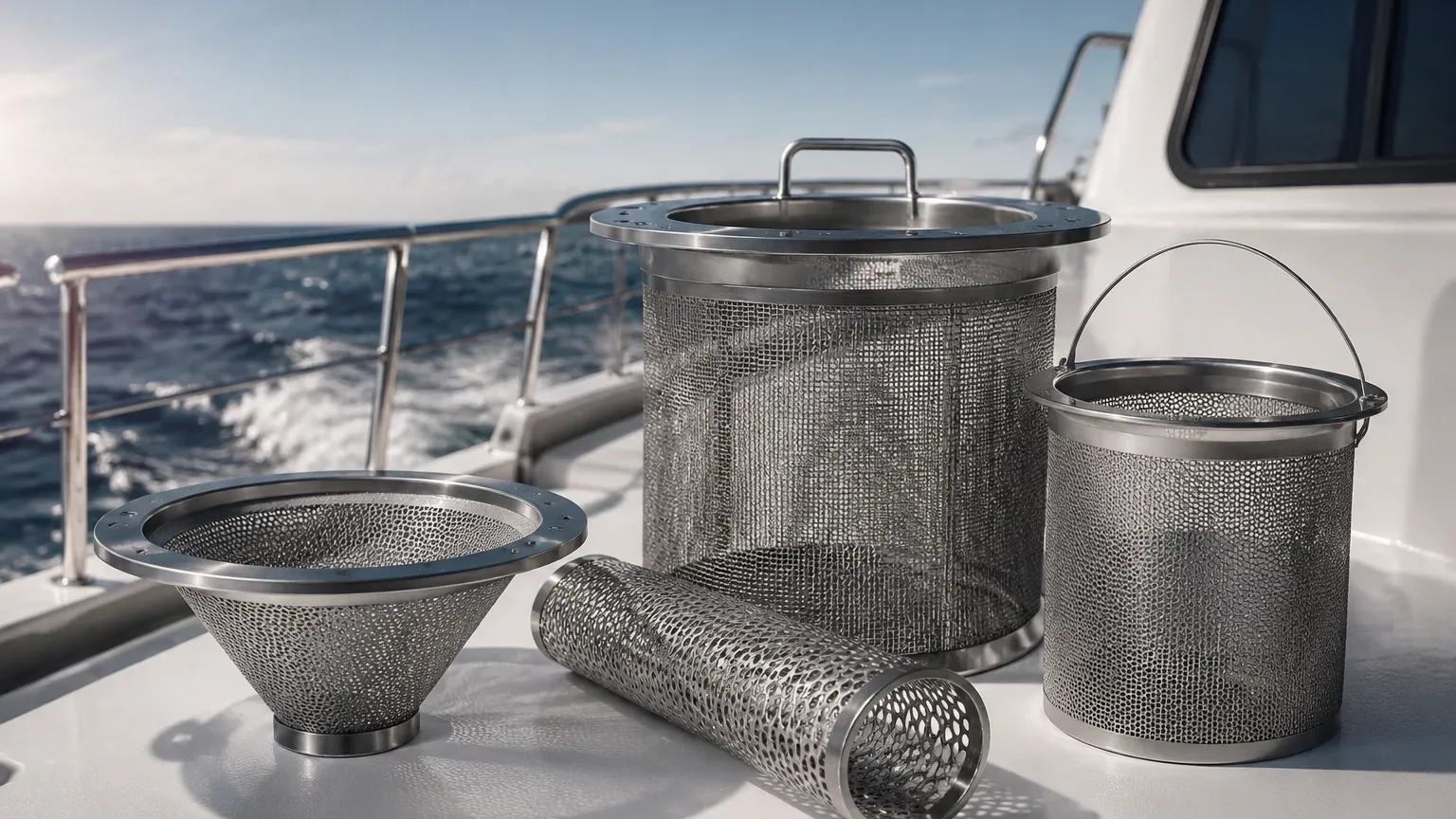
1. Perforated Metal Baskets: These are made from a single sheet of stainless steel with punched holes. They are exceptionally durable and resistant to the high-pressure surges often found in main engine intakes. They are ideal for catching larger debris like kelp and large shells.
2. Wire Mesh Lined Baskets: For applications requiring finer filtration, such as protecting high-pressure washdown pumps or delicate sensors, a perforated basket is often lined with a fine stainless steel wire mesh. This allows for filtration levels down to the micron level while maintaining the structural integrity provided by the perforated outer shell.
Structural Integrity and Bypass Prevention
A common failure point in low-quality strainers is the seal between the basket and the housing. If the basket does not sit perfectly flush, "bypass" occurs, where debris slips around the edges of the filter. Precision-manufactured baskets from Kaifil utilize reinforced rims and exact tolerances to ensure that 100% of the fluid passes through the filtration media.
Material Selection: Combating Galvanic and Pitting Corrosion
Marine environments are among the most corrosive on earth. When discussing strainers on a boat, material selection is the most significant factor in determining the total cost of ownership (TCO). While bronze is a traditional choice for housings, the internal filtration components are almost exclusively stainless steel due to the need for high tensile strength and thin-wall efficiency.
The Advantage of 316L Stainless Steel
316L stainless steel contains molybdenum, which significantly enhances its resistance to chloride-induced pitting. In stagnant water—such as when a boat is docked for several weeks—lower grades of metal can develop localized corrosion cells. 316L remains passive in these conditions, ensuring that the mesh does not develop holes that would compromise the filtration system.
Electrolysis and Sacrificial Anodes
Engineers must also consider the galvanic series. When different metals are in contact in an electrolyte (saltwater), the less noble metal will corrode. Industrial strainer housings often include a zinc anode to protect the internal components. However, using high-quality stainless steel for the basket ensures that the filtration surface itself does not become the sacrificial element, maintaining the precise micron rating over years of service.
Sizing and Flow Rate Optimization
One of the most frequent mistakes in marine system design is undersizing the strainer. A strainer that is too small creates a significant pressure drop (Delta P), which forces the pump to work harder, leading to cavitation and premature pump failure.
Calculating the Open Area Ratio
When selecting Strainers & Baskets, engineers look at the "Open Area Ratio" (OAR). This is the ratio of the total area of the holes in the basket to the cross-sectional area of the inlet pipe. For marine raw water applications, an OAR of at least 6:1 is typically recommended. This ensures that even if the basket is 50% clogged with debris, there is still enough open area to allow the required flow of cooling water to the engine without increasing resistance.
Flow Velocity and Turbulence
High-velocity water entering a strainer can cause turbulence, which may vibrate the basket and lead to fatigue stress at the weld points. Professional-grade baskets are designed with reinforced longitudinal seams and heavy-duty bottom plates to withstand these hydraulic forces. Proper sizing ensures that the velocity through the mesh remains within the laminar flow range, which optimizes particle capture and reduces wear.
Maintenance Protocols and Operational Reliability
Even the best-engineered strainers on a boat require regular maintenance. In industrial and commercial maritime operations, maintenance must be fast and predictable to avoid downtime.
Visual Inspection and Access
Many modern marine strainers feature clear sight glasses or lids, allowing operators to inspect the basket without opening the system. However, in high-pressure or deep-sea applications, all-metal housings are preferred for their burst strength. In these cases, differential pressure gauges are installed. A rise in the pressure drop across the strainer indicates that the basket is reaching its holding capacity and requires cleaning.
Cleaning Procedures
Stainless steel baskets are preferred for their ease of cleaning. Unlike synthetic filters, a stainless steel basket can be removed, hosed down, and even scrubbed with a stiff brush to remove stubborn biological growth (like barnacle spat or algae) without damaging the filtration media. This reusability is a key factor in reducing the environmental footprint and operational costs of a vessel.
Customization for OEM Marine Applications
Standard off-the-shelf strainers do not always fit the unique spatial constraints of a modern engine room or the specific flow requirements of specialized industrial equipment. This is where custom manufacturing becomes essential.
Tailored Geometry
Kaifil works with marine engineers to develop custom basket geometries, including offset handles, slanted bottoms for angled housings, and multi-stage filtration baskets. These customized solutions allow for maximum filtration surface area within a compact footprint, which is a critical consideration in the tight confines of a boat's machinery space.
Specialized Coatings and Finishes
In some specialized chemical transport vessels or research boats, stainless steel baskets may require additional treatments such as electropolishing. This process smooths the surface of the metal at a microscopic level, making it even harder for biological organisms to attach to the mesh and reducing the frequency of cleaning cycles.
Total Cost of Ownership in Marine Filtration
When procurement teams evaluate strainers on a boat, the initial purchase price is often a secondary concern compared to the long-term costs of maintenance and potential failure. A low-quality strainer basket that fails can allow debris to destroy a heat exchanger or a raw water pump, leading to repairs that cost ten times the price of a premium stainless steel component.
By investing in high-quality Strainers & Baskets, vessel operators ensure:
* Extended Component Life: High-grade 316L stainless steel resists the harsh marine environment longer than standard alloys.
* Reduced Labor Costs: Easier cleaning and fewer replacements mean less time spent by the crew in the bilge.
* System Protection: Reliable filtration prevents downstream damage to engines, HVAC, and desalination systems.
* Safety: In heavy seas, the last thing a captain needs is an engine shutdown due to a clogged or failed cooling water intake.
Conclusion
Strainers on a boat are a small but vital link in the chain of marine engineering. From the initial design phase to daily operations, the choice of filtration media and basket construction has a profound impact on the reliability and safety of the vessel. For industrial marine applications, the use of precision-engineered stainless steel filtration components is not an option—it is a necessity. By focusing on material quality, proper sizing, and robust construction, engineers can ensure that their sea-going systems remain protected against the unpredictable debris of the world's oceans.
