


Strainer Qfc
In industrial fluid handling, the efficiency of a system is often dictated by the reliability of its filtration components. Among the various configurations available to engineers, the strainer qfc (Quick Filter Change) design has emerged as a critical standard for applications where process continuity and minimal maintenance downtime are paramount. These systems, categorized under the broader heading of Strainers & Baskets, serve as the primary defense mechanism for downstream equipment such as pumps, heat exchangers, and sensitive instrumentation.
Selecting a strainer qfc system requires a deep understanding of fluid dynamics, material compatibility, and mechanical engineering principles. This article explores the technical nuances of these systems, providing engineers and procurement teams with the factual basis needed to optimize their filtration infrastructure.
The Engineering Logic of Quick Filter Change (QFC) Designs
The "QFC" designation primarily refers to the mechanical features that allow for rapid access to the internal basket or screen. In traditional strainer designs, accessing the filter element often requires specialized tools, the removal of multiple heavy bolts, and significant manual labor. For high-volume industrial processes, this translates to costly downtime.
A strainer qfc system typically incorporates several engineering features to streamline this process:
1. Tool-less Access: Many QFC models utilize hand-operated knobs or swing-bolt closures. These allow operators to depressurize the housing and open the cover in seconds rather than minutes.
2. Hinged Covers: By integrating a heavy-duty hinge, the cover remains attached to the housing, preventing damage to the sealing surfaces and reducing the risk of workplace injuries during maintenance.
3. Pressure Equalization: Advanced QFC units often include integrated vent valves or bypass ports to ensure the internal pressure is safely neutralized before the housing is opened.
From an engineering perspective, the transition to QFC designs is not merely about convenience; it is a strategic decision to improve the Total Cost of Ownership (TCO) by reducing labor hours and maximizing the "up-time" of the fluid circuit.
Structural Integrity and Material Selection
Industrial strainers operate under significant mechanical stress, including internal pressure, thermal expansion, and the physical impact of suspended solids. Therefore, the material of construction is the most critical factor in ensuring long-term reliability. Stainless steel remains the industry standard for high-performance Strainers & Baskets due to its superior mechanical properties.
Stainless Steel Grades
* Grade 304: Suitable for general industrial applications, providing excellent strength and basic corrosion resistance for water treatment and non-corrosive chemical processing.
* Grade 316/316L: The preferred choice for pharmaceutical, food and beverage, and marine environments. The addition of molybdenum enhances resistance to pitting and crevice corrosion, particularly in chloride-rich environments.
* Specialty Alloys: For highly aggressive chemical environments, manufacturers like Kaifil can provide custom solutions using Hastelloy or Duplex stainless steels, which offer enhanced resistance to stress corrosion cracking.
Sealing Components
The "Quick" aspect of a strainer qfc system is only effective if the seal remains intact after repeated openings. Engineers must specify seal materials based on the chemical profile and temperature of the process fluid. Common options include:
* Buna-N (Nitrile): Standard for oil and water applications.
* EPDM: Excellent for steam and polar solvents, though incompatible with petroleum-based fluids.
* Viton (FKM): High-temperature resistance and broad chemical compatibility.
* PTFE Encapsulated: Provides the chemical inertness of Teflon with the elasticity of an elastomer core.
Filtration Accuracy and Basket Configuration
The heart of any strainer qfc system is the internal basket. Unlike fine membrane filters, strainers are generally used for coarse filtration, removing particles ranging from several millimeters down to approximately 40 microns. The configuration of the basket determines both the filtration efficiency and the pressure drop across the unit.
Perforated vs. Mesh Linings
Most industrial baskets feature a heavy-duty perforated metal support structure. For finer filtration requirements, this support is lined with a precision-woven stainless steel wire mesh.
* Perforated Metals: These are defined by hole diameter and pitch. A larger open area reduces the initial pressure drop but may allow larger contaminants to pass through.
* Wire Mesh: Defined by mesh count (the number of wires per linear inch). High-count meshes provide precise filtration but require more frequent cleaning due to the increased surface area for particle entrapment.
The Importance of the Open Area Ratio
A critical engineering metric for Strainers & Baskets is the "Open Area Ratio" (OAR). This is the ratio between the total open area of the strainer basket and the internal cross-sectional area of the inlet pipe. A high OAR (typically 6:1 or higher) ensures that the strainer can accumulate a significant amount of debris before the pressure drop (ΔP) begins to impact system performance. This extended service life between cleanings is a primary goal of the strainer qfc design.
Performance Metrics: Managing Pressure Drop
In any hydraulic system, every component introduces a degree of resistance to flow, measured as pressure drop. Engineers must calculate the clean pressure drop of a strainer qfc unit to ensure the system pump has sufficient head to maintain the required flow rate.
Factors influencing pressure drop include:
* Fluid Viscosity: Higher viscosity fluids (such as heavy oils or syrups) require larger mesh openings or larger housing sizes to maintain flow.
* Specific Gravity: Denser fluids increase the energy required to move through the filtration media.
* Contaminant Loading: As the basket collects debris, the effective open area decreases, causing an exponential rise in pressure drop.
Most modern strainer qfc installations include differential pressure gauges. These instruments provide real-time data, signaling operators exactly when the basket needs to be serviced. Servicing the unit before reaching the maximum allowable ΔP prevents basket collapse and ensures that contaminants are not forced through the mesh media.
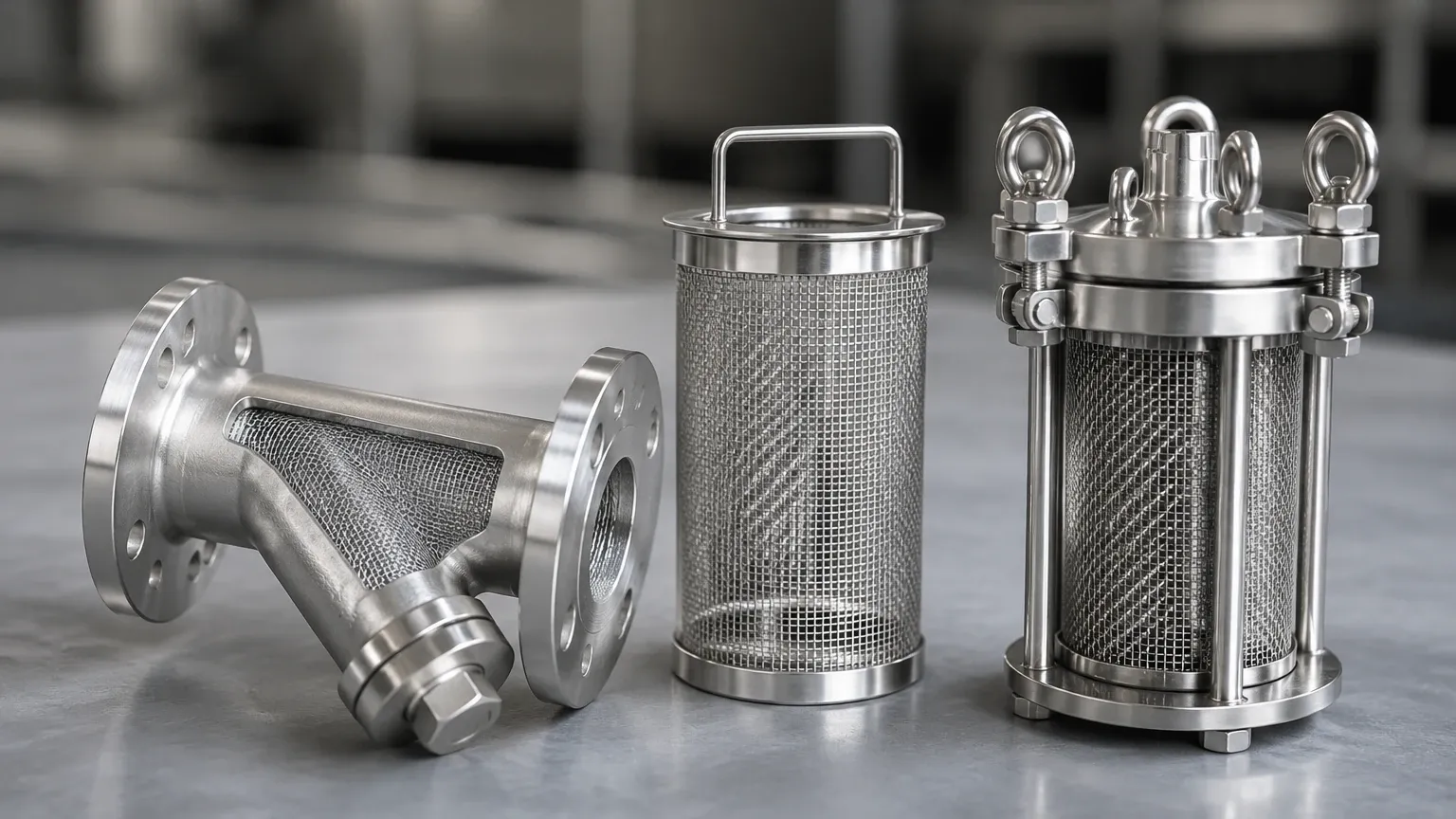
Customization and OEM Solutions
While off-the-shelf strainers may suffice for standard plumbing applications, industrial processes often demand customized solutions. Manufacturers specializing in stainless steel filtration, such as Kaifil, provide the engineering expertise required to adapt strainer qfc designs to specific environmental constraints.
Customization options often include:
* Non-Standard Inlet/Outlet Configurations: Offset nozzles, right-angle flows, or specific flange ratings (ANSI, DIN, JIS) to match existing piping.
* Internal Coatings: For applications involving abrasive slurries, internal surfaces can be treated to increase wear resistance.
* Magnetic Inserts: To capture fine ferrous particles that might otherwise pass through a standard mesh, magnetic separators can be integrated into the basket assembly.
* Steam Jacketing: For fluids that must be maintained at a specific temperature to prevent solidification (such as resins or liquid chocolate), the strainer housing can be jacketed for steam or thermal oil circulation.
Maintenance Protocols for Strainer QFC Systems
The longevity of a strainer qfc system is directly linked to the quality of its maintenance. Because these units are designed for frequent access, the maintenance procedure should be standardized to prevent mechanical wear.
1. Inspection of Sealing Surfaces: Every time the cover is opened, the O-ring and the machined seating surface should be inspected for nicks, debris, or chemical degradation.
2. Basket Cleaning: Baskets should be cleaned using methods compatible with the contaminant. For example, organic buildup may require ultrasonic cleaning, while inorganic debris can often be removed with high-pressure water or air.
3. Lubrication: Swing bolts and hinges should be lubricated with food-grade or industrial-grade grease (depending on the application) to ensure the "quick change" functionality remains smooth over years of service.
Selection Criteria for Engineering and Procurement
When specifying a strainer qfc for a new or existing system, engineers should confirm the following data points to ensure the selected hardware meets the application's demands:
* Flow Rate (GPM/LPM): Both average and peak flow rates.
* Operating Pressure and Temperature: Including potential surge pressures.
* Nature of Contaminants: Particle size distribution, shape (fibrous vs. spherical), and concentration.
* Fluid Chemistry: pH levels and the presence of oxidizing agents.
* Space Constraints: The physical footprint available for the housing and the clearance required to remove the basket.
By focusing on these factual boundaries, purchasing teams can avoid the common pitfall of undersizing a strainer, which leads to excessive maintenance and potential pump cavitation.
Conclusion
The strainer qfc represents a sophisticated intersection of mechanical design and process efficiency. By prioritizing rapid access without compromising the structural integrity provided by high-grade stainless steel, these systems ensure that industrial fluid circuits remain protected and productive. Whether for chemical processing, water treatment, or food production, the integration of high-quality Strainers & Baskets is a fundamental requirement for modern engineering excellence. Choosing a manufacturer with deep technical expertise in custom filtration ensures that the specific challenges of each application are met with a durable, high-performance solution.
