


Strainers Types
In industrial fluid handling systems, the protection of sensitive downstream equipment—such as pumps, valves, flow meters, and heat exchangers—is a critical engineering priority. Industrial strainers serve as the primary line of defense, mechanically removing unwanted solids from liquids, gases, or steam. Unlike fine filtration systems that may target sub-micron particles, strainers are typically designed for coarser separation, yet they require precise engineering to ensure they do not introduce excessive pressure drops or become points of system failure.
Selecting the appropriate equipment from the various strainers types available requires a deep understanding of the application's flow dynamics, the nature of the contaminants, and the operational requirements for maintenance and downtime. This guide examines the technical characteristics of common strainer configurations and the engineering factors that dictate their performance in demanding industrial environments.
The Fundamental Role of Strainers in Industrial Systems
While the terms "filter" and "strainer" are sometimes used interchangeably, in a technical B2B context, a strainer is specifically a device used to remove larger particles from a process fluid. The goal is often protection rather than purification. For instance, in a chemical processing plant, a strainer might be installed upstream of a high-precision pump to prevent metal shavings or scale from damaging the pump’s internal impellers.
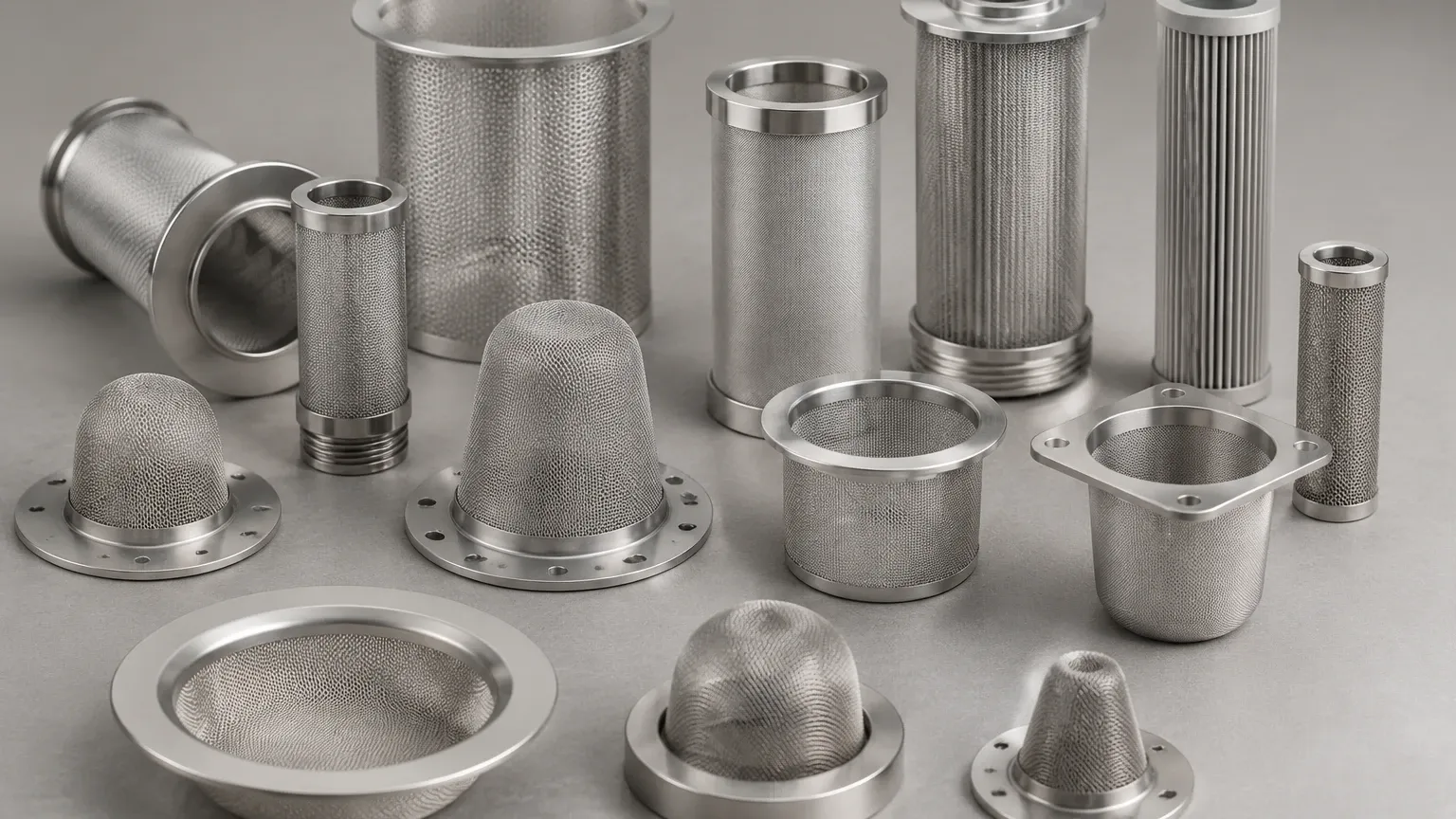
When evaluating Strainers & Baskets, engineers must consider the "open area ratio." This is the ratio between the total open area of the strainer element and the internal cross-sectional area of the pipe. A higher ratio typically allows for longer run times between cleanings and a lower initial pressure drop. Standard industrial designs often aim for a 3:1 or 4:1 ratio, though custom high-capacity baskets can exceed this for high-debris applications.
Detailed Analysis of Primary Strainers Types
Industrial strainers are categorized by their mechanical configuration and how they are integrated into the piping system. Each type offers specific advantages regarding pressure handling, debris capacity, and ease of maintenance.
Y-Strainers
Named for their "Y" shaped configuration, these are perhaps the most common strainers used in industrial piping. They are typically utilized for pressurized lines, whether liquid or gas, where the amount of material to be removed is relatively small.
* Engineering Advantage: Y-strainers are compact and can be installed in either horizontal or vertical positions (provided the "leg" points downward to collect debris). They are exceptionally well-suited for high-pressure steam applications.
* Maintenance: They often feature a "blow-off" port in the cap, allowing for cleaning without removing the screen, provided the debris is loose enough to be flushed out by the system pressure.
Basket (Simplex) Strainers
Basket strainers feature a vertical cylinder that houses a removable basket-shaped element. Because the basket is larger than the screen in a Y-strainer, these units have a higher dirt-holding capacity and a lower pressure drop.
* Engineering Advantage: They are ideal for liquid applications where high flow rates are required and where the particulate load is significant. The top-loading design allows for easy removal of the basket for manual cleaning.
* Limitation: The system must be shut down or the flow diverted to clean a simplex basket strainer.
Duplex (Twin) Strainers
For processes that cannot be interrupted, duplex strainers are the standard solution. A duplex system consists of two separate strainer chambers connected by a diverter valve. When one basket becomes clogged, the flow is switched to the second chamber, allowing the first to be cleaned without stopping the process.
* Engineering Advantage: Continuous operation is the primary benefit. These are common in lubrication systems, cooling water lines, and fuel oil systems where downtime is not an option.
T-Strainers
T-strainers (or Bathtub strainers) feature a straight-through flow path with a perpendicular strainer chamber.
* Engineering Advantage: They offer a very low pressure drop and are often used in larger pipe diameters where space is a constraint. They can be designed for quick-opening covers, making them efficient for high-flow water intake systems.
Temporary (Cone or Witch's Hat) Strainers
These are simple, cost-effective components designed for use during system start-up. They are installed between flanges to catch welding slag, tools, or construction debris that may have been left in the pipes. Once the system has been flushed and is running cleanly, these are typically removed.
Material Selection and Engineering for Durability
The efficacy of different strainers types is heavily dependent on the materials used for both the housing and the internal filtration element. In industrial environments, stainless steel is the preferred material due to its mechanical strength and resistance to corrosion.
1. Stainless Steel 304: Suitable for general industrial applications, water treatment, and food processing where moderate corrosion resistance is required.
2. Stainless Steel 316/316L: The standard for chemical processing, pharmaceuticals, and marine environments. The addition of molybdenum provides superior resistance to chlorides and pitting.
3. Specialty Alloys: For highly aggressive fluids or extreme temperatures, manufacturers may utilize Monel, Hastelloy, or Duplex Stainless Steel.
Beyond the housing, the strainer element itself usually consists of a perforated metal support sheet lined with a fine wire mesh. The choice of weave—such as plain weave, twilled weave, or Dutch weave—determines the filtration accuracy and the structural integrity of the basket under differential pressure.
Technical Parameters: Micron Rating and Open Area Ratio
When specifying a strainer, engineers must define the required level of separation, often measured in mesh size or microns.
* Mesh Size: Refers to the number of openings per linear inch. A 20-mesh screen has 20 openings per inch. As the mesh number increases, the opening size decreases.
* Micron Rating: A more precise measurement of the largest particle that can pass through the mesh. For example, a 100-mesh screen typically correlates to approximately 140-150 microns.
It is a common engineering mistake to specify a mesh that is too fine for the application. A finer mesh increases the frequency of cleaning and significantly raises the pressure drop across the unit. The rule of professional selection is to use the coarsest mesh that will still protect the downstream equipment.
Another critical factor is the Differential Pressure (ΔP). This is the difference in pressure between the inlet and the outlet of the strainer. As the strainer collects debris, the ΔP increases. Engineers must calculate the "clean pressure drop" and establish a "terminal pressure drop" at which the strainer must be cleaned to prevent the mesh from collapsing or the flow from being severely restricted.
Operational Considerations: Installation and Maintenance
The long-term reliability of industrial strainers depends on proper installation and a rigorous maintenance schedule.
Installation Best Practices
* Orientation: Ensure Y-strainers are installed so the debris pocket is at the lowest point. For vertical lines, flow must be downward.
* Accessibility: Provide enough clearance for basket removal. In large-scale industrial settings, this may require overhead lifting equipment for heavy baskets.
* Instrumentation: Installing pressure gauges upstream and downstream of the strainer is essential. This allows operators to monitor differential pressure in real-time and schedule cleaning based on actual performance data rather than arbitrary time intervals.
Maintenance and Cleaning
For manual strainers, the cleaning process involves isolating the unit, venting the pressure, and removing the element. It is vital to inspect the gaskets and seals during every cleaning cycle. In high-temperature or high-pressure applications, seals can degrade, leading to bypass—where fluid flows around the strainer element rather than through it, defeating the purpose of the device.
Custom Engineering and OEM Solutions for Specialized Applications
Standard off-the-shelf strainers often fail to meet the specific needs of complex industrial processes. This is where custom manufacturing becomes necessary. Customization options include:
* Custom Dimensions: Tailoring the face-to-face length or nozzle configurations to fit existing piping footprints without expensive modifications.
* Reinforced Baskets: For high-viscosity fluids or high-pressure systems, baskets may require internal bracing or heavier gauge perforated metal to withstand the mechanical stress of a high differential pressure.
* Multi-Stage Filtration: Some baskets can be designed with multiple layers of different mesh sizes to provide graduated filtration, capturing large debris in the outer layer and finer particles in the inner layer to prevent premature clogging.
* Surface Treatments: Electropolishing or specialized coatings can be applied to stainless steel components to improve corrosion resistance or to meet the stringent sanitary requirements of the food and pharmaceutical industries.
When sourcing Strainers & Baskets, it is important to work with a manufacturer that understands the nuances of material science and fluid dynamics. A well-engineered strainer does more than just catch debris; it optimizes the entire system's efficiency by minimizing energy loss through pressure drops and extending the service life of expensive machinery.
Conclusion
Understanding the various strainers types and their specific engineering constraints is essential for any technical professional involved in fluid system design or maintenance. Whether it is the compact versatility of a Y-strainer for steam lines or the continuous-duty capability of a duplex basket strainer for lubrication systems, the right choice depends on a balance of flow requirements, particulate load, and maintenance goals. By focusing on high-quality materials like stainless steel and ensuring precise mesh selection, industrial operations can achieve reliable, long-term protection for their most critical assets.
