


Strainer Rice Cooker
In the realm of commercial food processing and large-scale industrial catering, the efficiency of grain preparation is heavily dependent on the quality of filtration and separation components. While a "strainer rice cooker" may initially bring to mind domestic kitchen appliances, the industrial equivalent involves high-precision engineering of stainless steel baskets and strainers designed to withstand the rigors of continuous thermal cycling, chemical cleaning, and heavy mechanical loads. For engineers and procurement specialists in the food equipment manufacturing sector, selecting the right Strainers & Baskets is a critical decision that impacts both product quality and operational longevity.
Industrial rice preparation, whether for pre-packaged meals, large-scale canteen services, or specialized fermentation processes, requires precise water-to-grain ratios and effective drainage. This article explores the technical specifications, material considerations, and engineering principles behind high-performance strainer components used in industrial rice cooking and processing equipment.
Engineering Requirements for Food-Grade Strainers and Baskets
When designing or specifying a strainer rice cooker component for industrial use, the primary concern is the material's interaction with the food product and the environment. Industrial environments are significantly more demanding than residential settings, requiring materials that can maintain structural integrity at high temperatures while resisting the corrosive effects of moisture and cleaning agents.
Material Selection: SS304 vs. SS316
Stainless steel is the industry standard for food-grade filtration due to its non-reactive properties and ease of sterilization.
* Type 304 Stainless Steel: This is the most common grade used in food processing. It offers excellent corrosion resistance to most food products and is highly weldable, which is essential for creating the seamless joints required in hygienic strainer baskets.
* Type 316 Stainless Steel: For applications involving high saline content or more aggressive cleaning chemicals, SS316 is preferred. The addition of molybdenum enhances its resistance to pitting and crevice corrosion, making it a superior choice for long-term durability in demanding industrial steam environments.
Hygienic Design and Surface Finish
In the context of a strainer rice cooker, the surface finish is not merely aesthetic; it is a functional requirement. Industrial strainers must adhere to sanitary design principles to prevent the accumulation of organic matter. This involves ensuring that all welds are ground smooth and that the mesh or perforated surfaces are free of burrs. Electropolishing is often employed to achieve a microscopically smooth surface, which reduces the adhesion of starch and simplifies the cleaning-in-place (CIP) process.
Design Considerations for Industrial Rice Processing
The performance of a strainer rice cooker component is defined by its ability to facilitate rapid drainage while retaining the grain. This balance is achieved through careful calculation of the open area and the selection of the appropriate mesh or perforation pattern.
Open Area and Drainage Rates
The "open area" refers to the percentage of the strainer surface that allows for the passage of liquid or steam. In industrial rice cooking, a higher open area facilitates faster steam penetration during the cooking phase and quicker drainage during the rinsing or cooling phases. However, the engineer must balance this against the structural strength of the basket. If the wire diameter is too thin to maximize open area, the basket may deform under the weight of several hundred kilograms of saturated rice.
Mesh Size and Grain Retention
Rice grains vary in size depending on the variety (long-grain, short-grain, or broken rice). The mesh size of the strainer rice cooker must be small enough to prevent grain loss but large enough to prevent clogging by starch particles. For most industrial applications, a stainless steel wire mesh with a clear opening of 0.5mm to 1.5mm is standard. In cases where extremely fine particles must be managed, a multi-layer sintered mesh may be utilized to provide both fine filtration and high mechanical strength.
Comparing Wire Mesh vs. Perforated Metal
When specifying Strainers & Baskets for industrial rice processing, engineers often choose between woven wire mesh and perforated metal sheets. Each has distinct advantages depending on the specific application within the rice cooker assembly.
Woven Wire Mesh
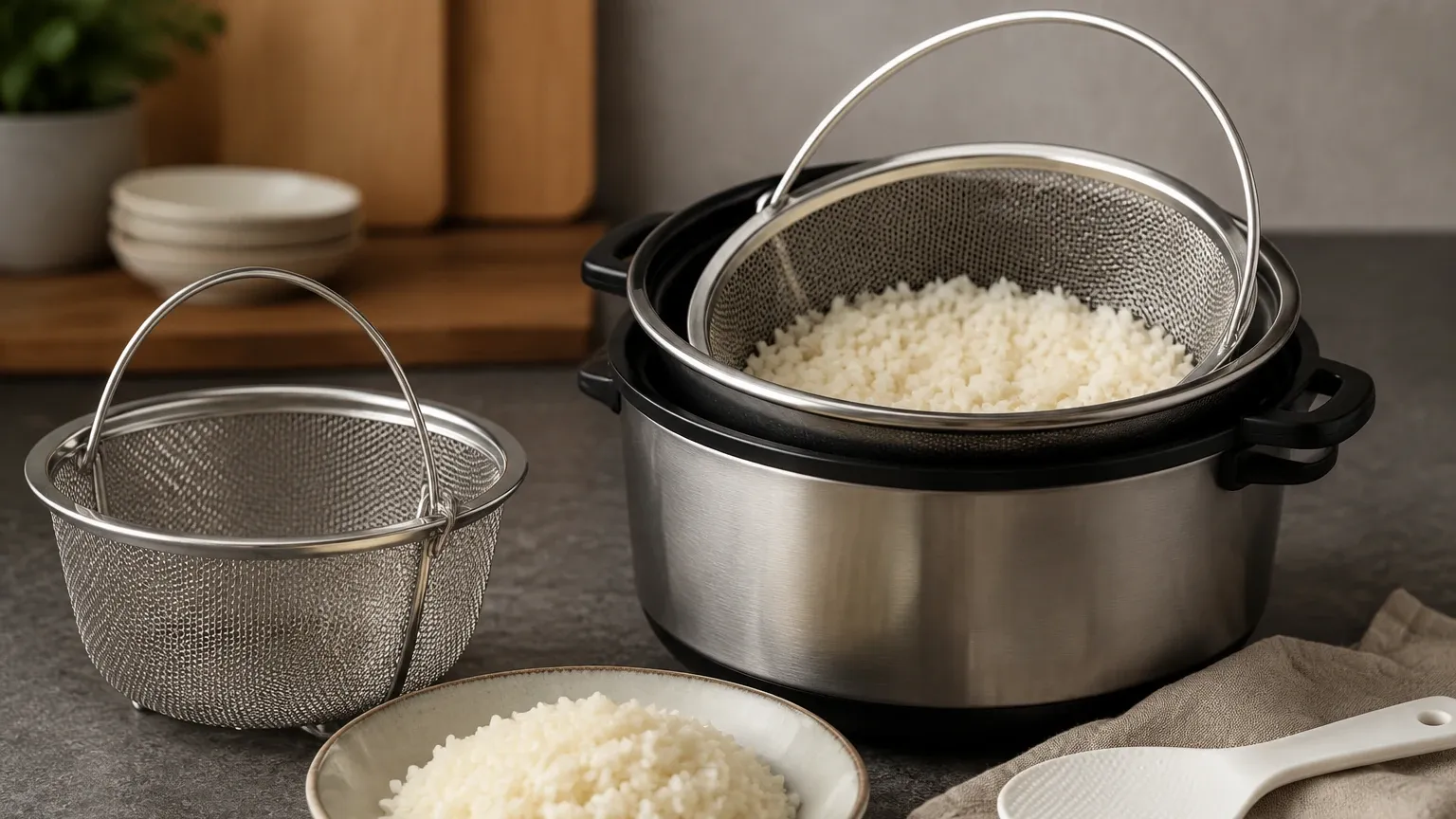
Woven wire mesh offers the highest percentage of open area, making it ideal for the inner lining of a strainer rice cooker where maximum steam flow is required. It is flexible and can be formed into complex basket shapes. However, for large-scale industrial use, wire mesh often requires a support frame or a secondary layer of coarser mesh to prevent sagging or tearing under load.
Perforated Metal
Perforated metal provides superior structural rigidity. In heavy-duty industrial rice cookers, the outer shell of the strainer basket is often constructed from perforated stainless steel. While the open area is typically lower than that of woven mesh, the durability is significantly higher. Modern CNC punching and laser cutting allow for precise hole patterns that can be customized to the specific flow requirements of the processing line.
Maintenance and Longevity of Filtration Components
The total cost of ownership for an industrial strainer rice cooker system is heavily influenced by the maintenance requirements and the replacement cycle of the filtration components. In a B2B environment, downtime is a significant expense, making durability a primary selection criterion.
Thermal Cycling and Stress Cracking
Industrial rice cookers operate by rapidly heating and cooling. This thermal cycling can cause expansion and contraction in the metal components. If the strainer basket is poorly designed or uses inferior materials, this can lead to stress cracking at the weld points. High-quality manufacturing processes, such as TIG (Tungsten Inert Gas) welding and proper annealing, are essential to ensure that the strainer can withstand thousands of cycles without failure.
Cleaning Protocols and Starch Build-up
Rice is high in starch, which becomes extremely adhesive when heated. Over time, starch can build up within the mesh of the strainer rice cooker, reducing flow rates and creating a potential breeding ground for bacteria. Industrial strainers must be designed to withstand high-pressure washing and caustic cleaning solutions. The use of high-grade stainless steel ensures that these harsh cleaning protocols do not lead to surface degradation or corrosion.
Customization Options for OEM Equipment Manufacturers
For manufacturers of industrial food processing equipment, off-the-shelf solutions are rarely sufficient. Every rice processing line has unique requirements based on the volume of production, the type of rice being processed, and the specific steam-injection technology used. Customization of Strainers & Baskets allows for optimized performance.
Tailored Geometry and Fittings
Custom strainer rice cooker components can be manufactured to fit specific vessel dimensions, including specialized flanges, handles, or reinforcement rings. This ensures a perfect seal within the cooking chamber, preventing steam bypass and ensuring uniform cooking of the entire batch.
Specialized Filtration Media
Depending on the process, an engineer might specify a combination of media. For example, a basket might feature a perforated metal base for strength and a fine wire mesh side wall for rapid lateral drainage. Advanced manufacturing techniques allow for the bonding of these different materials into a single, robust component.
Evaluating Total Cost and Performance Expectations
When purchasing industrial filtration components, the initial price is only one factor. Technical professionals must evaluate the performance expectations and the long-term reliability of the strainer rice cooker assembly.
Key evaluation criteria include:
1. Filtration Accuracy: Does the mesh size align with the smallest expected grain size to prevent yield loss?
2. Structural Integrity: Can the basket support the maximum batch weight without permanent deformation?
3. Regulatory Compliance: Does the manufacturer provide documentation for FDA or EU food contact compliance?
4. Ease of Integration: Are the tolerances of the custom fittings precise enough for rapid assembly in the OEM factory?
By focusing on these technical parameters, procurement teams can ensure they are investing in components that will enhance the efficiency of their food processing equipment and reduce the frequency of replacement.
Conclusion
The role of a strainer rice cooker in industrial settings is far more complex than its domestic counterpart. It is a precision-engineered component that must balance the competing demands of high drainage rates, grain retention, and structural durability. By selecting high-quality Strainers & Baskets made from premium stainless steel and designed with hygienic principles in mind, industrial food processors can achieve consistent results and long-term operational reliability. Whether for OEM integration or facility upgrades, understanding the engineering behind these components is essential for optimizing the large-scale preparation of rice and other grains.
