


Sink Drain Strainers
In industrial and commercial environments, the humble sink drain strainer is far more than a simple plumbing accessory. For facilities involved in food processing, pharmaceutical manufacturing, chemical handling, and large-scale laboratory operations, these components represent the first line of defense in maintaining system integrity and operational hygiene. High-performance sink drain strainers are engineered to prevent solid debris from entering wastewater systems, protecting downstream pumps, preventing costly pipe blockages, and ensuring compliance with environmental discharge regulations.
Selecting the appropriate filtration component requires an understanding of fluid dynamics, material compatibility, and the specific demands of the industrial environment. While standard consumer-grade options may suffice for residential use, industrial applications demand the durability and precision found in professional Strainers & Baskets. This guide explores the technical specifications, material considerations, and engineering factors that define high-quality industrial sink filtration.
The Role of High-Performance Strainers in Industrial Environments
Industrial sink drain strainers serve a critical dual purpose: equipment protection and process hygiene. In a commercial kitchen or a food production line, organic waste, fats, and solids can quickly accumulate in drainage systems. Without effective primary filtration at the source, these materials contribute to the formation of "fatbergs" or cause mechanical failure in grease interceptors and lift stations.
In chemical and pharmaceutical settings, the stakes are even higher. Strainers must not only capture solids but also withstand exposure to corrosive cleaning agents and high-temperature fluids. A failure in the strainer basket can lead to contaminated waste streams or the loss of valuable particulate matter that may need to be reclaimed or analyzed. Engineers often view these components as modular filtration units that must be integrated seamlessly into the broader facility infrastructure.
Material Science: Why Stainless Steel is the Standard
For industrial applications, the choice of material is non-negotiable. Stainless steel is the preferred medium for sink drain strainers due to its inherent resistance to corrosion, ease of sterilization, and mechanical strength. Kaifil specializes in manufacturing these components using high-grade alloys to meet specific environmental challenges.
Grade 304 Stainless Steel
Grade 304 is the most common material for general industrial and commercial use. It provides excellent resistance to oxidation and is highly durable against physical impact. In environments where the primary goal is capturing food waste or inert debris, 304 stainless steel offers a cost-effective balance of performance and longevity.
Grade 316 and 316L Stainless Steel
In more demanding environments, such as chemical processing plants or facilities using high-salinity fluids, Grade 316 stainless steel is required. The addition of molybdenum enhances its resistance to pitting and crevice corrosion, particularly in chloride-rich environments. Grade 316L (low carbon) is often specified for components that require extensive welding, as it minimizes the risk of intergranular corrosion at the weld sites.
Beyond corrosion resistance, stainless steel provides a non-porous surface that inhibits bacterial growth. This is critical in food and beverage applications where the "clean-in-place" (CIP) capability of a strainer basket can impact the overall sanitary rating of the facility.
Design Specifications: Perforated Metal vs. Wire Mesh
When specifying sink drain strainers, engineers must choose between different filtration media based on the size of the particles they need to capture and the required flow rate. The two primary designs involve perforated metal and woven wire mesh.
Perforated Metal Strainers
Perforated strainers are manufactured by punching holes into a sheet of stainless steel. These are exceptionally robust and can withstand significant mechanical stress without deforming. They are ideal for capturing larger debris, such as vegetable scraps, plastic fragments, or metal shavings. The hole size and pattern (staggered vs. straight) determine the open area ratio, which directly impacts the flow rate and pressure drop across the strainer.
Woven Wire Mesh Strainers
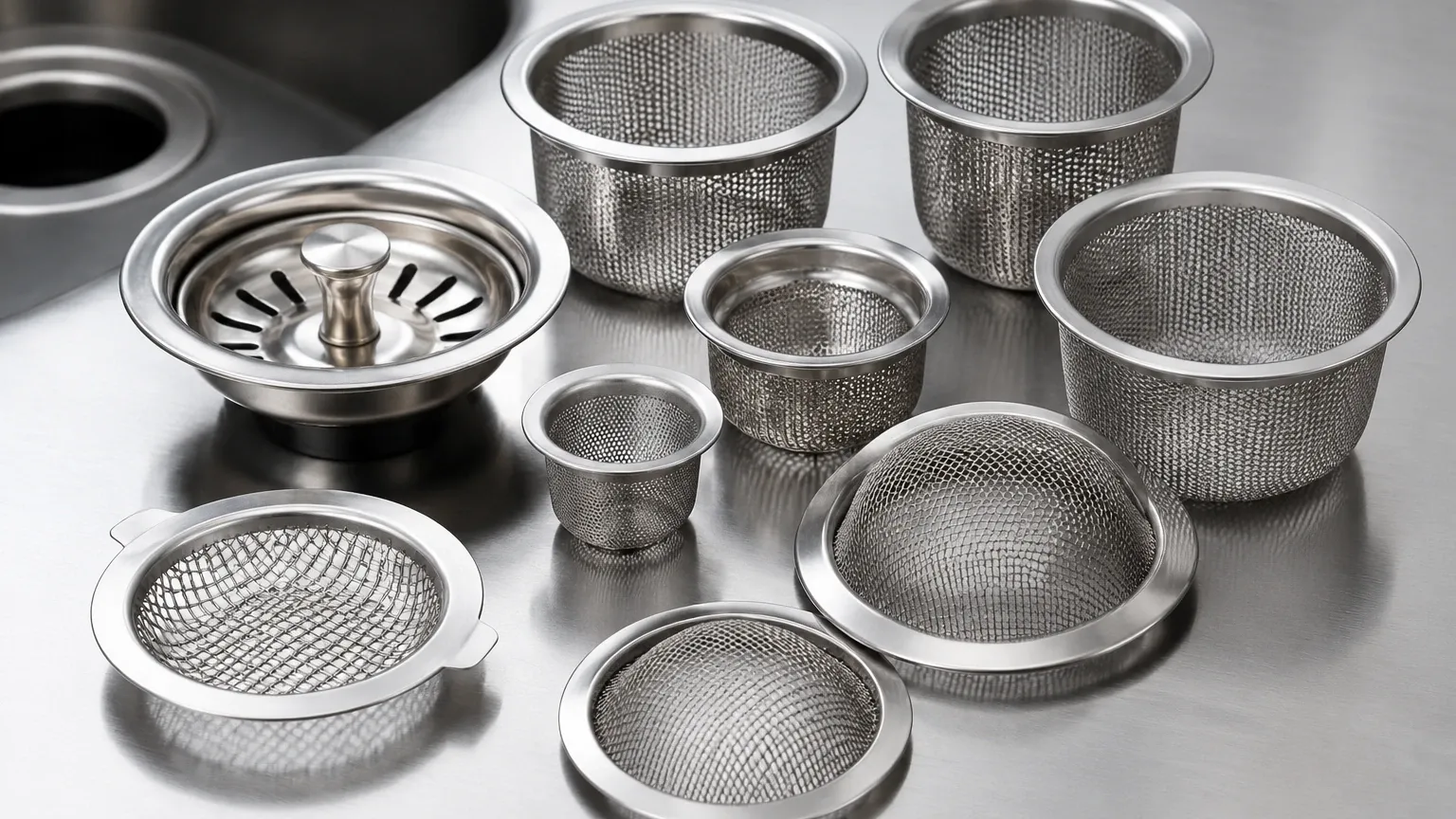
For applications requiring the capture of finer particulates, woven wire mesh is utilized. This allows for much smaller filtration ratings, often measured in microns. Wire mesh strainers are frequently used in laboratory sinks or specialized industrial washing stations where fine sediment must be removed from the effluent. In many heavy-duty designs, a wire mesh liner is supported by a perforated metal outer basket to combine fine filtration with structural rigidity.
Key Performance Metrics for Strainers & Baskets
Evaluating the effectiveness of a sink drain strainer involves more than checking its dimensions. Engineers must consider several technical metrics to ensure the component does not become a bottleneck in the system.
1. Open Area Ratio: This is the ratio of the total area of the holes to the total area of the strainer surface. A higher open area ratio allows for higher flow rates and a lower initial pressure drop. However, it must be balanced against the structural integrity of the basket.
2. Dirt Holding Capacity: The volume of the basket determines how much debris it can hold before the flow is significantly restricted. In high-volume industrial sinks, a deeper basket or a wide-flange design may be necessary to extend the time between cleaning cycles.
3. Flow Velocity and Turbulence: The design of the strainer should minimize turbulence, which can cause foaming in certain chemical applications or lead to the premature wear of the strainer material through erosion.
4. Sealing Integrity: For strainers that also function as stoppers, the quality of the seal (often made of EPDM, Viton, or Silicone) is paramount. The seal must be compatible with the chemicals and temperatures present in the waste stream.
For a comprehensive look at available configurations and technical data, engineers can Review product options and application support to match specific flow requirements with the right basket geometry.
Customization and OEM Solutions for Specialized Systems
Standard off-the-shelf sink strainers often fail to meet the unique requirements of specialized industrial equipment. Customization is a core strength of manufacturers like Kaifil, where filtration components are tailored to fit proprietary machine designs or non-standard drainage systems.
Dimensional Customization
Industrial sinks vary widely in drain diameter and depth. Custom-manufactured strainers ensure a precision fit, which is essential to prevent "bypass"—where debris escapes around the edges of the strainer because of a poor fit. Custom flange widths and basket depths can be engineered to integrate with existing plumbing without requiring expensive modifications.
Specialized Fittings and Handles
In many industrial processes, the ease of removal is a safety and efficiency concern. Custom strainers can be equipped with heavy-duty handles, locking mechanisms, or even integrated sensors to alert operators when a basket is full. For high-temperature applications, heat-resistant grips or specialized lifting tools may be incorporated into the design.
Multi-Stage Filtration
Some complex systems require multi-stage strainers, where a coarse outer basket captures large debris and a fine inner mesh captures smaller particles. This "staged" approach prevents the fine mesh from clogging prematurely and simplifies the cleaning process.
Maintenance Protocols and Longevity
The total cost of ownership (TCO) for industrial filtration components is heavily influenced by their maintenance requirements and service life. A cheap, poorly made strainer may save money upfront but can lead to significant costs in labor and plumbing repairs if it fails or clogs frequently.
Cleaning Procedures
Stainless steel strainers are designed for easy cleaning. In food-grade environments, they should be able to withstand high-pressure steam cleaning and caustic detergents. The design should avoid "dead zones" or sharp internal corners where organic material can collect and rot.
Inspection Cycles
Regular inspection is vital. Engineers should check for signs of "blinding" (permanent clogging of the mesh), mechanical deformation, or corrosion at the weld points. In high-vibration environments, such as sinks connected to industrial disposals or vibrating screens, the strainer's mounting hardware should also be checked for looseness.
Replacement Indicators
While a high-quality stainless steel strainer can last for years, it is a consumable item. Replacement should occur if the mesh becomes frayed, as loose wires can enter the pump system, or if the structural frame becomes warped, compromising the seal. Keeping a stock of replacement baskets ensures that operations are not halted due to a damaged filtration component.
Selection Criteria for Engineers and Purchasing Teams
When preparing to procure sink drain strainers for a facility-wide upgrade or a new installation, technical professionals should confirm the following details to ensure the correct specification:
* Chemical Compatibility: List all chemicals, including cleaning agents, that will pass through the drain. This determines whether 304 or 316 stainless steel is required.
* Temperature Range: Confirm the maximum temperature of the effluent. High temperatures may require specific grades of stainless steel or specialized gasket materials.
* Particle Size Distribution: Identify the smallest particle that must be captured. This dictates the mesh count or perforation size.
* Flow Rate Requirements: Ensure the strainer's open area can handle the peak flow of the system without causing backup.
* Regulatory Compliance: Determine if the component needs to meet specific standards, such as FDA, NSF, or 3-A Sanitary Standards for food and pharmaceutical applications.
By focusing on these technical parameters, purchasing teams can move beyond commodity-based buying and invest in filtration solutions that enhance the reliability and efficiency of their industrial operations. Whether for a single laboratory sink or a massive food processing line, the right strainer is a small but vital component in the engineering of a successful facility.
