


Types of Strainers
In industrial fluid handling systems, the protection of sensitive downstream equipment—such as pumps, valves, flow meters, and heat exchangers—is a critical engineering priority. Industrial strainers serve as the primary line of defense, removing solid particles from liquids or gases through a perforated metal or wire mesh screening element. Unlike fine filters, which often require frequent cartridge replacements, strainers are typically designed to remove larger debris and are engineered for durability and ease of cleaning.
Selecting the correct equipment requires a deep understanding of the various types of strainers available and how their mechanical designs interact with system flow, pressure, and maintenance requirements. This guide examines the technical specifications and application contexts for the most common industrial strainer configurations.
Understanding Industrial Strainers: Function and Classification
A strainer is a closed vessel with a cleanable screen element designed to remove and retain foreign particles. While the terms "filter" and "strainer" are sometimes used interchangeably, the industry generally distinguishes them by the size of the particles removed. Strainers typically handle particles visible to the naked eye (approximately 40 microns and larger), whereas filters address microscopic contaminants.
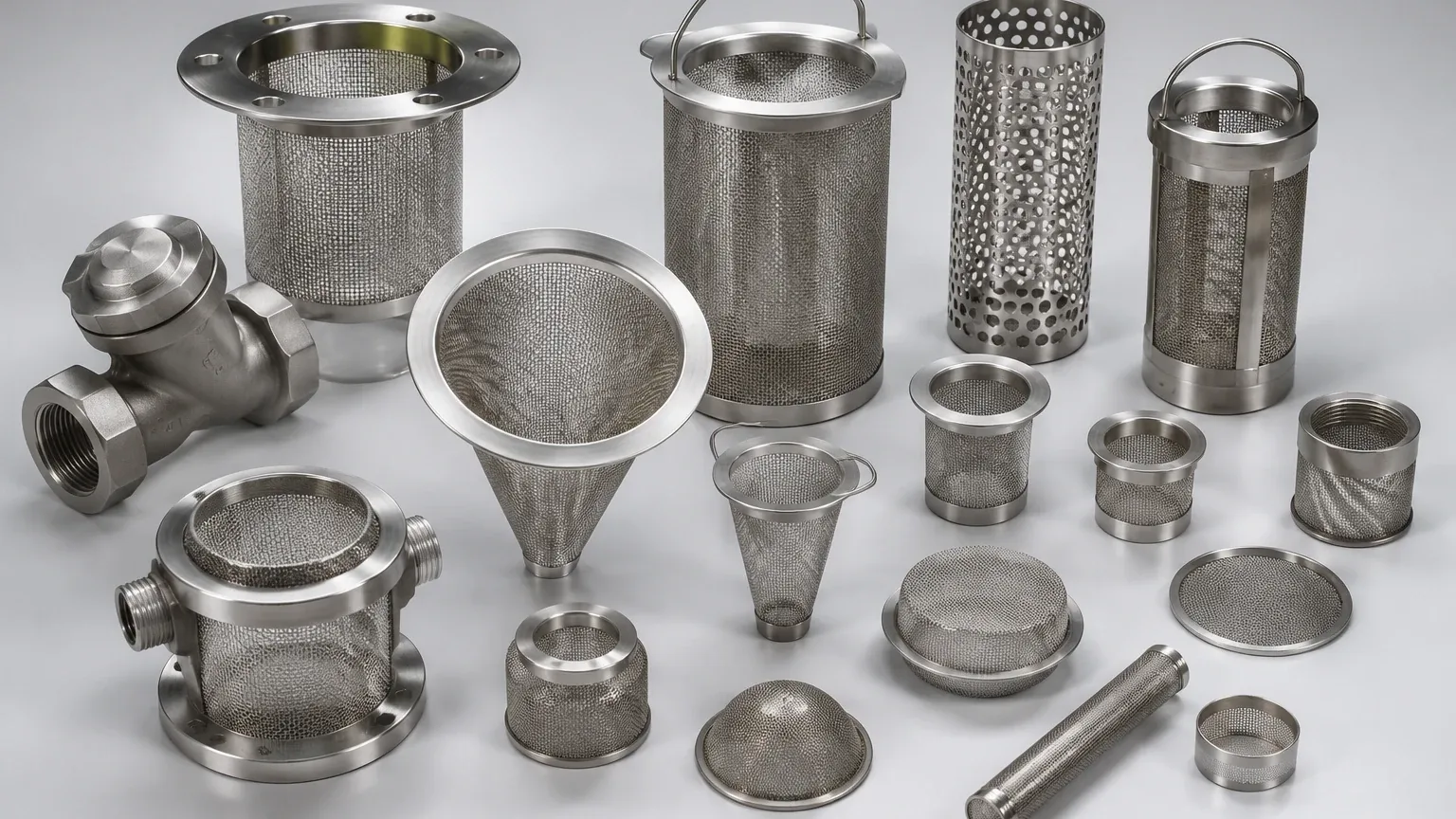
The effectiveness of Strainers & Baskets depends on the open area ratio (OAR), the material of construction, and the internal geometry. Engineers must balance the need for high-capacity debris retention with the allowable pressure drop across the unit.
Primary Types of Strainers by Design
Industrial strainers are categorized primarily by their body shape and the orientation of the flow path. Each design offers specific advantages regarding installation space, pressure rating, and debris capacity.
Y-Type Strainers
The Y-strainer is perhaps the most common configuration in industrial piping. Named for its "Y" shape, it features a straining leg that intersects the main flow line at an angle.
* Application: Y-strainers are ideally suited for high-pressure systems, including steam, gas, and liquid lines where the amount of debris is relatively low.
* Installation: They can be installed in either horizontal or vertical (downward flow) positions. This flexibility makes them a staple in compact piping layouts.
* Engineering Advantage: Because of their compact size, they are often more cost-effective for high-pressure applications (up to ASME Class 2500). However, they have a smaller dirt-holding capacity compared to basket-style designs.
T-Type Strainers
T-type or "Bathtub" strainers feature a body shaped like a "T" relative to the pipeline. These are often used in larger pipe sizes where a Y-strainer would be too heavy or difficult to maintain.
* Application: Commonly used in suction lines for pumps and in applications requiring high flow rates.
* Engineering Advantage: T-strainers offer a straight-through flow path, which can result in lower pressure drops. They also allow for easier access to the screen element via a top-opening cover, which is often preferred in large-diameter piping (6 inches and above).
Basket Strainers and Their Variations
Basket strainers, also known as pot strainers, utilize a vertical cylinder (the basket) to capture debris. These are generally used in liquid applications where the concentration of solids is higher, as the basket design provides a larger surface area for accumulation.
Simplex Basket Strainers
A simplex strainer consists of a single basket chamber. To clean or replace the basket, the flow must be shut down and the system depressurized.
* Usage: Best for batch processes or systems where a temporary shutdown for maintenance does not impact overall plant productivity.
* Design Considerations: Engineers often specify simplex strainers with quick-opening covers (such as swing bolts) to minimize downtime during the cleaning cycle.
Duplex (Twin) Basket Strainers
For continuous-flow applications where the system cannot be shut down, duplex strainers are the standard. These units consist of two separate basket chambers connected by a diverter valve (either a plug valve or a sliding gate).
* Operational Flow: When one basket becomes clogged, the operator shifts the valve to divert flow to the clean chamber. The dirty basket can then be removed, cleaned, and replaced while the system remains online.
* Critical Sectors: Common in chemical processing, oil and gas, and power generation where process continuity is vital.
Temporary and Specialty Strainers
Not all filtration needs are permanent. During the commissioning of a new plant or after major repairs, piping systems often contain construction debris like welding slag, rust, or tools.
Conical and Basket Temporary Strainers
Often referred to as "Witch’s Hats" (conical) or "Top Hats" (basket), these are designed to be sandwiched between two pipe flanges.
* Function: They provide high-velocity protection during the initial startup phase. Once the system is flushed clean, these strainers are typically removed.
* Risk Management: While cost-effective, they lack a housing, meaning the pipe must be disassembled to check or clean the screen. If left in place too long, they can collapse under the weight of accumulated debris, potentially damaging downstream equipment.
Automatic Self-Cleaning Strainers
In high-volume applications with heavy debris loading, manual cleaning becomes impractical. Automatic strainers use a motorized cleaning arm or a backwash mechanism to clear the screen without interrupting flow. These are frequently found in raw water intake and cooling tower applications.
Material Selection and Engineering Specifications
The performance of different types of strainers is heavily influenced by the materials used for the body and the internal screen.
Body Materials
* Carbon Steel: Standard for oil and gas applications where corrosion is not a primary concern.
* Stainless Steel (304/316): Essential for food and beverage, pharmaceutical, and chemical industries. Stainless steel provides superior corrosion resistance and prevents metallic contamination of the process fluid.
* Specialty Alloys: For highly corrosive environments, materials like Duplex stainless steel or Hastelloy may be required.
The Straining Element (The Mesh)
The internal element is usually a two-stage construction: a heavy-duty perforated metal sheet that provides structural integrity, lined with a fine wire mesh that determines the filtration accuracy.
* Perforation Size: Usually ranges from 1/32" to 1/2".
* Mesh Count: Refers to the number of openings per linear inch. A higher mesh count indicates finer filtration.
* Micron Rating: Engineers must specify the micron rating based on the smallest particle that could damage downstream components.
Key Selection Criteria for Engineering and Procurement
When evaluating which types of strainers to integrate into a system, technical teams should confirm the following parameters:
1. Open Area Ratio (OAR): This is the ratio of the total area of the holes in the screen to the cross-sectional area of the inlet pipe. An OAR of 4:1 is often considered a standard for general liquid service, ensuring that the strainer does not become a bottleneck.
2. Pressure Drop ($ΔP$): Every strainer introduces a pressure drop. Engineers must calculate the "clean" pressure drop and determine the "dirty" pressure drop limit at which the screen must be cleaned. High $ΔP$ can lead to pump cavitation or reduced flow rates.
3. Viscosity of the Fluid: High-viscosity liquids (like heavy oils or syrups) require larger screen surface areas and coarser mesh to maintain flow, as they pass through small openings with greater resistance.
4. Nature of Contaminants: Are the solids hard and angular, or soft and fibrous? Fibrous debris can "staple" itself into wire mesh, making cleaning difficult and potentially requiring a perforated plate instead of a mesh lining.
Maintenance and Operational Considerations
The total cost of ownership (TCO) for a strainer is not just the purchase price; it includes the labor and downtime associated with maintenance.
* Differential Pressure Gauges: Installing DP gauges across the strainer is the most effective way to monitor performance. These gauges provide a clear signal to operators when the basket or screen is nearing capacity.
* Blow-off Connections: Many Y-strainers and some basket strainers include a blow-off port in the cover. This allows for the removal of loose debris using system pressure without opening the housing, extending the interval between manual cleanings.
* Seal Integrity: For hazardous or high-temperature fluids, the choice of gasket or O-ring material (Viton, EPDM, PTFE) is critical to prevent leaks during thermal cycling or chemical exposure.
Conclusion
Selecting from the various types of strainers requires a balance of mechanical constraints, fluid dynamics, and operational goals. Whether utilizing a Y-strainer for high-pressure steam or a duplex basket strainer for continuous chemical processing, the primary objective remains the protection of the system's most valuable components. By specifying the correct geometry, material, and micron rating, engineers can ensure long-term reliability and optimized flow performance across any industrial application.
