


Titan Basket Strainers
In industrial fluid handling, the protection of downstream equipment—such as pumps, valves, and heat exchangers—is a primary engineering concern. Debris, scale, and particulate matter can cause catastrophic mechanical failure or significantly reduce the efficiency of a system. Among the most reliable solutions for large-capacity filtration are basket strainers. Specifically, titan basket strainers have become a benchmark in the industry for their robust construction and ability to handle high flow rates with minimal pressure loss.
For engineers and procurement teams, selecting the right strainer involves more than just matching pipe sizes. It requires a deep dive into material compatibility, filtration surface area, and the specific hydraulic demands of the application. This guide examines the technical nuances of basket strainers, focusing on the performance expectations and selection criteria essential for industrial operations.
Engineering Fundamentals of Basket Strainers
Unlike Y-strainers, which are typically used for smaller amounts of debris or in steam applications, basket strainers are designed for systems where high concentrations of solids are expected. The "basket" design allows for a much larger holding capacity, which translates to longer run times between cleaning cycles.
Simplex vs. Duplex Configurations
The most common titan basket strainers are simplex strainers. These are used in batch processes where the system can be shut down temporarily to remove and clean the basket. However, in continuous flow operations where downtime is not an option, duplex (or twin) basket strainers are utilized. These units feature two separate basket chambers connected by a diverter valve, allowing the operator to switch flow to a clean chamber while the other is serviced.
Flow Dynamics and Pressure Drop
A critical factor in strainer selection is the pressure drop (ΔP). Every strainer introduces a restriction in the line. As the basket collects debris, the open area decreases, and the pressure drop increases. Engineers must calculate the clean pressure drop using the flow coefficient (Cv) provided by the manufacturer. If the initial pressure drop is too high, it may indicate that the strainer body is undersized for the required flow rate or that the mesh size is unnecessarily fine for the application.
Technical Specifications of Titan Basket Strainers
Titan basket strainers are engineered to meet stringent industrial standards, including ASME B16.5 and B16.34. These standards ensure that the pressure-retaining components can withstand the rated temperatures and pressures of the piping system.
Pressure Ratings and End Connections
Most industrial basket strainers are available in various pressure classes, typically ranging from Class 125 to Class 2500. The choice of end connection—whether flanged, threaded, or socket weld—depends on the piping material and the ease of maintenance required. Flanged connections are standard for larger titan basket strainers because they allow for easier removal of the entire unit if deep cleaning or inspection of the internal housing is necessary.
The Importance of the Open Area Ratio (OAR)
The efficiency of a strainer is often measured by its Open Area Ratio. This is the ratio of the total open area of the strainer basket to the internal cross-sectional area of the inlet pipe. A high OAR (typically 6:1 or higher) ensures that the strainer can accumulate a significant amount of debris before the pressure drop becomes critical. This is a hallmark of well-engineered Strainers & Baskets, providing a buffer that protects the system during unexpected surges of particulate matter.
Material Selection for Corrosive and High-Temperature Environments
The longevity of a basket strainer is dictated by its material of construction. While cast iron and ductile iron are suitable for non-corrosive water services, chemical processing and pharmaceutical applications demand higher-grade alloys.
1. Carbon Steel (WCB): Ideal for oil and gas applications where high strength is required but corrosion is not a primary concern.
2. Stainless Steel (304/316): These materials offer excellent resistance to corrosion and are the standard for food, beverage, and chemical industries. Stainless steel baskets are also more resistant to erosion caused by high-velocity fluid flow.
3. Specialty Alloys: For highly aggressive media, materials like Hastelloy, Monel, or Titanium may be required. These are often used in seawater applications or concentrated acid lines.
Beyond the body material, the seal and gasket materials (Buna-N, EPDM, Viton, or PTFE) must be checked for chemical compatibility and temperature limits. A failure in the cover gasket can lead to hazardous leaks or system depressurization.
Sizing the Filtration Media: Mesh vs. Perforation
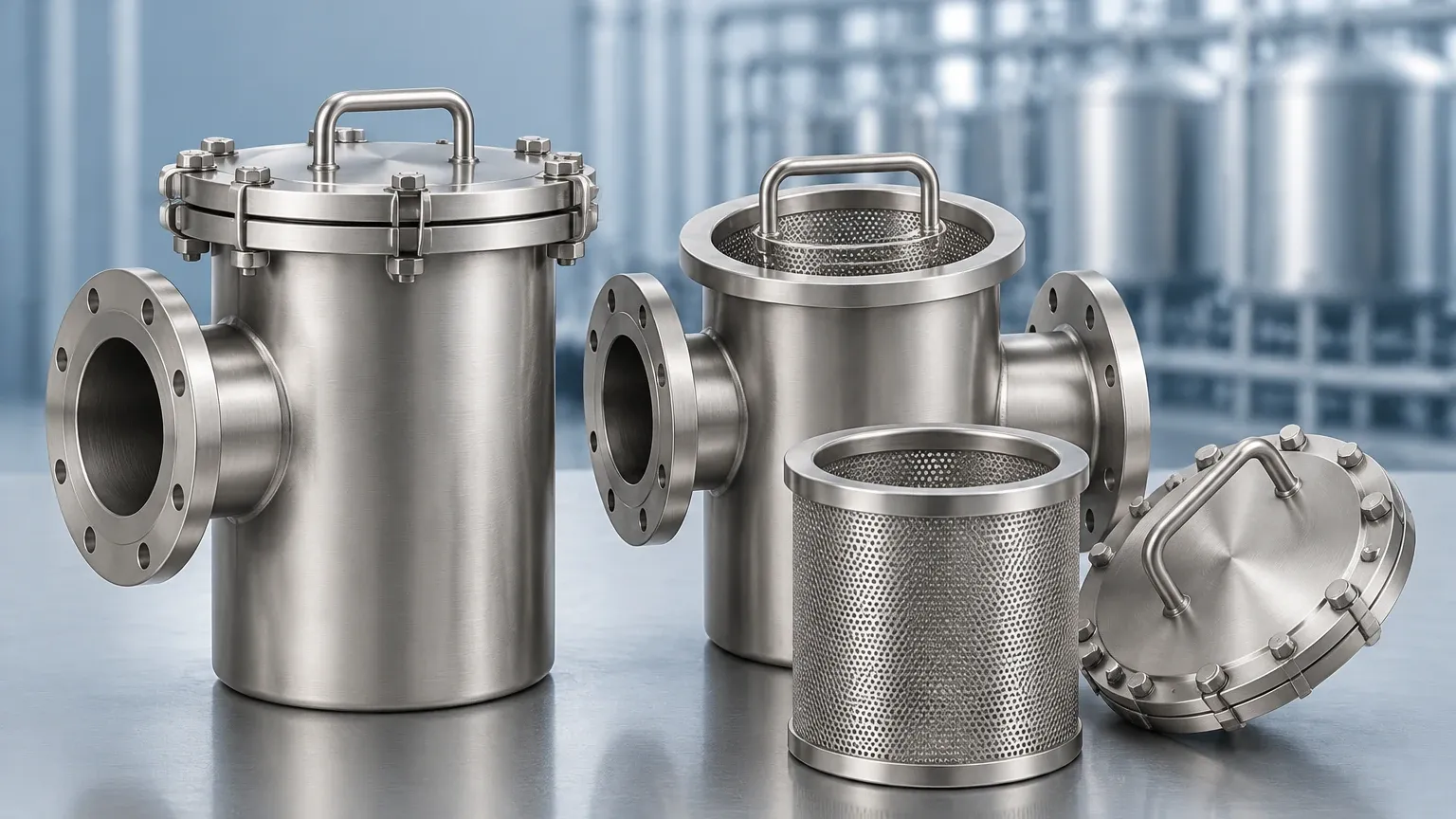
The internal basket is the heart of the strainer. It typically consists of a perforated metal sheet which may be lined with a finer wire mesh.
Perforated Plate
Perforated plates are used for removing larger particles (usually 1/32" to 1/2"). They provide the structural integrity of the basket. Common hole patterns include staggered or straight rows, with staggered patterns generally offering more open area.
Wire Mesh Linings
When finer filtration is required, a stainless steel wire mesh is spot-welded or mechanically fastened to the inside of the perforated basket. Mesh sizes are defined by the number of openings per linear inch. For example, a 100-mesh screen has 100 openings per inch and can capture particles down to approximately 140 microns.
Engineers must balance the desire for "clean" fluid with the reality of maintenance. Selecting a mesh that is too fine will lead to rapid clogging and frequent downtime. The general rule is to select a mesh size that is slightly smaller than the smallest particle that could damage the downstream equipment.
Maintenance Protocols and Component Replacement
To ensure the reliable operation of titan basket strainers, a proactive maintenance schedule is required. The most effective way to monitor a strainer's condition is through the installation of differential pressure gauges across the inlet and outlet.
Cleaning Cycles
When the differential pressure reaches a predetermined limit (usually 5-10 psi above the clean pressure drop), the basket should be cleaned.
* Venting: Before opening the cover, the internal pressure must be vented.
* Draining: The drain plug at the bottom of the strainer body should be opened to remove the fluid from the chamber.
* Inspection: Once the basket is removed, it should be inspected for signs of mechanical fatigue, such as broken welds or distorted mesh. A damaged basket allows bypass, rendering the strainer useless.
Spare Parts Management
For critical systems, it is recommended to keep a spare basket and a set of cover gaskets on-site. This minimizes the time the system is offline. Because baskets are subject to high differential pressures when clogged, they can eventually collapse if not serviced promptly. Custom-manufactured stainless steel baskets can often be engineered to provide higher structural strength than standard OEM replacements.
Custom Engineering for Specialized Filtration Requirements
While standard titan basket strainers meet the needs of many general industrial applications, certain processes require customized solutions. Factors that may necessitate a custom-engineered strainer include:
* Non-Standard Dimensions: When a strainer must fit into an existing piping footprint with specific face-to-face dimensions.
* High Solids Loading: Applications involving heavy sludge or fibrous materials may require specialized basket geometries or self-cleaning mechanisms.
* Extreme Pressure/Temperature: Systems operating outside the standard ASME class ratings require custom wall thicknesses and specialized welding procedures.
* Specific Micron Ratings: When standard mesh sizes do not provide the required filtration efficiency, multi-layered sintered wire mesh baskets can provide precise filtration down to the single-micron level while maintaining high flow rates.
Custom manufacturers like Kaifil specialize in these high-performance components, providing the engineering support necessary to bridge the gap between standard catalog items and the specific needs of a complex industrial facility. By focusing on the structural integrity of the wire mesh and the precision of the fit within the strainer housing, custom baskets can extend the life of the entire filtration system.
Conclusion: Making an Informed Selection
Selecting titan basket strainers requires a comprehensive understanding of the fluid properties, flow conditions, and the sensitivity of downstream components. By evaluating the Open Area Ratio, material compatibility, and the trade-offs between filtration fineness and maintenance frequency, engineers can ensure system reliability.
Whether opting for a standard simplex unit or a complex duplex system, the goal remains the same: efficient removal of contaminants with minimal impact on system hydraulics. For those dealing with unique challenges or requiring high-durability stainless steel components, consulting with a manufacturer experienced in custom filtration solutions is the most effective path toward optimized performance.
