


Strainer Unit
In industrial fluid handling systems, the protection of downstream equipment is a primary engineering concern. A strainer unit serves as a mechanical line of defense, designed to remove coarse particles, debris, and contaminants from liquid or gas streams. Unlike fine filtration systems that target sub-micron particles, industrial strainers are typically utilized to protect pumps, valves, meters, and heat exchangers from damage or clogging caused by larger solids. Selecting the correct strainer unit requires a deep understanding of fluid dynamics, material compatibility, and the specific mechanical requirements of the application.
As a professional manufacturer, Kaifil specializes in providing high-performance Strainers & Baskets engineered for demanding environments. This guide explores the technical considerations, design variations, and selection criteria essential for engineers and procurement teams when integrating a strainer unit into an industrial process.
The Role of a Strainer Unit in Industrial Piping
The primary function of an industrial strainer unit is the removal of unwanted solids via a perforated plate or wire mesh medium. While the terms "filter" and "strainer" are often used interchangeably, in a technical context, a strainer is usually defined by its ability to be cleaned and reused, and its focus on larger particle sizes (typically 40 microns and above).
In a typical piping circuit, the strainer unit is installed upstream of sensitive components. For example, in a pumping system, a suction strainer prevents large debris from entering the pump casing, which could otherwise lead to impeller damage or mechanical seal failure. In steam systems, Y-strainers are frequently used to protect steam traps and control valves from pipe scale and rust. The reliability of these systems depends heavily on the structural integrity of the strainer basket and the efficiency of the housing design.
Technical Components of a Strainer Unit
A standard industrial strainer unit consists of several critical components, each contributing to its overall performance and service life:
1. Strainer Housing: The pressure vessel that contains the fluid and the straining element. It must be rated for the maximum operating pressure and temperature of the system.
2. Straining Element (Basket or Screen): The core component, usually made of stainless steel wire mesh or perforated metal. This element determines the filtration accuracy.
3. Seals and Gaskets: These prevent bypass leakage and external leaks. Material selection (such as EPDM, Viton, or PTFE) is critical for chemical compatibility.
4. Cover/Closure: The access point for cleaning the element. Designs range from bolted covers for high-pressure applications to quick-opening swing bolts for systems requiring frequent maintenance.
5. Blow-down or Drain Port: Allows for the removal of accumulated sediment without fully dismantling the unit.
Engineering Criteria for Selection
Selecting a strainer unit is not merely a matter of matching pipe sizes. Engineers must evaluate several variables to ensure the unit does not become a bottleneck or a point of failure.
Flow Rate and Pressure Drop (Delta P)
Every strainer unit introduces a degree of resistance to the flow, resulting in a pressure drop. This is measured as the difference between the inlet and outlet pressure. An excessive pressure drop can lead to cavitation in pumps or reduced system efficiency. Engineers use the Flow Coefficient (Cv) to calculate the expected pressure drop at a given flow rate.
A key metric in design is the "Open Area Ratio" (OAR). This is the ratio of the total open area of the strainer element to the internal cross-sectional area of the inlet pipe. For most industrial applications, an OAR of at least 6:1 is recommended to ensure a low initial pressure drop and to provide sufficient dirt-holding capacity before cleaning is required.
Filtration Accuracy: Mesh vs. Perforation
The level of protection required determines the choice of the straining medium. Perforated metals are typically used for coarser straining (1/32" to 1/4" holes), providing high structural strength. For finer requirements, a stainless steel wire mesh is layered over a perforated metal support basket.
When specifying a strainer unit, it is vital to distinguish between "nominal" and "absolute" ratings. Most strainers are rated nominally, meaning they will stop a high percentage of particles of a certain size, but not necessarily 100%. If the application involves sensitive instrumentation, a finer mesh with a reinforced basket design may be necessary to prevent bypass.
Material Selection and Corrosion Resistance
The longevity of a strainer unit is dictated by its material of construction. Stainless steel is the industry standard for high-performance applications due to its mechanical strength and resistance to corrosion.
* Grade 304 Stainless Steel: Suitable for general industrial use, water treatment, and mildly corrosive environments. It offers excellent cost-to-performance value.
* Grade 316/316L Stainless Steel: Preferred for chemical processing, pharmaceutical, and marine applications. The addition of molybdenum enhances resistance to pitting and crevice corrosion, particularly in chloride-rich environments. 316L (low carbon) is often specified for applications involving welding to prevent intergranular corrosion.
* Specialty Alloys: For highly aggressive media or extreme temperatures, alloys such as Monel, Hastelloy, or Duplex stainless steel may be required.
Kaifil focuses on high-quality stainless steel fabrication, ensuring that the internal baskets and the external housings can withstand the thermal and chemical stresses of industrial operations.
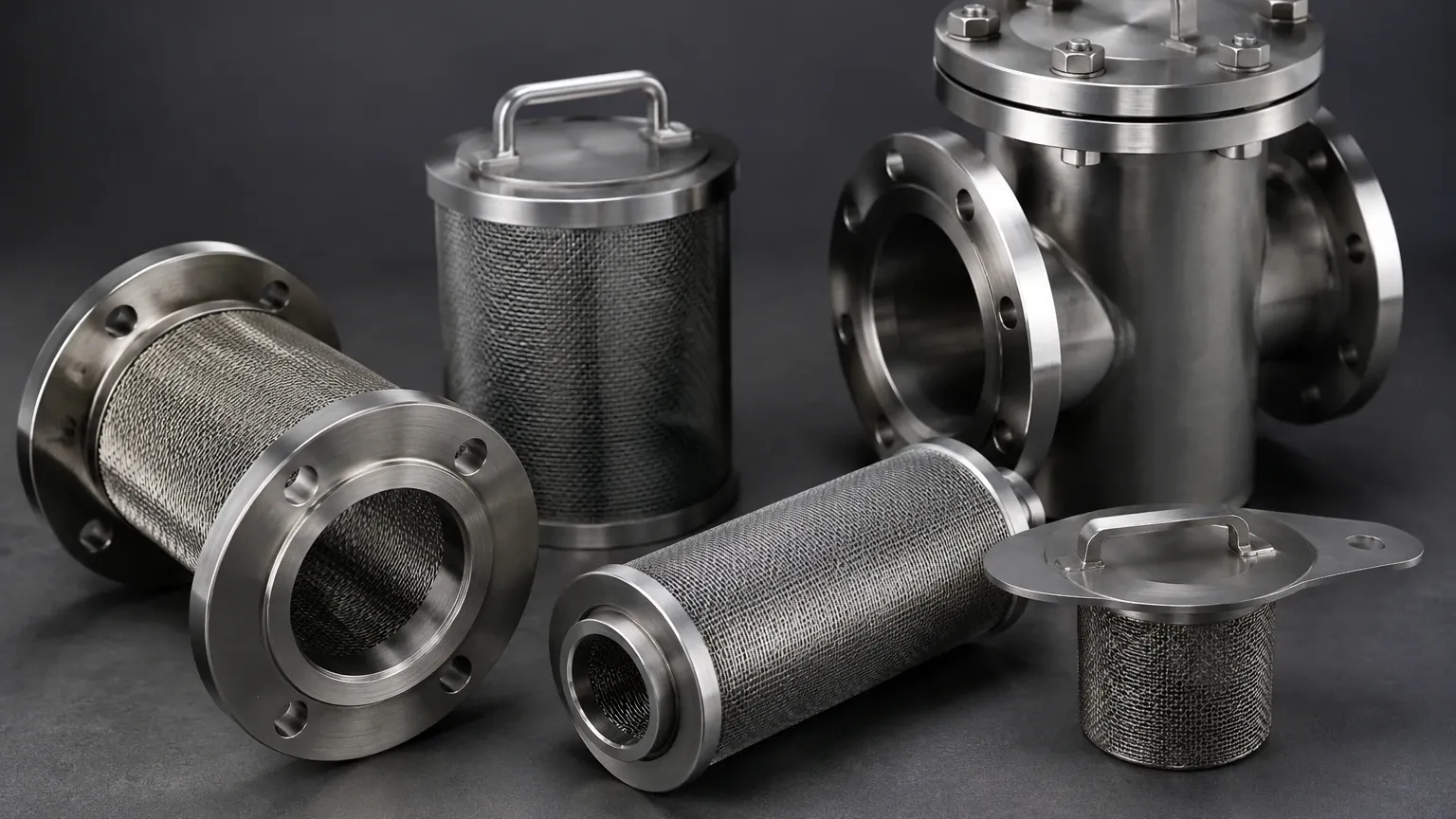
Common Types of Strainer Units
Depending on the installation space and the need for continuous operation, different configurations of a strainer unit are available.
Y-Strainers
Named for their shape, Y-strainers are compact and primarily used for gas or steam lines where the amount of debris is relatively low. They can be installed horizontally or vertically (downward flow). Their main advantage is their high pressure rating and space-saving design, though they typically have a smaller dirt-holding capacity than basket types.
Basket (Simplex) Strainers
Basket strainers feature a vertical chamber that houses a large, removable basket. This design allows for a much higher OAR and greater debris storage. They are the standard choice for liquid applications where the system can be temporarily shut down to remove the basket for cleaning.
Duplex Strainers
A duplex strainer unit consists of two separate strainer chambers connected by a diverter valve. This configuration is essential for critical processes that cannot be interrupted. When one basket becomes clogged, the flow is diverted to the clean chamber, allowing the operator to service the first basket without stopping the flow. This is common in lubrication systems, fuel lines, and continuous chemical production.
Operational Maintenance and Cleaning Cycles
The total cost of ownership for a strainer unit is often determined by its maintenance requirements. A common error in industrial settings is waiting for the flow to stop before cleaning the strainer. This can lead to the structural collapse of the basket due to the high differential pressure.
Monitoring Differential Pressure
It is highly recommended to install differential pressure (DP) gauges across the inlet and outlet of the strainer unit. Typically, a clean strainer will show a DP of 1-2 psi. When the DP reaches 10-15 psi, the basket should be cleaned. Automated systems can use DP switches to trigger an alarm or initiate a backwash cycle in self-cleaning models.
Cleaning Protocols
For manual strainers, the cleaning process involves isolating the unit, venting the pressure, and removing the basket. Stainless steel baskets should be cleaned using appropriate methods—such as ultrasonic cleaning, high-pressure water jets, or chemical baths—depending on the nature of the contaminant. Abrasive mechanical scrubbing should be avoided as it can damage the fine wire mesh and alter the filtration rating.
Customization and OEM Solutions
Standard off-the-shelf strainers may not meet the specific spatial or performance requirements of complex industrial plants. Customization is often necessary to optimize the strainer unit for a specific application. Engineering teams should consider the following customization options:
* Custom Dimensions: Tailoring the inlet/outlet orientation and face-to-face dimensions to fit existing piping.
* Reinforced Baskets: Adding internal supports or outer shrouds to baskets to handle high-viscosity fluids or high-pressure surges.
* Specialized Coatings: Applying PTFE or other linings for extreme chemical resistance.
* Magnetic Inserts: Adding magnetic rods within the basket to capture fine iron and steel particles that might otherwise pass through the mesh.
Kaifil provides extensive OEM capabilities, working directly with engineers to develop bespoke Strainers & Baskets that meet precise filtration accuracies and mechanical specifications.
Conclusion
A well-engineered strainer unit is vital for the reliability and efficiency of industrial fluid systems. By carefully considering flow rates, pressure drops, and material compatibility, and by implementing a proactive maintenance schedule, facilities can significantly reduce downtime and protect expensive downstream assets. Whether the application requires a simple Y-strainer for steam lines or a complex duplex system for chemical processing, selecting a high-quality stainless steel solution ensures long-term performance in demanding environments.
