


Using Wire Strainers
In industrial fluid handling, the integrity of downstream equipment—such as pumps, flow meters, heat exchangers, and spray nozzles—depends heavily on the effective removal of unwanted solids from the process stream. Industrial Strainers & Baskets serve as the primary mechanical barrier against debris, scale, and particulate matter. Unlike fine filtration systems designed to remove microscopic contaminants, strainers are typically utilized for coarser separation, protecting high-value assets from catastrophic failure or accelerated wear.
Selecting and using wire strainers effectively requires an understanding of fluid dynamics, material science, and mechanical engineering. This guide examines the technical considerations essential for engineers and procurement teams when integrating these components into complex industrial systems.
Understanding the Role of Strainers & Baskets in Industrial Systems
While the terms "filter" and "strainer" are sometimes used interchangeably, they serve distinct roles in a process pipeline. A strainer is generally defined as a device that removes larger particles from a liquid or gas, often utilizing a reusable wire mesh or perforated metal screen. The primary objective is not necessarily to achieve high-purity fluid, but to ensure that the particle size remaining in the stream does not exceed the tolerances of downstream components.
When using wire strainers, the choice of configuration—whether Y-strainers, T-strainers, or basket strainers—depends on the piping layout and the frequency of cleaning required. Basket strainers, in particular, are favored in applications where high flow rates and high solids loading are common. Their larger surface area compared to Y-strainers allows for greater dirt-holding capacity and longer intervals between maintenance cycles.
Engineering Specifications: Material Selection and Mesh Geometry
The performance of a strainer is dictated by its construction materials and the geometry of the straining element. In industrial environments involving corrosive chemicals, high temperatures, or hygienic requirements, stainless steel is the standard material of choice.
Material Grades
* Stainless Steel 304: Suitable for general-purpose applications, providing excellent strength and basic corrosion resistance. It is commonly used in water treatment and standard industrial cooling systems.
* Stainless Steel 316/316L: Contains molybdenum, which significantly enhances resistance to chloride-induced pitting and stress corrosion cracking. This is the preferred material for chemical processing, marine environments, and pharmaceutical applications.
* Specialty Alloys: For extreme environments involving highly acidic or alkaline fluids, materials such as Monel, Hastelloy, or Duplex stainless steel may be required to prevent premature mechanical failure.
Mesh vs. Perforation
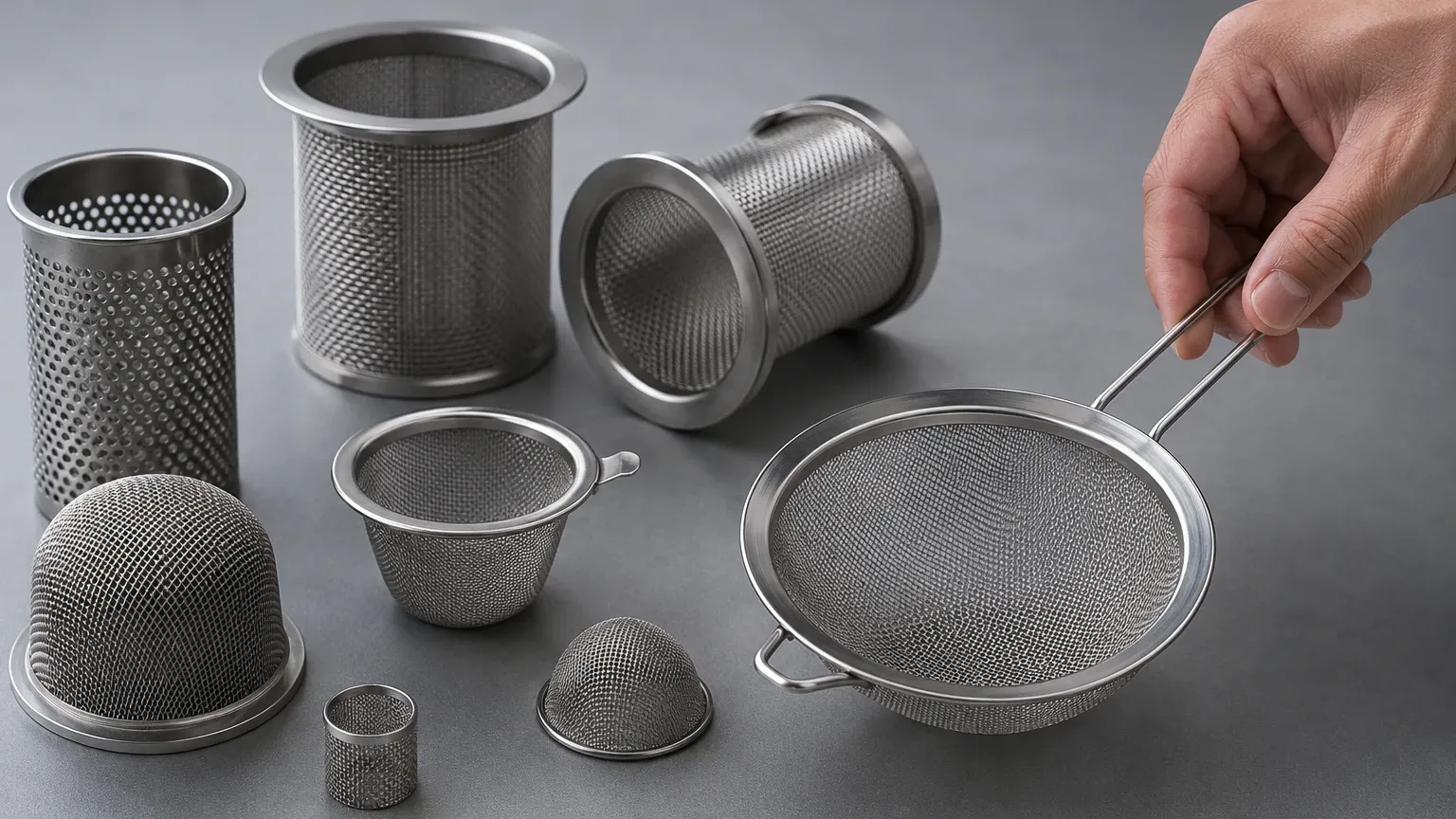
The straining element can be constructed from perforated plate or woven wire mesh. Perforated plates provide high structural rigidity and are ideal for removing large debris. However, when finer retention is required (typically below 200 microns), a wire mesh lining is added to the perforated basket. When using wire strainers with mesh linings, engineers must account for the "open area ratio." A higher open area reduces the initial pressure drop but may compromise the mechanical strength of the mesh if not properly supported by a heavier backup cylinder.
Key Performance Indicators: Flow Rate and Pressure Drop
One of the most critical factors in using wire strainers is the calculation of the clean pressure drop ($ΔP$). Every component in a piping system introduces resistance to flow. If the strainer is undersized, it can cause significant energy loss, cavitation in pumps, and reduced system efficiency.
Factors Influencing Pressure Drop:
1. Fluid Viscosity: Higher viscosity fluids (such as heavy oils or syrups) require larger mesh openings or increased surface area to maintain flow without excessive pressure buildup.
2. Solids Loading: The concentration of contaminants determines how quickly the $ΔP$ will increase during operation. In systems with high solids loading, duplex strainers are often employed to allow for continuous operation while one basket is being cleaned.
3. Velocity: Fluid velocity should generally be kept within 5 to 10 feet per second for liquid applications to minimize turbulence and erosion of the strainer element.
Engineers should specify the maximum allowable pressure drop before cleaning is required. Typically, a strainer should be cleaned or replaced when the pressure differential reaches 5 to 10 psi above the clean state. Failure to monitor this can lead to the collapse of the basket or the forcing of contaminants through the mesh.
Operational Guidelines for Using Wire Strainers
Proper installation and routine maintenance are essential to the longevity of the filtration system. When using wire strainers, several operational best practices should be followed to ensure consistent performance.
Installation Orientation
Strainers must be installed in the correct orientation relative to the flow direction, usually indicated by an arrow on the housing. For basket strainers, sufficient clearance must be provided above or beside the unit to allow for the removal of the basket. In horizontal lines, Y-strainers should have their "leg" pointing downward to trap debris effectively without obstructing the main flow path.
Monitoring and Maintenance
Automated systems often utilize differential pressure sensors to alert operators when a basket is full. In manual systems, a regular inspection schedule must be established. When cleaning the wire mesh, it is important to use methods that do not damage the wire geometry. High-pressure air or water can be effective, but mechanical scrubbing with abrasive tools should be avoided as it can enlarge the mesh openings, leading to "bypass" where particles larger than the rated micron size pass through the system.
Gasket and Seal Integrity
Every time a strainer is opened for cleaning, the gaskets or O-rings should be inspected for wear, compression set, or chemical degradation. A compromised seal can lead to external leaks or, more critically, internal bypass, where fluid skips the straining element entirely.
Identifying and Mitigating Common Operational Risks
Using wire strainers is not without risks, particularly in demanding industrial environments. Understanding these risks allows for better system design and preventive measures.
* Mechanical Collapse: If the pressure differential across the basket exceeds the structural limits of the wire mesh or the supporting perforated plate, the element may buckle or tear. This often happens during sudden surges in flow or when a system is left unmonitored.
* Corrosion and Erosion: Even stainless steel can succumb to erosion if the fluid contains abrasive particles at high velocities. This thins the wire diameter over time, eventually leading to failure. Regular wall-thickness inspections or the use of hardened coatings can mitigate this.
* Bypass: Bypass occurs when fluid finds a path around the straining element rather than through it. This is usually caused by improper seating of the basket or damaged seals. In precision applications, bypass can lead to the immediate failure of downstream components like high-pressure nozzles.
Customization for Specialized Industrial Applications
Off-the-shelf straining solutions often fail to meet the specific needs of specialized processes. Custom-engineered Strainers & Baskets allow for the optimization of the filtration surface area, material compatibility, and mechanical reinforcement.
For example, in the food and beverage industry, strainers must feature sanitary welds and polished surfaces to prevent bacterial growth in "dead zones." In the oil and gas sector, strainers may need to be designed to withstand extremely high pressures (ANSI Class 600 or higher) and be equipped with quick-opening covers to minimize downtime during maintenance.
Customization also extends to the physical dimensions of the basket. OEM manufacturers can produce baskets that fit existing housings while improving the internal flow distribution, thereby extending the service life of the equipment.
Total Cost of Ownership (TCO) Considerations
When evaluating the cost of using wire strainers, procurement teams should look beyond the initial purchase price. The Total Cost of Ownership includes:
1. Maintenance Labor: How long does it take to swap or clean a basket? Quick-release mechanisms can reduce labor costs significantly.
2. Energy Consumption: A poorly designed strainer with a high permanent pressure drop increases the load on pumps, leading to higher electricity costs over the life of the system.
3. Component Longevity: High-quality stainless steel strainers that resist corrosion and mechanical stress will require fewer replacements, providing better long-term value than cheaper, thinner-walled alternatives.
4. Downstream Protection: The most significant cost associated with straining is the potential cost of *not* straining. The repair of a damaged centrifugal pump or the cleaning of a fouled heat exchanger far exceeds the investment in a robust straining system.
Conclusion: Selection Checklist for Engineers
Before finalizing a specification for industrial strainers, engineers should confirm the following data points:
* Fluid Properties: Viscosity, temperature, and chemical composition.
* Contaminant Profile: Type of solids (fibrous, granular, or sludge) and the maximum allowable particle size for downstream equipment.
* Flow Parameters: Minimum, normal, and maximum flow rates, along with the maximum operating pressure.
* Structural Requirements: Maximum allowable pressure drop (clean and dirty) and required housing material.
* Operational Constraints: Available space for installation and the preferred method for cleaning (manual vs. automatic).
By carefully considering these factors and opting for high-quality, precision-manufactured components, industrial facilities can ensure reliable performance and protect their critical infrastructure from the risks associated with particulate contamination.
