


Using Strainers for Acrylic Pouring
Acrylic pouring, a technique within fluid art, relies heavily on the controlled movement and separation of pigments within a liquid medium. While often viewed through an aesthetic lens, the process is fundamentally an exercise in fluid dynamics and precision filtration. For professional artists, industrial designers, and manufacturers of art supplies, the choice of filtration components—specifically when using strainers for acrylic pouring—determines the consistency, repeatability, and complexity of the final output.
In industrial contexts, the use of Strainers & Baskets extends beyond simple debris removal. These components act as flow modulators, breaking down the surface tension of the paint and directing the fluid into specific geometric patterns. Understanding the technical specifications of these metal components is essential for achieving professional-grade results in high-volume or high-precision applications.
The Role of Strainers in Fluid Art Dynamics
In the context of acrylic pouring, a strainer serves two primary functions: filtration and pattern generation. From a technical perspective, the paint used in these applications is a non-Newtonian fluid, meaning its viscosity changes under stress. When this fluid is forced through the mesh of a strainer, it undergoes shear thinning, which allows it to flow more predictably through the apertures.
Filtration and Quality Control
Before the aesthetic process begins, filtration is a critical step in quality control. Acrylic paints, especially when mixed with pouring mediums or additives like silicone oil, can develop clumps, skin, or undissolved pigment particles. Using industrial-grade stainless steel strainers ensures that these impurities are removed, preventing "nibs" or surface irregularities on the canvas or substrate. For large-scale installations or commercial production, even a single particle can compromise the integrity of the finish.
Pattern Generation and Flow Modulation
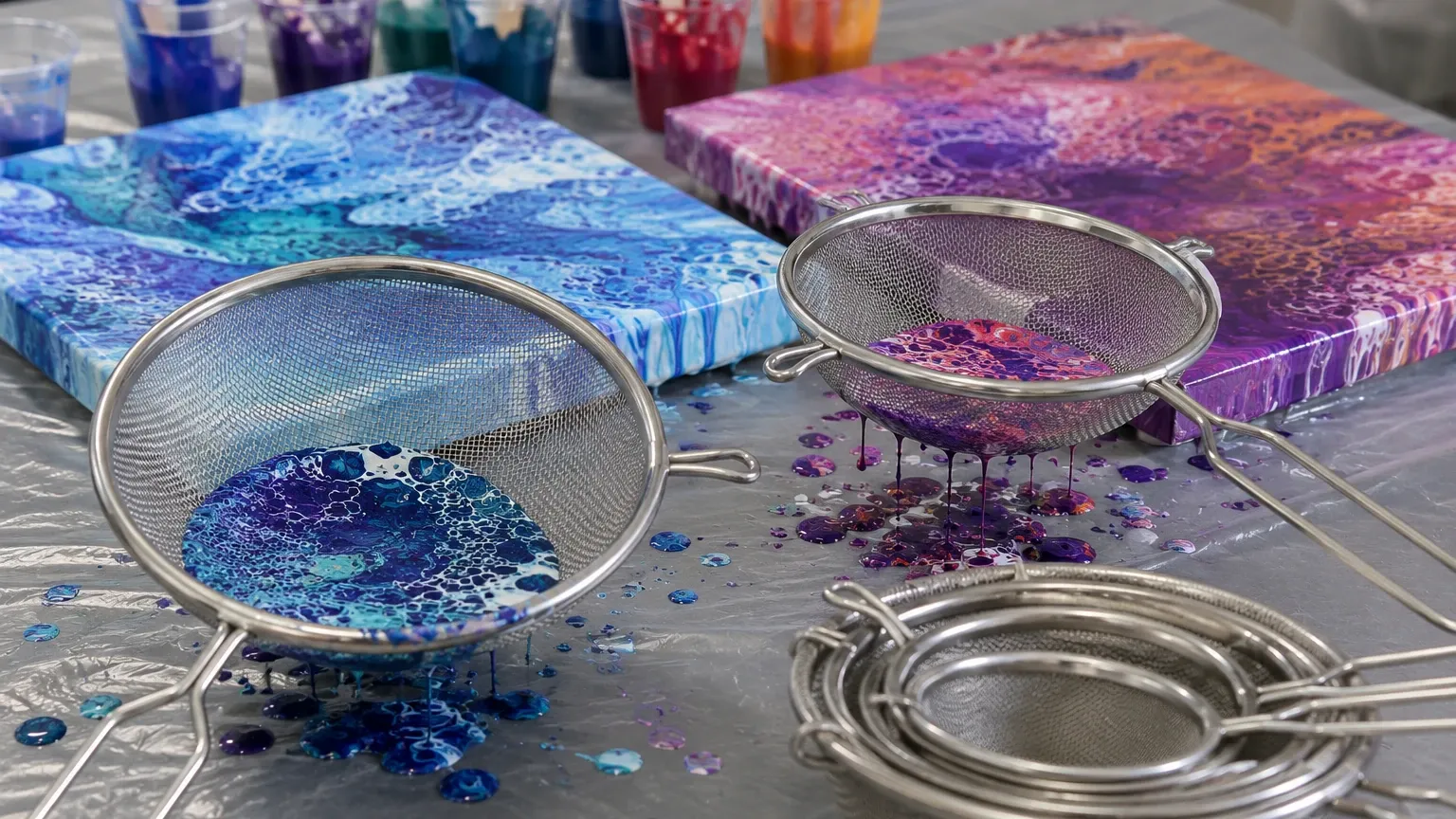
The geometry of the strainer—whether it is a conical basket, a flat mesh, or a custom-designed radial strainer—dictates the distribution of the paint. As the paint is poured into the center of the strainer, the wire mesh splits the stream into multiple smaller rivulets. This division creates the "kaleidoscope" or "flower" patterns characteristic of the technique. The precision of the wire spacing and the diameter of the wire itself directly influence the sharpness and symmetry of these patterns.
Technical Specifications: Mesh Size and Wire Diameter
When selecting strainers for professional fluid applications, engineers and artists must look beyond standard kitchenware and evaluate technical specifications such as mesh count, micron rating, and open area percentage.
Understanding Mesh Count
Mesh count refers to the number of openings per linear inch. In acrylic pouring, the choice of mesh count depends on the viscosity of the paint mixture:
* Coarse Mesh (20–40 Mesh): Ideal for high-viscosity paints or "thick pours." These allow for faster flow rates and produce broader, more defined bands of color.
* Fine Mesh (60–100 Mesh): Used for highly diluted mixtures or when a very delicate, intricate pattern is required. Fine mesh provides higher filtration accuracy but requires the paint to have a lower viscosity to prevent clogging.
Open Area Percentage
The open area is the ratio of the total area of the holes to the total area of the mesh. A higher open area allows for a higher flow rate with less pressure drop. For gravity-fed acrylic pouring, a high open area is generally preferred to ensure the paint flows smoothly through the basket without pooling excessively in the center, which can lead to muddying of colors.
Material Selection: Why Stainless Steel is Essential
In industrial filtration, material compatibility is a primary concern. While plastic or nylon strainers are available, stainless steel is the standard for professional and industrial-scale acrylic pouring for several engineering reasons.
Chemical Compatibility
Acrylic paints and pouring mediums contain various polymers, surfactants, and sometimes solvents or thinning agents. Stainless steel (specifically T-304 or T-316 grades) offers exceptional corrosion resistance. Unlike plastic, which can degrade or become stained over time, stainless steel remains inert, ensuring that no metallic impurities or degraded plastic particles contaminate the paint.
Durability and Structural Integrity
Industrial Strainers & Baskets are designed to withstand repeated use and rigorous cleaning. The structural integrity of a stainless steel basket ensures that the mesh does not sag or deform under the weight of the paint. A deformed mesh will lead to asymmetrical patterns, which is a common failure point in lower-quality equipment.
Ease of Cleaning and Maintenance
Acrylic paint dries quickly and can be difficult to remove from fine apertures. Stainless steel can withstand aggressive cleaning methods, including the use of solvents, high-pressure water, or ultrasonic cleaning tanks. This longevity significantly reduces the total cost of ownership for professional studios and manufacturing facilities compared to disposable or low-grade alternatives.
Engineering Considerations for Custom Strainer Designs
For manufacturers looking to develop proprietary pouring tools or for artists working on large-scale industrial projects, customization is often necessary. Standard off-the-shelf strainers may not provide the specific flow characteristics required for unique applications.
Basket Geometry
The shape of the basket—conical, cylindrical, or flat-bottomed—affects the velocity of the paint as it exits the mesh. Conical baskets tend to concentrate the flow toward the center, creating a denser pattern, while flat-bottomed baskets distribute the paint more evenly across a wider surface area. Custom-engineered baskets can be manufactured with reinforced rims and handles to facilitate ease of use in industrial environments.
Reinforced Mesh and Support Structures
In larger strainers, the mesh may require a perforated metal support or a heavier wire backing to maintain its shape. This is particularly important when using strainers for acrylic pouring on a large scale, where the volume of paint can exert significant pressure on the filtration surface.
Evaluating Performance and Common Risks
Using the wrong type of strainer can lead to several technical issues that compromise the final product. Engineers and purchasing teams should be aware of the following risks when selecting filtration components:
1. Clogging and Flow Restriction: If the micron rating is too small for the pigment particle size or the viscosity of the medium, the strainer will clog. This leads to uneven flow and can ruin the pattern mid-pour.
2. Color Mudding: If the mesh design causes too much turbulence, the distinct layers of color may mix prematurely inside the basket, resulting in a "muddy" or greyed-out appearance rather than crisp, defined cells.
3. Surface Tension Issues: Low-quality materials may have surface finishes that cause the paint to cling to the wire rather than flowing through cleanly. Professional stainless steel strainers often undergo electropolishing to create a smooth, non-stick surface that promotes laminar flow.
Maintenance and Longevity of Industrial Strainers
To maintain the performance of stainless steel strainers in a B2B or professional art production environment, a strict maintenance protocol is recommended. Because acrylic is a film-forming binder, any residue left in the mesh will harden and permanently alter the filtration characteristics.
* Immediate Rinsing: Strainers should be submerged in water or a cleaning solution immediately after use to prevent the acrylic from curing.
* Ultrasonic Cleaning: For fine mesh strainers (above 80 mesh), ultrasonic cleaning is the most effective way to remove dried paint from the intersections of the wires, where manual scrubbing cannot reach.
* Inspection for Mesh Blinding: Regular inspection should be conducted to check for "blinding," where particles become permanently lodged in the mesh. If blinding exceeds 10-15% of the surface area, the strainer should be replaced to ensure consistent flow patterns.
Conclusion: Selecting the Right Partner for Filtration Solutions
Whether for specialized fluid art applications or broader industrial filtration needs, the quality of the strainer is a decisive factor in process efficiency and output quality. Using strainers for acrylic pouring requires a balance of precision engineering and durable material selection. By opting for high-quality stainless steel Strainers & Baskets, users ensure that their equipment can handle the chemical and physical demands of modern acrylic mediums.
Kaifil provides a range of customizable filtration solutions designed to meet the rigorous standards of various industries. From material selection and mesh sizing to the design of complex basket geometries, our engineering expertise supports customers in achieving reliable and repeatable filtration performance. When precision and durability are non-negotiable, industrial-grade stainless steel components offer the most robust solution for managing fluid dynamics in both artistic and industrial applications.
