


Strainer Znacenje
In the context of industrial fluid handling and process engineering, understanding the term "strainer znacenje"—which translates to the meaning or significance of a strainer—is fundamental to maintaining system integrity. A strainer is a mechanical device installed in a pipeline to remove unwanted solids from fluids, including liquids, gases, or steam. Unlike fine filtration systems that target microscopic particles, strainers are typically designed to capture larger debris that could damage sensitive downstream equipment such as pumps, valves, meters, and heat exchangers.
For engineers and procurement professionals, the significance of a strainer goes beyond simple debris removal. It represents the first line of defense in a process circuit. Choosing the correct Strainers & Baskets involves evaluating flow rates, pressure drops, and material compatibility to ensure long-term operational efficiency. This guide explores the technical definitions, types, and selection criteria essential for industrial applications.
The Engineering Definition and Function of Industrial Strainers
To fully grasp the "strainer znacenje" in a B2B environment, one must distinguish between straining and filtration. While the terms are often used interchangeably, straining generally refers to the removal of larger particles (typically 40 microns and above) using a perforated metal or wire mesh screen. Filtration usually involves the removal of much smaller particles using disposable media or specialized membranes.
The primary function of an industrial strainer is to protect the process infrastructure. In hydraulic systems, chemical processing plants, and food production lines, even a small amount of scale, rust, or weld slag can cause catastrophic failure of precision components. By intercepting these solids, strainers prevent downtime and reduce the total cost of ownership for the entire system.
From a technical perspective, a strainer operates on the principle of mechanical separation. As fluid passes through the straining element (the basket or screen), the solids are trapped while the clean fluid continues through the outlet. The efficiency of this process is measured by the "open area ratio," which compares the total area of the holes in the screen to the cross-sectional area of the inlet pipe. A higher ratio typically results in a lower pressure drop and longer intervals between cleanings.
Types of Strainers and Baskets: Simplex, Duplex, and Y-Strainers
Industrial strainers are categorized based on their housing configuration and how they are integrated into the piping system. Selecting the right type depends on whether the process can be paused for maintenance and the volume of debris expected.
Y-Strainers
Y-strainers are named for their shape and are most commonly used in pressurized lines, especially for steam, gas, or liquid applications where the amount of debris is relatively low. They are compact and can be installed horizontally or vertically. Because the dirt-holding capacity of a Y-strainer is smaller than that of a basket strainer, they are ideal for systems that require infrequent cleaning.
Simplex Basket Strainers
Simplex strainers feature a basket-shaped element that can hold a significantly larger volume of debris than a Y-strainer. These are used in liquid applications where the flow can be temporarily shut down to remove and clean the basket. The top-loading design allows for easier access to the internal components compared to Y-strainers.
Duplex Basket Strainers
In critical applications where the flow cannot be interrupted—such as in continuous chemical processing or cooling water systems—duplex strainers are the standard. A duplex system consists of two separate strainer chambers connected by a diverting valve. When one basket becomes clogged, the flow is switched to the clean chamber, allowing the operator to clean the first basket without stopping the process.
Material Selection and Technical Specifications
When evaluating "strainer znacenje" for a specific project, material selection is the most critical factor for durability. Industrial environments often involve corrosive fluids, high temperatures, and varying pressures, necessitating robust materials like stainless steel.
Stainless Steel 304 and 316L
Stainless steel is the preferred material for most high-performance strainers due to its resistance to oxidation and corrosion. SS304 is suitable for general industrial use, while SS316L is required for more aggressive environments, such as chemical processing or marine applications, due to its higher molybdenum content. For the food and beverage industry, stainless steel ensures that the straining process does not introduce contaminants into the product stream.
Mesh and Perforation Sizes
The straining element itself can be made from perforated metal or woven wire mesh. Perforated metal is used for coarse straining, with hole diameters typically ranging from 1/32" to 1/2". For finer straining requirements, a wire mesh lining is added to the perforated basket. Mesh size is defined by the number of openings per linear inch; a higher mesh count indicates a finer straining capability.
Pressure and Temperature Ratings
Engineers must confirm that the strainer housing and the internal element can withstand the maximum operating pressure and temperature of the system. Failure to account for pressure spikes or thermal expansion can lead to basket collapse or housing rupture.
Performance Evaluation: Pressure Drop and Flow Rates
A critical aspect of the "strainer znacenje" in system design is the impact on fluid dynamics. Every strainer introduces a degree of resistance to the flow, known as pressure drop (Delta P). As the basket collects debris, the resistance increases, leading to a higher pressure drop.
Calculating the Clean Pressure Drop
Before installation, engineers must calculate the clean pressure drop based on the fluid's viscosity, specific gravity, and flow velocity. Manufacturers provide flow coefficient (Cv) values to assist in these calculations. A well-sized strainer should ideally have a clean pressure drop of less than 2 PSI.
Monitoring the Dirty Pressure Drop
To prevent damage to the internal basket, it is essential to monitor the pressure differential across the strainer. Most industrial systems utilize differential pressure gauges. Once the pressure drop reaches a predetermined limit (often 5 to 10 PSI above the clean pressure drop), the basket must be cleaned. Ignoring this can result in the "burst pressure" of the basket being exceeded, causing the trapped debris to bypass the strainer and enter the downstream system.
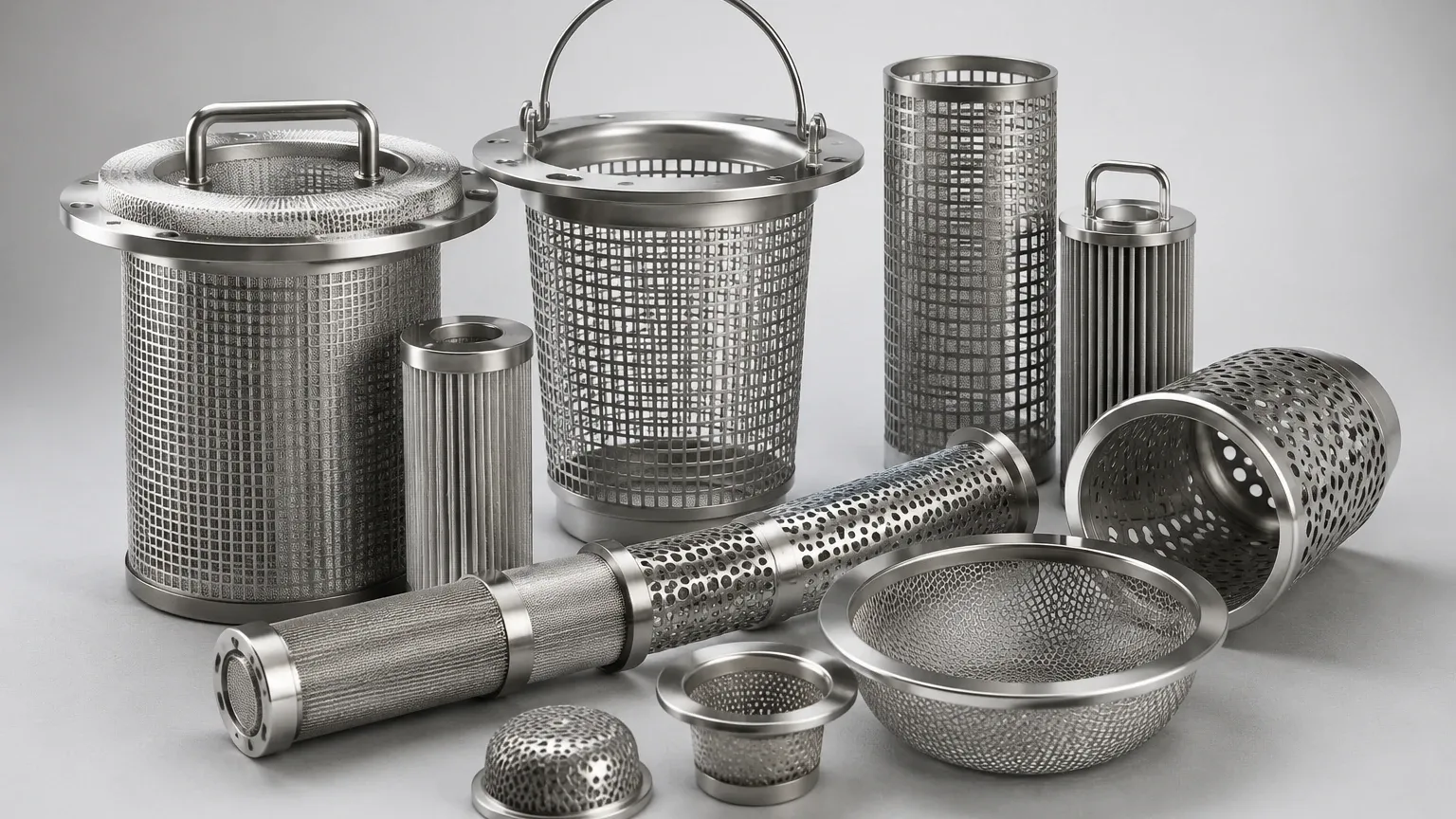
Customization and OEM Considerations for Industrial Filters
Standard off-the-shelf strainers may not meet the requirements of specialized industrial applications. This is where the capability for customization becomes vital. Manufacturers like Kaifil specialize in developing custom stainless steel filtration solutions that address specific engineering challenges.
Custom Basket Designs
Depending on the fluid characteristics, a standard basket may require reinforcement to handle high-viscosity liquids or high-velocity flows. Customizations can include heavy-duty support frames, magnetic inserts to capture fine iron particles, or specialized coatings for extreme chemical resistance.
Dimensional Adjustments
In retrofit projects, space constraints often dictate the physical dimensions of the strainer housing. Custom OEM manufacturing allows for the adjustment of inlet and outlet positions, flange types (ANSI, DIN, or JIS), and overall height to fit into existing piping layouts without requiring extensive modifications.
Filtration Accuracy
While traditional strainers focus on larger debris, custom-engineered Strainers & Baskets can be designed with multi-layered wire mesh to achieve specific filtration accuracies that bridge the gap between coarse straining and fine filtration. This is particularly useful in hydraulic systems where component tolerances are extremely tight.
Maintenance and Total Cost of Ownership
Understanding the "strainer znacenje" also involves recognizing the long-term maintenance requirements. A strainer is not a "fit and forget" component; its effectiveness depends on regular servicing.
1. Cleaning Protocols: For simplex strainers, the process involves depressurizing the line, opening the cover, and washing the basket. In food-grade applications, the basket may require ultrasonic cleaning or CIP (Clean-In-Place) compatibility.
2. Gasket and Seal Replacement: Every time a strainer is opened for cleaning, the gaskets or O-rings should be inspected. Using high-quality Viton or PTFE seals ensures a leak-proof restart.
3. Total Cost of Ownership (TCO): While a cheaper strainer made of inferior materials may have a lower initial cost, the TCO can be significantly higher due to frequent basket replacements, corrosion-related housing failures, and the cost of unplanned downtime. Investing in high-quality stainless steel components reduces these long-term risks.
Conclusion: Selecting the Right Filtration Partner
The "strainer znacenje" in modern industry is clear: it is a vital component for process safety, equipment protection, and product quality. Whether you are dealing with water treatment, chemical processing, or industrial hydraulics, the choice of strainer directly impacts the reliability of your operation.
When selecting a manufacturer, it is important to look for technical expertise in material science and precision engineering. A partner that understands the nuances of flow dynamics and can provide customized OEM solutions will ensure that your filtration system performs as expected under the most demanding conditions. By focusing on quality materials like 304 and 316L stainless steel and adhering to rigorous manufacturing standards, you can achieve a balance of high filtration performance and low operational costs.
For those seeking reliable, high-performance components, exploring a comprehensive range of Strainers & Baskets is the first step toward optimizing your industrial filtration strategy. Proper selection today prevents the costly mechanical failures of tomorrow.
