


1 Gallon Paint Strainers
In industrial finishing and chemical processing, the quality of the final coating is directly proportional to the purity of the fluid applied. While the term "1 gallon paint strainers" often evokes images of simple mesh bags used in residential DIY projects, the industrial reality is far more complex. For engineering and procurement teams managing small-batch production, laboratory testing, or specialized coating lines, selecting the right filtration component is a critical decision that impacts equipment longevity, surface finish quality, and operational efficiency.
Industrial-grade 1 gallon paint strainers serve as the primary defense against particulates, undissolved resins, and environmental contaminants that can compromise high-precision spray systems. When integrated into professional Strainers & Baskets configurations, these components ensure that only homogenized, clean fluid reaches the application point.
The Critical Role of Precision Filtration in Industrial Coatings
Industrial coatings are engineered fluids with specific rheological properties. Whether dealing with high-solids epoxies, automotive basecoats, or specialized chemical primers, the presence of oversized particles can lead to catastrophic failures in the application process.
1 gallon paint strainers are typically utilized in batch processing where smaller volumes of high-value coatings are prepared. In these environments, the strainer must perform two primary functions: protection and refinement. Protection involves shielding sensitive equipment—such as high-pressure pumps and fine-nozzle spray guns—from abrasive particles that cause premature wear or immediate clogging. Refinement involves ensuring the paint's consistency, removing "skins" that form during storage, and filtering out any agglomerates that may have formed during the mixing of pigments and binders.
Failure to implement adequate filtration at the 1-gallon scale often results in "spitting" at the spray tip, surface craters, or uneven film thickness. For industries like aerospace or medical device manufacturing, such defects are not merely aesthetic issues; they are functional failures that necessitate expensive rework and material waste.
Material Engineering: Evaluating Nylon vs. Stainless Steel Mesh
When specifying 1 gallon paint strainers for industrial use, the choice of material is the first engineering hurdle. The two most common materials are synthetic polymers (nylon/polyester) and metallic alloys (primarily 304 or 316 stainless steel).
Synthetic Mesh Strainers
Disposable nylon or polyester strainers are common for one-time use or in applications where the coating chemistry is relatively inert. These are often designed as elastic-top bags or cone-shaped inserts. While cost-effective for single batches, they present risks in industrial environments. Synthetic fibers can shed, introducing new contaminants into the fluid. Furthermore, certain aggressive solvents used in industrial thinners can soften or partially dissolve synthetic meshes, leading to a loss of filtration integrity.
Stainless Steel Metal Strainers
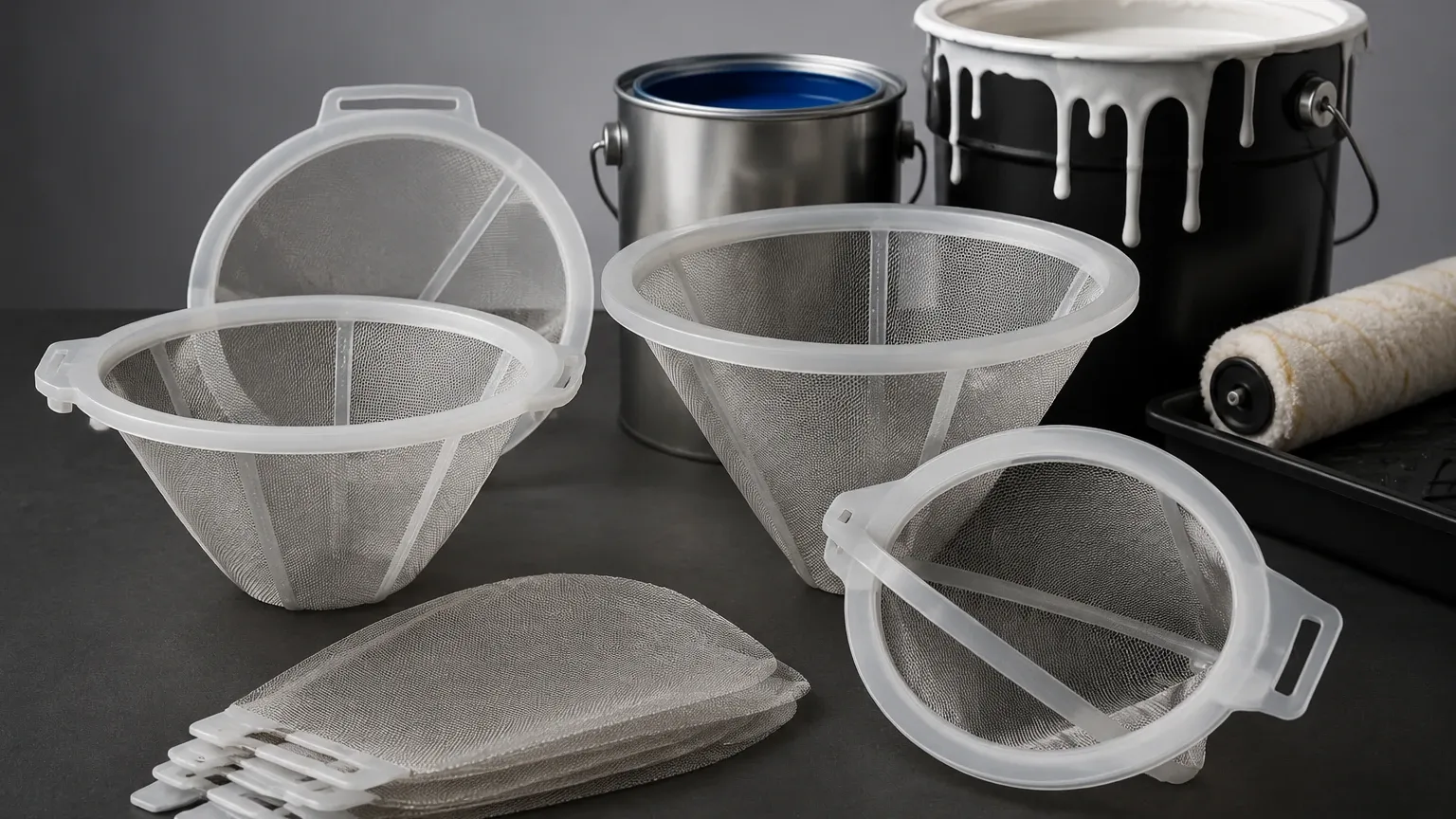
For demanding industrial applications, stainless steel is the preferred material. Stainless steel 1 gallon paint strainers offer several technical advantages:
* Chemical Compatibility: 304 and 316 stainless steel are resistant to a vast array of solvents, acids, and alkaline cleaners, making them suitable for virtually any industrial coating chemistry.
* Structural Integrity: Unlike fabric bags, metal mesh strainers maintain their shape under the pressure of high-viscosity fluids. This prevents the "stretching" of pores that can occur with nylon, which would otherwise allow oversized particles to pass through.
* Reusability and Sustainability: Metal strainers are designed for repeated use. With proper cleaning protocols, a single stainless steel basket can replace thousands of disposable bags, reducing the facility's waste stream and long-term procurement costs.
Technical Specifications: Micron Ratings and Mesh Counts
Selecting 1 gallon paint strainers requires a precise understanding of micron ratings and mesh counts. The "mesh count" refers to the number of openings per linear inch, while the "micron rating" refers to the actual size of the particles the strainer will trap.
In the context of 1-gallon batches, common specifications include:
* Coarse Filtration (250+ Microns / ~60 Mesh): Used for heavy primers, textured coatings, or as a pre-filter for heavily contaminated reclaimed fluids.
* Medium Filtration (150–200 Microns / ~80–100 Mesh): The standard for most industrial enamels and latex-based coatings. This level effectively removes skins and larger agglomerates without significantly restricting flow.
* Fine Filtration (100 Microns and below / 150+ Mesh): Essential for high-gloss topcoats, automotive finishes, and clear coats where even microscopic imperfections are unacceptable.
Engineers must balance filtration fineness with flow rate. A mesh that is too fine for the fluid's viscosity will lead to rapid blinding (clogging), causing production delays and potential pump cavitation if the strainer is part of an inline suction system.
Industrial Applications for 1 Gallon Paint Strainers
While the name suggests a narrow focus on paint, these strainers are versatile components used across various industrial sectors:
1. Automotive Refinishing: Small-batch color matching and custom topcoat preparation require absolute purity. Stainless steel strainers are used here to ensure that metallic flakes or specialized pigments are evenly distributed and free of clumps.
2. Chemical Processing: In R&D labs, 1 gallon paint strainers are used to filter catalyst solutions or small chemical batches before they are introduced into larger reactors.
3. Food and Beverage: When constructed from food-grade 316 stainless steel, these strainers are used to filter oils, flavorings, or small batches of liquid ingredients, ensuring compliance with hygiene standards.
4. Pharmaceuticals: Precision metal strainers are used in the filtration of coatings for tablets or specialized liquid medications where particulate control is a regulatory requirement.
5. Hydraulic and Lubrication Systems: For small reservoirs, these strainers act as fill-point filters to ensure that new oil or hydraulic fluid is free of contaminants before entering the system.
Selection Criteria for Procurement and Engineering Teams
When evaluating 1 gallon paint strainers for a facility, technical professionals should confirm the following criteria with their supplier:
1. Housing Compatibility
Will the strainer be used as a drop-in basket for a pressurized vessel, or is it a gravity-fed insert for an open container? The flange design and dimensions must be exact to prevent fluid bypass. In professional Strainers & Baskets systems, the seal between the strainer rim and the housing is the most common point of failure.
2. Viscosity and Flow Rate
High-viscosity fluids require more surface area to maintain an acceptable flow rate. If a standard 1-gallon basket provides insufficient surface area, engineers may need to specify a pleated mesh design, which significantly increases the filtration area within the same physical footprint.
3. Cleaning and Maintenance Requirements
For reusable stainless steel strainers, the ease of cleaning is paramount. Ultrasonic cleaning or back-flushing are common methods. The strainer's construction—specifically the type of weave (plain, twill, or dutch weave)—will dictate how easily trapped particles can be removed.
4. Pressure Differentials
In pressurized systems, the strainer must be able to withstand the differential pressure (Delta P) as it loads with contaminants. A reinforced support basket may be necessary to prevent the fine mesh from collapsing or deforming under load.
Maintenance and Longevity of Reusable Metal Strainers
To maximize the ROI of stainless steel 1 gallon paint strainers, a strict maintenance protocol is required. Unlike disposable options, metal strainers represent a capital investment that can last for years if handled correctly.
* Immediate Rinsing: Strainers should never be allowed to dry with coating material on the mesh. Immediate immersion in a compatible solvent or cleaning agent is necessary to prevent permanent blinding.
* Inspection for Mesh Fatigue: Over time, the mechanical stress of cleaning and fluid pressure can cause "wire shifting" or micro-tears. Regular inspection under magnification ensures that the micron rating remains consistent.
* Ultrasonic Cleaning: For fine meshes (below 100 microns), manual brushing can damage the wires. Ultrasonic baths are the industry standard for vibrating trapped particles out of the mesh interstices without compromising the structural integrity of the weave.
Total Cost of Ownership: Disposable vs. Custom Metal Solutions
From a procurement perspective, the initial cost of a high-quality stainless steel 1 gallon paint strainer is significantly higher than a pack of disposable nylon bags. However, the Total Cost of Ownership (TCO) often favors the metal solution in industrial settings.
Consider the following factors:
* Waste Disposal Costs: In many jurisdictions, paint-contaminated disposable filters are classified as hazardous waste, carrying high disposal fees. Reusable filters minimize this waste stream.
* Quality Consistency: Metal strainers provide a fixed, non-deformable pore size. Disposable bags can stretch under the weight of a gallon of paint, leading to inconsistent filtration and potential product rejection.
* Downtime: A burst nylon bag during a filtration cycle can contaminate an entire batch and require extensive cleaning of the downstream equipment. The mechanical strength of stainless steel virtually eliminates this risk.
For facilities looking to optimize their small-batch processes, transitioning to engineered Strainers & Baskets offers a path toward higher precision and lower long-term operational costs. By focusing on material compatibility, precise micron ratings, and robust construction, engineers can ensure that their 1 gallon paint strainers are an asset to their production quality rather than a weak link in the chain.
