


15mm Strainers
In industrial fluid handling, the integrity of downstream equipment often depends on the efficiency of primary filtration components. 15mm strainers, corresponding to the DN15 nominal diameter or 1/2-inch pipe size, serve as a critical line of defense in small-bore piping systems. These components are designed to remove coarse particles, debris, and suspended solids from liquids and gases, preventing damage to sensitive instruments, pumps, and valves.
As a specialized manufacturer, Kaifil provides high-performance Strainers & Baskets engineered to meet the rigorous demands of chemical processing, pharmaceutical manufacturing, and hydraulic systems. Understanding the technical specifications, material compatibility, and flow dynamics of 15mm strainers is essential for engineers tasked with optimizing system uptime and reducing maintenance costs.
Technical Specifications and Material Selection
The performance of a 15mm strainer is primarily dictated by its material of construction and its mechanical design. In industrial environments where corrosion resistance and structural integrity are paramount, stainless steel is the industry standard.
Grade 304 vs. Grade 316L Stainless Steel
For most general-purpose industrial applications, Grade 304 stainless steel offers sufficient resistance to oxidation and many organic chemicals. However, in more aggressive environments—such as those involving chlorides or acidic solutions in chemical processing—Grade 316L is preferred. The addition of molybdenum in 316L enhances pitting resistance, while the lower carbon content facilitates better weldability and reduces the risk of intergranular corrosion in the heat-affected zones of the strainer body.
Connection Types and Pressure Ratings
15mm strainers are typically integrated into piping via threaded or flanged connections. Threaded options, including NPT (National Pipe Thread) or BSP (British Standard Pipe), are common for 1/2-inch lines due to their ease of installation in compact spaces. For high-pressure or high-vibration environments, socket weld or flanged connections (following ANSI or DIN standards) provide a more robust, leak-proof seal. Engineers must verify that the strainer housing is rated for the system’s maximum allowable working pressure (MAWP), often ranging from PN16 up to PN64 or higher in specialized hydraulic applications.
Filtration Principles and Mesh Selection for DN15 Systems
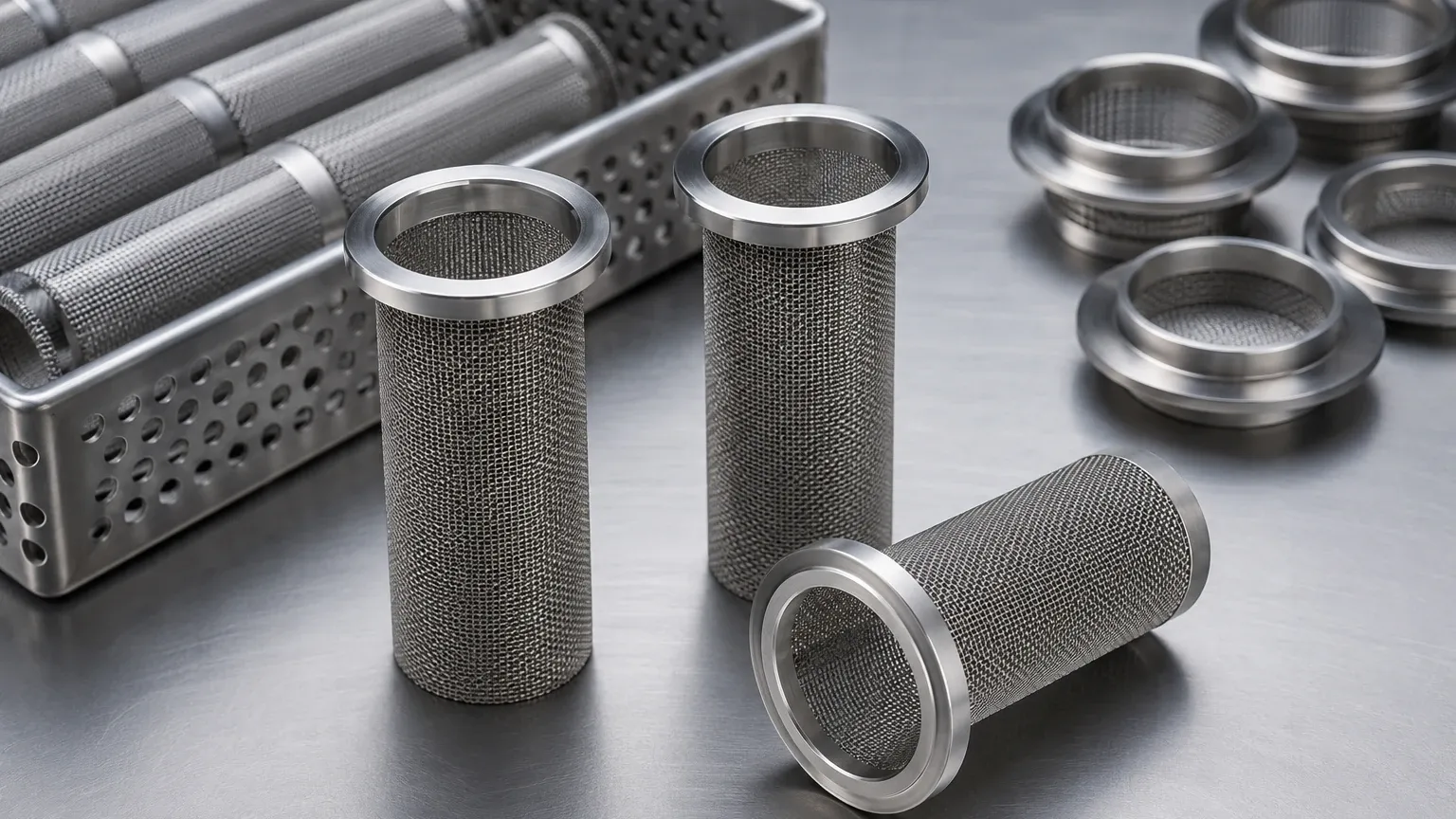
The heart of any 15mm strainer is the internal element, which may be a simple perforated screen or a sophisticated wire mesh basket. The selection of the filtration media determines the particle retention capability and the impact on the system's pressure profile.
Micron Rating and Mesh Count
Mesh size refers to the number of openings per linear inch. A higher mesh count results in finer filtration but also increases the resistance to flow. For 15mm strainers, common mesh sizes range from 20 mesh (approx. 840 microns) for coarse debris to 400 mesh (approx. 37 microns) for fine particulate removal. When selecting a mesh, engineers must balance the need for protection with the risk of rapid clogging. If the mesh is too fine for the particulate load, the frequency of cleaning will increase, leading to higher operational costs.
The Importance of the Open Area Ratio
The "open area" is the total area of the holes in the strainer element expressed as a percentage of the total screen area. For efficient operation, the open area of the 15mm strainer element should ideally be three to four times the cross-sectional area of the inlet pipe. This ratio ensures that even as the screen begins to capture debris, the pressure drop ($ΔP$) remains within acceptable limits, preventing cavitation in pumps or insufficient flow to downstream processes.
Common Applications for 15mm Strainers
Despite their small footprint, 15mm strainers are indispensable across various sectors. Their role is often focused on protecting high-value components in localized loops or branch lines.
Chemical Dosing and Injection
In chemical processing, precise dosing is required for catalysts, inhibitors, and reagents. 15mm strainers are installed upstream of dosing pumps and flow meters to ensure that no particulate matter interferes with the accuracy of the injection or damages the pump diaphragms. Stainless steel construction ensures that the strainer does not react with the process fluid.
Steam and Condensate Systems
In steam lines, 15mm Y-strainers are frequently used to protect steam traps and control valves from pipe scale and rust. The ability of stainless steel to withstand high temperatures and thermal cycling makes it the ideal material for these applications. Removing solids from the condensate return line also helps in maintaining the efficiency of heat exchangers.
Pharmaceutical and Food Grade Processes
For sanitary applications, 15mm strainers must feature high-quality surface finishes (often electropolished) to prevent bacterial growth and facilitate Clean-in-Place (CIP) procedures. These strainers are used to filter out process-related solids or accidental contaminants in small-batch production lines, ensuring the final product meets stringent purity standards.
Operational Considerations: Pressure Drop and Maintenance
One of the most critical factors in the lifecycle of a 15mm strainer is how it is maintained. Neglecting the filtration element can lead to system-wide performance degradation.
Monitoring Differential Pressure
As a strainer captures debris, the pressure drop across the unit increases. In critical 15mm lines, installing pressure gauges upstream and downstream of the strainer allows operators to monitor this differential pressure. A significant increase in $ΔP$ indicates that the basket or screen is reaching its holding capacity and requires cleaning. Failure to clean the element can result in the screen collapsing under the pressure of the fluid, which could send both the debris and fragments of the screen downstream.
Cleaning and Replacement Cycles
The design of 15mm strainers, particularly the Y-type or basket type, usually allows for relatively easy access to the internal element. For Y-strainers, a blow-down valve can sometimes be installed on the strainer cap to flush out accumulated debris without stopping the flow. However, for a thorough cleaning, the system must be depressurized, and the basket removed. Kaifil’s Strainers & Baskets are designed for durability, allowing for multiple cleaning cycles using ultrasonic baths or high-pressure air/water, provided the mesh is not mechanically damaged.
Engineering Selection Criteria for 15mm Strainers
When specifying a 15mm strainer for a new project or as a replacement part, engineers should confirm several key parameters to ensure long-term reliability.
1. Fluid Characteristics: Is the fluid corrosive, abrasive, or viscous? Viscous fluids require larger mesh openings or increased surface area to prevent excessive pressure drop.
2. Flow Rate: The maximum and minimum flow rates must be known. High velocity can cause erosion of the strainer mesh, while low velocity might allow particles to settle in the pipe rather than being trapped in the strainer.
3. Temperature Limits: Ensure that the seals and gaskets (such as PTFE, EPDM, or Viton) are compatible with the operating temperature of the process.
4. Installation Orientation: Y-strainers can be installed in horizontal or vertical (downward flow) lines. However, basket strainers are generally restricted to horizontal installations. Incorrect orientation will prevent the strainer from properly trapping and retaining debris.
5. Customization Requirements: In many OEM applications, standard off-the-shelf strainers may not fit the space constraints or specific filtration requirements. Custom-fabricated 15mm strainers can include specialized handle designs for easy removal, magnetic inserts to capture fine ferrous particles, or reinforced baskets for high-pressure differentials.
Total Cost of Ownership (TCO)
While the initial purchase price of a 15mm strainer is a factor, the total cost of ownership includes maintenance labor, the cost of replacement elements, and the potential cost of downstream equipment failure. Investing in a high-quality stainless steel strainer from a reputable manufacturer like Kaifil reduces the risk of premature failure and extends the service life of the entire system. By selecting the correct mesh size and material from the outset, engineers can minimize the frequency of manual interventions and ensure that the filtration system operates at peak efficiency.
In conclusion, 15mm strainers are vital components that provide essential protection for small-bore industrial piping. Whether used in hydraulic systems, chemical dosing, or steam lines, their ability to reliably remove contaminants is fundamental to process stability. By focusing on technical parameters such as material grade, open area ratio, and pressure ratings, procurement and engineering teams can select filtration solutions that deliver consistent performance in the most demanding industrial environments.
