


Strainer 5 Letters Crossword Clue
In the world of puzzles and word games, the search for a strainer 5 letters crossword clue often leads to a simple, five-letter answer: "SIEVE." While this suffices for a morning pastime, the implications of straining and filtration in an industrial context are far more complex and critical. In engineering and manufacturing, a strainer is not merely a household tool but a sophisticated component designed to protect downstream equipment, ensure product purity, and maintain the integrity of fluid systems.
At Kaifil, we understand that while a "sieve" might be the answer to a riddle, the answer to industrial fluid challenges lies in high-performance Strainers & Baskets. This guide explores the technical nuances of these components, moving beyond the crossword definition to examine the engineering principles, material selections, and customization options essential for modern industrial applications.
From Sieve to Industrial Strainer: Defining the Difference
In common parlance, the terms "sieve" and "strainer" are often used interchangeably. However, in a B2B or industrial engineering environment, the distinction is vital. A sieve is typically used for particle size analysis or dry material separation. In contrast, an industrial strainer is a closed-vessel component integrated into a piping system to remove unwanted solids from liquids, gases, or steam via a perforated or wire mesh straining element.
Industrial strainers are categorized by their configuration and the specific role they play in a process line. Unlike the simple 5-letter crossword answer, industrial filtration solutions must withstand high pressures, corrosive chemicals, and extreme temperatures. The primary goal is protection—shielding pumps, valves, meters, and spray nozzles from debris that could cause mechanical failure or process downtime.
Engineering Considerations for Strainer Selection
When transitioning from a general concept to a specific industrial requirement, engineers must evaluate several technical parameters. Selecting the right strainer involves more than just matching a pipe size; it requires a deep dive into the fluid dynamics and the nature of the contaminants.
1. Material Compatibility
The choice of material is the first line of defense against system failure. Stainless steel is the industry standard due to its balance of strength and corrosion resistance.
- SS304: Suitable for general-purpose applications, including water treatment and some food processing environments where atmospheric corrosion is the primary concern.
- SS316/SS316L: Higher molybdenum content provides superior resistance to chlorides and acids, making it essential for chemical processing, marine applications, and pharmaceutical manufacturing.
- Specialty Alloys: For highly aggressive environments, materials like Hastelloy or Monel may be required to prevent pitting and stress corrosion cracking.
2. Filtration Accuracy and Micron Rating
The "mesh" of a strainer determines what size particles are captured. This is measured in microns or mesh count. A 5-letter crossword clue might not require precision, but an industrial process does.
- Coarse Straining: Using perforated metal to remove large debris (1/32" to 1/4" holes).
- Fine Straining: Using multi-layered wire mesh to capture particles down to 5 microns.
Engineers must balance the need for fine filtration with the risk of rapid clogging, which leads to excessive pressure drops.
3. Pressure Drop (Delta P)
Every strainer introduces a restriction in the flow path. The pressure drop (ΔP) is the difference in pressure between the inlet and the outlet. An optimized strainer design minimizes this drop to maintain system efficiency. Factors influencing ΔP include the open area ratio of the basket, the viscosity of the fluid, and the flow velocity.
Types of Industrial Strainers and Baskets
Industrial systems utilize various configurations of strainers depending on the continuity of the process and the volume of debris.
Simplex Basket Strainers
Simplex strainers are used in systems where the flow can be interrupted for cleaning. They feature a single basket chamber. When the pressure gauge indicates a high differential, the system is shut down, the chamber is opened, and the basket is cleaned or replaced. These are common in batch processing and cooling water lines.
Duplex (Twin) Basket Strainers
For continuous processes where downtime is not an option, duplex strainers are the standard. They consist of two separate strainer chambers connected by a diverter valve. When one basket becomes full, the flow is switched to the clean chamber, allowing the operator to service the dirty basket without stopping the process. This is critical in chemical plants and oil refineries.
Y-Strainers and T-Strainers
- Y-Strainers: Compact and typically used for steam or high-pressure gases where the amount of debris is minimal. Their shape allows for installation in both horizontal and vertical pipelines.
- T-Strainers: Often used in large-diameter pipelines, offering a straight-through flow path and a larger holding capacity than Y-strainers.
The Role of Customization in Filtration Performance
Off-the-shelf solutions rarely meet the specific demands of specialized industrial sectors. Customization is where Kaifil provides significant value to engineering teams. A strainer 5 letters crossword clue doesn't account for the variables of a high-viscosity polymer line or a sterile pharmaceutical process.
Custom Basket Designs
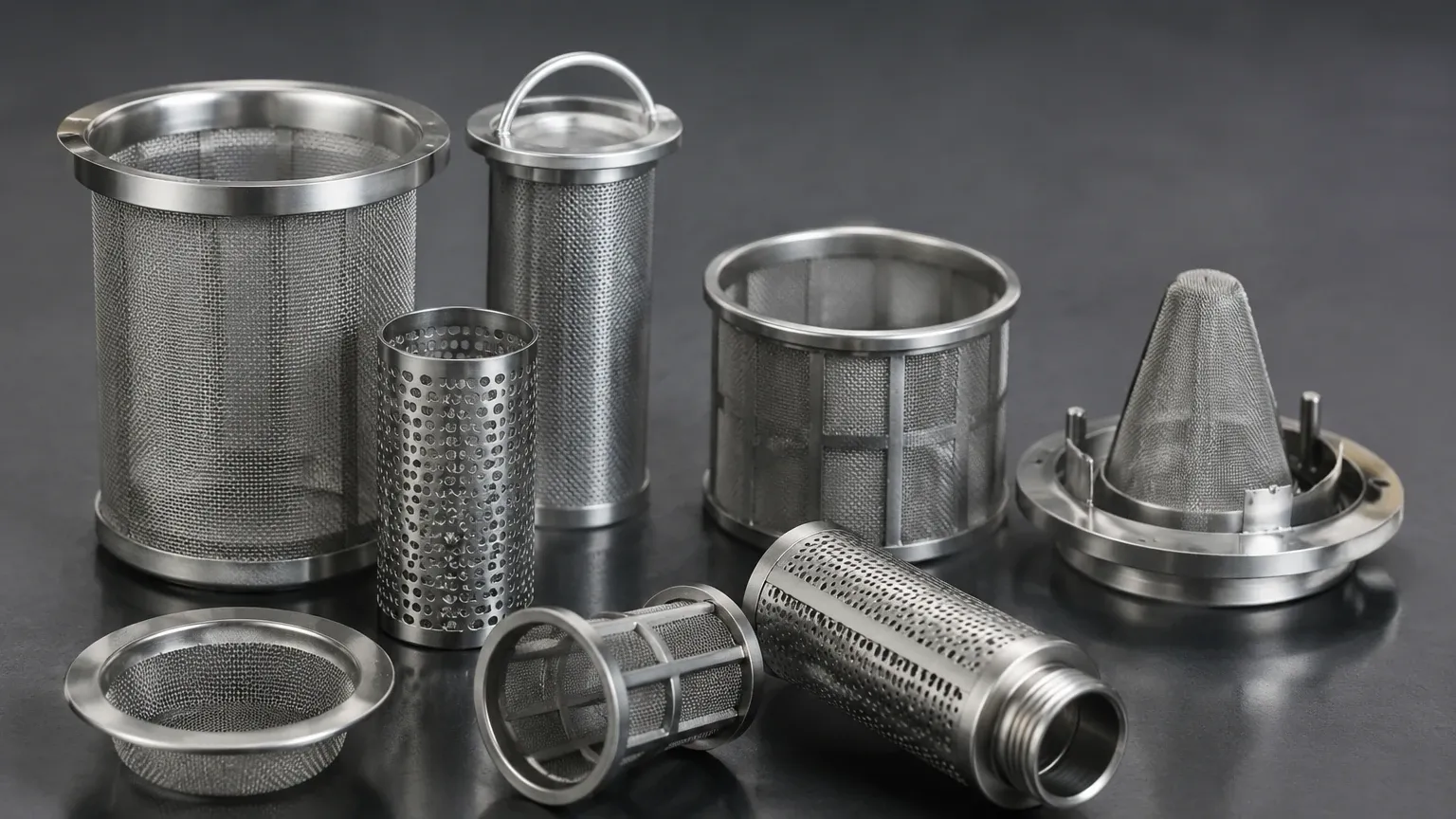
Baskets can be reinforced with internal or external supports to handle high-pressure differentials that might otherwise collapse a standard mesh. We offer customized handle designs for easier extraction, slanted bottoms for specific drainage requirements, and multi-stage baskets that combine a coarse outer layer with a fine inner mesh.
OEM and Precision Manufacturing
For equipment manufacturers (OEMs), integrating a filtration component requires precise dimensional tolerances. Using advanced manufacturing techniques such as CNC punching, laser cutting, and specialized welding (TIG/Plasma), we ensure that every basket fits perfectly within the housing, preventing "bypass"—where fluid escapes around the edges of the filter element.
Maintenance and Total Cost of Ownership (TCO)
Purchasing a strainer is an investment in the longevity of the entire system. When evaluating costs, engineers should look beyond the initial purchase price to the Total Cost of Ownership (TCO).
Cleaning Cycles and Durability
A poorly designed basket may require frequent cleaning, increasing labor costs and the risk of damage during handling. High-quality stainless steel baskets from Kaifil are designed for easy cleaning and repeated use. The durability of the wire mesh and the integrity of the welds determine how many cleaning cycles a basket can survive before the mesh begins to fray or detach from the frame.
Replacement Indicators
Operating a system with a clogged strainer increases the load on pumps, leading to higher energy consumption and potential motor burnout. Installing differential pressure sensors across the strainer housing provides real-time data, allowing for predictive maintenance rather than reactive repairs.
Applications Across Demanding Industries
Our Strainers & Baskets are utilized across a spectrum of industries, each with unique challenges:
- Chemical Processing: Handling aggressive solvents and catalysts requires high-grade stainless steel and precise micron ratings to ensure chemical purity.
- Food and Beverage: Compliance with sanitary standards is paramount. Our strainers feature smooth surface finishes and crevice-free welds to prevent bacterial growth.
- Pharmaceuticals: Requiring absolute filtration and full material traceability, our components support the rigorous validation processes of the medical industry.
- Water Treatment: From desalination to municipal supply, large-scale baskets remove sand, scale, and organic matter to protect sensitive membranes and valves.
- Hydraulic Systems: Protecting high-pressure hydraulic pumps from particulate contamination is essential for preventing catastrophic component failure.
Conclusion: Moving Beyond the Crossword
While "sieve" is the answer to the strainer 5 letters crossword clue, it is only the beginning of the conversation in an industrial setting. Effective filtration requires a deep understanding of fluid mechanics, material science, and mechanical design.
By selecting the right strainer configuration, material, and mesh size, engineers can significantly improve system reliability and product quality. At Kaifil, we combine manufacturing expertise with engineering support to deliver customized filtration solutions that stand up to the most demanding industrial environments. Whether you are designing a new system or looking to optimize an existing process, our technical team is ready to assist in selecting the ideal components for your specific application.
