


60 Mesh Strainers
In industrial fluid processing, the efficiency of a system often depends on the precision of its primary filtration components. Among the various specifications available to engineers, 60 mesh strainers represent a critical balance between flow capacity and particulate retention. These components are designed to capture particles larger than approximately 250 microns, making them an essential safeguard for pumps, nozzles, and heat exchangers in diverse industrial environments.
As a specialized manufacturer, Kaifil provides high-performance stainless steel filtration solutions tailored to the rigorous demands of chemical, pharmaceutical, and food processing sectors. Understanding the technical nuances of 60 mesh strainers is vital for procurement teams and engineers looking to optimize process uptime and protect downstream equipment.
Technical Fundamentals of 60 Mesh Filtration
The term "60 mesh" refers to the number of openings per linear inch of the wire cloth. To calculate the actual filtration rating, one must account for both the mesh count and the wire diameter. In a standard industrial 60 mesh configuration, the aperture size is typically around 0.0098 inches or 250 microns.
The Relationship Between Mesh and Micron
For engineers, the micron rating is often more critical than the mesh count alone. While a 60 mesh strainer is generally classified as a medium-coarse filter, its performance is influenced by the wire diameter used during the weaving process. A thicker wire increases the structural integrity of the mesh but reduces the percentage of open area, which can lead to a higher initial pressure drop. Conversely, a thinner wire provides a larger open area but may require additional reinforcement, such as a perforated metal support, to withstand high-pressure differentials.
Weave Types and Structural Integrity
Most 60 mesh strainers utilize a plain weave pattern, where each warp wire crosses over and under each shute wire at 90-degree angles. This provides a stable, consistent opening size across the entire surface of the filter. For more demanding applications involving high-velocity flows or abrasive media, the mesh can be sintered or multi-layered to prevent wire migration and ensure the long-term stability of the filtration pore size.
Material Integrity and Chemical Compatibility
Selecting the correct alloy for 60 mesh strainers is paramount to ensuring the longevity of the filtration system. Industrial environments often expose filters to corrosive chemicals, extreme temperatures, and high mechanical stress. Kaifil specializes in stainless steel constructions, primarily utilizing Grade 304 and Grade 316L.
Stainless Steel 304 vs. 316L
* Grade 304: This is the standard choice for general industrial applications. It offers excellent durability and resistance to oxidation. It is widely used in water treatment and food processing where the chemical environment is relatively neutral.
* Grade 316L: For applications involving chlorides, acids, or high-salinity fluids, 316L is the preferred material. The addition of molybdenum provides superior pitting resistance. In the pharmaceutical and chemical sectors, 316L is often required to meet stringent hygiene and corrosion standards.
Thermal and Mechanical Limits
Stainless steel 60 mesh strainers are capable of operating in temperatures ranging from cryogenic levels to over 800°F (427°C), depending on the housing and seal materials. Unlike synthetic filter media, metal mesh does not soften or deform under thermal stress, maintaining a consistent 250-micron nominal rating throughout the production cycle.
Structural Design: Comparing Strainers & Baskets for Industrial Use
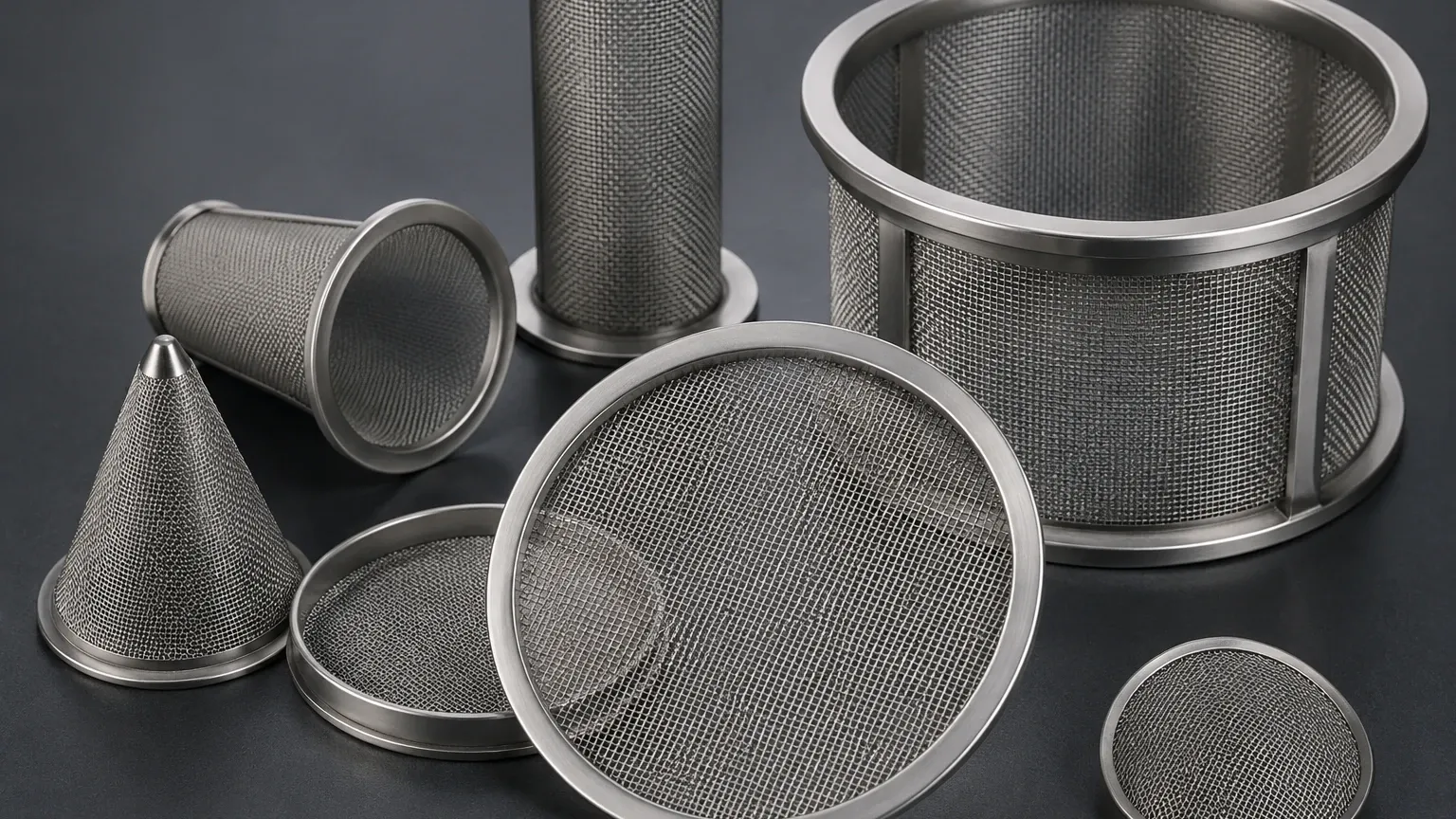
The physical configuration of the filter element significantly impacts its dirt-holding capacity and the frequency of maintenance. When evaluating Strainers & Baskets, engineers must determine which geometry best suits their piping layout and flow requirements.
Conical and Cylindrical Strainers
Standard cylindrical strainers are often used in inline applications where space is limited. These are typically designed for temporary use during system commissioning or for processes with very low particulate loading. However, for continuous industrial operations, a basket configuration is usually more effective.
Basket Strainer Advantages
Basket strainers provide a larger surface area compared to simple cylindrical designs. This increased Effective Filtration Area (EFA) allows for higher flow rates and a lower rate of pressure increase as contaminants accumulate. High-quality baskets often feature reinforced bottoms and heavy-duty handles to facilitate easy removal and cleaning. In high-pressure systems, the 60 mesh screen is typically pleated or supported by a perforated metal cage to prevent the mesh from collapsing under the force of the fluid.
Calculating Flow Dynamics and Pressure Differential
A critical factor in the selection of 60 mesh strainers is the "clean pressure drop" (ΔP). This is the difference in pressure between the inlet and outlet of the strainer when the mesh is completely clean. For a 60 mesh screen, the open area typically ranges between 35% and 45%.
Factors Influencing Pressure Drop
1. Fluid Viscosity: Higher viscosity fluids require more force to pass through the 250-micron openings, leading to a higher ΔP. If the fluid is highly viscous, a larger strainer body or a coarser mesh may be necessary to maintain flow.
2. Velocity: As the flow velocity increases, the pressure drop increases exponentially. Engineers should aim for a velocity that minimizes turbulence and prevents "particle bypass," where high pressure forces contaminants through the mesh.
3. Particulate Loading: As the 60 mesh openings begin to trap debris, the available open area decreases, and the pressure drop rises. Monitoring this differential is the primary method for determining when a filter needs cleaning or replacement.
Critical Application Scenarios for 250-Micron Filtration
The 60 mesh specification is ubiquitous across several industries due to its ability to remove visible particulates without excessively restricting flow.
Food and Beverage Processing
In the production of juices, syrups, and oils, 60 mesh strainers are used to remove pulp, seeds, or larger carbonized particles that may occur during heating processes. The use of stainless steel ensures compliance with food safety regulations and allows for Clean-in-Place (CIP) procedures.
Hydraulic and Lube Oil Systems
Protecting sensitive hydraulic valves and pumps requires the removal of metallic shavings and environmental dust. A 60 mesh strainer serves as an excellent primary filter or suction strainer, preventing large debris from entering the pump intake and causing catastrophic mechanical failure.
Water Treatment and Irrigation
In industrial cooling towers and large-scale irrigation systems, 60 mesh strainers protect spray nozzles from clogging. By removing sand, scale, and organic matter, these filters ensure a consistent spray pattern and reduce the need for frequent nozzle maintenance.
Maintenance Strategies and Service Life Extension
One of the primary advantages of stainless steel 60 mesh strainers is their reusability. Unlike disposable cartridges, metal mesh can be cleaned and returned to service multiple times, significantly reducing the total cost of ownership.
Cleaning Protocols
* Manual Cleaning: For basket strainers, the element is removed and washed using high-pressure water or air. In cases where the contaminants are oily or adhesive, ultrasonic cleaning or chemical baths may be required to clear the 250-micron apertures.
* Backwashing: Some advanced systems allow for automated backwashing, where the flow is reversed to flush contaminants off the surface of the mesh. This is particularly effective for 60 mesh screens, as the relatively large openings allow for efficient release of trapped particles.
Inspection for Wear
Regular inspection is necessary to identify signs of "blinding" (permanent clogging) or mechanical damage. In high-vibration environments, the points where the mesh is welded to the support structure should be checked for fatigue cracks. If the mesh appears stretched or the wire spacing has become irregular, the element should be replaced to maintain filtration accuracy.
Engineering Custom Solutions for Specific Process Requirements
While standard sizes are available, many industrial processes require customized 60 mesh strainers to fit existing housing dimensions or to handle unique flow conditions. Kaifil’s engineering team works closely with clients to develop bespoke filtration components that address specific challenges.
Customization Options
* Reinforcement Layers: Adding a 10 mesh or 20 mesh backing to the 60 mesh screen to provide additional mechanical strength without significantly affecting flow.
* Specialized Fittings: Custom flanges, NPT threads, or quick-disconnect fittings can be integrated directly into the strainer design for seamless installation.
* Pleated Designs: For applications with limited space but high particulate loads, pleating the 60 mesh wire cloth can increase the surface area by up to 300%, drastically extending the time between cleaning cycles.
By focusing on precision manufacturing and material quality, Kaifil ensures that every 60 mesh strainer provides reliable, long-term performance in the most demanding B2B industrial applications. Whether you are upgrading an existing system or designing a new process line, selecting the right combination of mesh, material, and structural design is the key to operational efficiency.
