


Strainer 90
In industrial fluid handling systems, the configuration of piping often dictates the type of filtration hardware required to protect downstream equipment. The term "strainer 90" typically refers to 90-degree or right-angle strainers, which are essential components designed to remove unwanted solids from liquid or gas streams while simultaneously facilitating a change in flow direction. Unlike standard straight-through strainers, these configurations are specifically engineered for applications where space is at a premium or where the system layout requires the inlet and outlet ports to be perpendicular to one another.
For engineers and procurement specialists, selecting the correct Strainers & Baskets involves more than just matching pipe diameters. It requires a deep understanding of fluid dynamics, material compatibility, and the specific mechanical stresses associated with right-angle flow paths. As a professional manufacturer, Kaifil specializes in custom stainless steel filtration solutions that address these complex requirements, providing precision-engineered components for demanding industrial environments.
Understanding the Role of 90-Degree Strainers in Industrial Piping
The primary function of a strainer 90 is to provide coarse or fine filtration at a point where the piping system turns. This dual-purpose design—acting as both a filter and a 90-degree elbow—simplifies system architecture by reducing the number of fittings and potential leak points. These strainers are commonly found in pump suction lines, cooling water systems, and chemical processing plants where compact equipment skids are utilized.
Configuration and Flow Path Dynamics
In a 90-degree strainer, the fluid enters through one port, passes through a basket or screen, and exits through a port located at a 90-degree angle. This configuration can be designed as an "elbow strainer" or a "T-type strainer" with a plugged side. The internal geometry is critical; because the fluid must change direction within the strainer body, there is a natural tendency for turbulence and localized pressure drops.
Engineering a high-performance strainer 90 requires optimizing the internal chamber to ensure that the effective filtration area is large enough to compensate for the directional change. A well-designed unit ensures that the velocity profile remains as uniform as possible as it passes through the mesh, preventing premature clogging in specific zones of the basket.
Engineering Considerations for Strainers & Baskets
When integrating Strainers & Baskets into a high-pressure or high-flow system, several engineering variables must be evaluated to ensure long-term reliability and operational efficiency.
Pressure Drop and Flow Efficiency
The "clean pressure drop" (ΔP) is a vital metric for any filtration component. In a 90-degree configuration, the pressure drop is generally higher than in a straight-line Y-strainer of the same size due to the momentum change of the fluid. Engineers must calculate the total system head loss to ensure that the pump NPSH (Net Positive Suction Head) requirements are met, particularly when the strainer is placed on the suction side.
To minimize ΔP, Kaifil focuses on maximizing the "open area ratio" (OAR). The OAR is the ratio of the total area of the holes in the internal screen to the cross-sectional area of the inlet pipe. A ratio of 4:1 or 6:1 is often targeted for industrial applications to ensure that even as the strainer 90 begins to collect debris, the flow remains within acceptable parameters.
Structural Integrity and Material Fatigue
Because the fluid impacts the internal basket at an angle, the mechanical stress on the filtration element is non-uniform. In high-velocity systems, this can lead to vibration or fatigue of the wire mesh. Industrial-grade strainers often utilize a heavy-duty perforated metal backup cylinder to support the finer wire mesh. This "double-layer" construction ensures that the filter can withstand the differential pressure without collapsing or deforming over time.
Material Selection for High-Performance Filtration
Material science plays a decisive role in the longevity of Strainers & Baskets. Industrial environments often involve corrosive chemicals, extreme temperatures, or strict sanitary requirements. Stainless steel is the industry standard due to its mechanical strength and resistance to oxidation.
Stainless Steel Grades: 304 vs. 316L
* Grade 304: Suitable for general industrial applications, including water treatment and mild chemical processing. It provides excellent strength and good corrosion resistance at a cost-effective price point.
* Grade 316L: Containing molybdenum, 316L offers superior resistance to chlorides and pitting. This is the preferred material for marine environments, pharmaceutical manufacturing, and the food and beverage industry. The "L" denotes low carbon content, which is essential for components that require welding, as it prevents carbide precipitation and maintains corrosion resistance at the weld joints.
For specialized applications, Kaifil can also provide filtration components in high-nickel alloys or other specialty metals, depending on the chemical composition of the process fluid and the operating temperature.
Surface Treatments and Finishing
In industries such as pharmaceuticals or food processing, the surface finish of the strainer 90 is as important as the material itself. Electropolishing or mechanical polishing to specific Ra (Roughness Average) values ensures that there are no microscopic pits where bacteria can grow. This level of precision manufacturing is a hallmark of high-quality stainless steel filtration solutions.
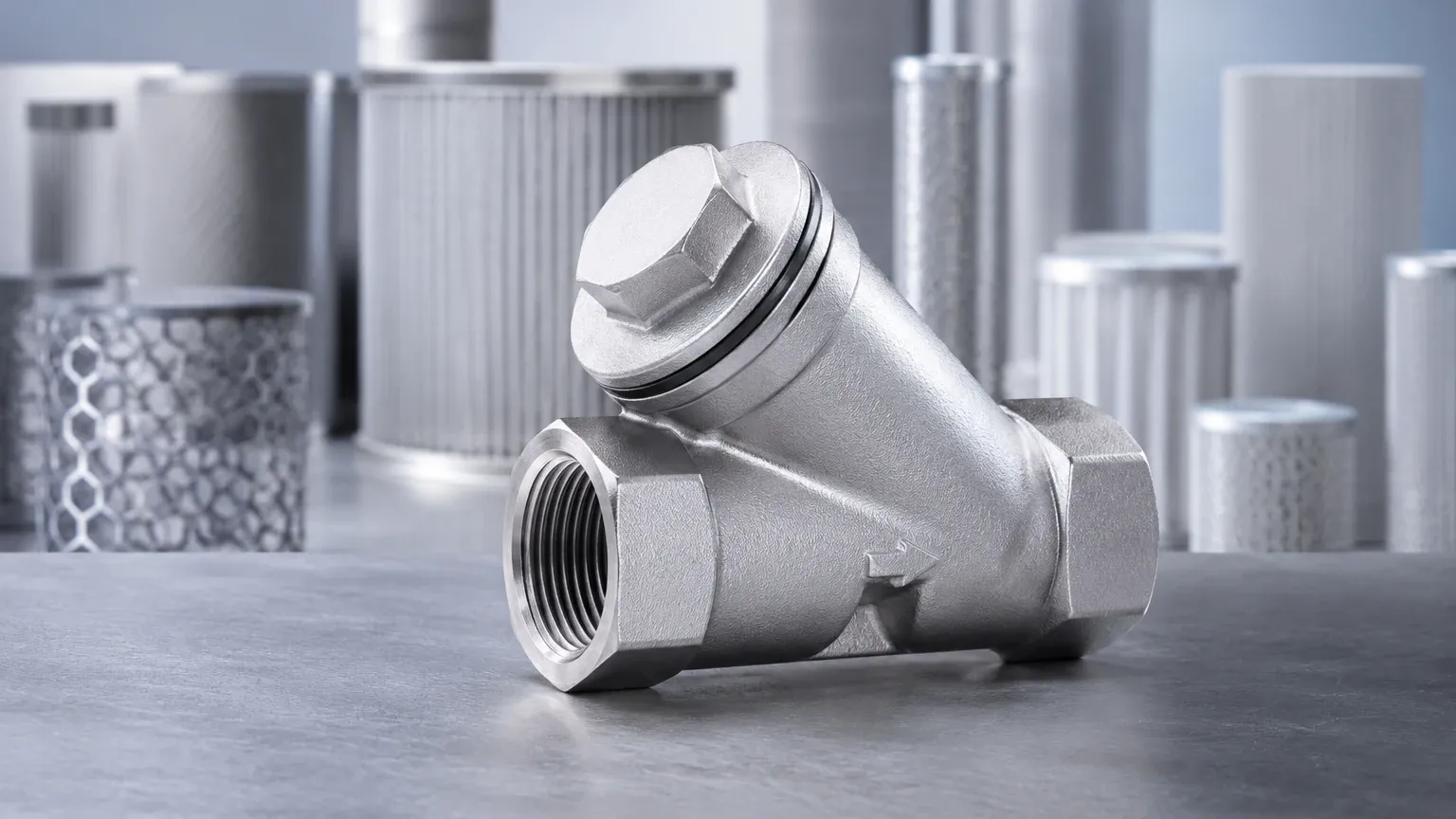
Customization Options for Specific Industrial Applications
Standard off-the-shelf strainers often fail to meet the precise needs of specialized engineering projects. Customization allows for the optimization of every aspect of the strainer 90, from the micron rating to the housing dimensions.
Tailoring Filtration Accuracy (Micron Ratings)
The choice of mesh size depends entirely on the size of the particles that need to be removed. Coarse strainers may use perforated plates with hole sizes ranging from 1/16" to 1/2", while fine filtration requires woven wire mesh capable of capturing particles down to 5 or 10 microns.
When specifying a strainer 90, engineers must balance the need for fine filtration with the risk of rapid clogging. In some cases, a graduated basket—using multiple layers of mesh with decreasing hole sizes—can be used to capture a range of particle sizes, extending the time between cleaning cycles.
Connection Types and Housing Variations
The physical integration of the strainer into the piping system can be achieved through various connection types:
* Flanged Connections: Ideal for high-pressure systems and large pipe diameters, allowing for easy removal for maintenance.
* Threaded (NPT/BSP) Connections: Common in smaller diameter lines (typically under 2 inches).
* Butt-Weld or Socket-Weld: Used in permanent installations where leak prevention is the highest priority.
Custom housing designs can also include features such as quick-opening covers (for tool-less maintenance), vent valves, and drain plugs to facilitate the safe removal of captured debris.
Maintenance and Operational Longevity
The total cost of ownership for Strainers & Baskets is heavily influenced by how easily they can be maintained. A strainer 90 that is difficult to access or clean will inevitably lead to increased downtime and higher labor costs.
Cleaning Protocols for Stainless Steel Baskets
One of the primary advantages of stainless steel baskets is that they are reusable. Unlike disposable cartridge filters, these baskets can be cleaned via backwashing, ultrasonic cleaning, or manual pressure washing. For the strainer 90, the design should allow for the basket to be removed without dismantling the entire piping section. Top-entry designs are particularly popular for this reason, as the basket can be lifted straight out of the housing once the cover is removed.
Monitoring Differential Pressure
To prevent equipment damage, industrial systems should be equipped with differential pressure gauges across the strainer. A significant increase in ΔP indicates that the basket is reaching its holding capacity. Automated systems may include a pressure switch that triggers an alarm or initiates a bypass or cleaning cycle when the pressure reaches a pre-set limit.
Strategic Procurement: Evaluating Total Cost of Ownership
When sourcing a strainer 90, purchasing teams must look beyond the initial purchase price. A low-cost strainer made with inferior materials or poor welding techniques may fail prematurely, leading to catastrophic downstream equipment damage—such as pump impeller erosion or valve clogging.
Key factors in evaluating a supplier include:
1. Manufacturing Capabilities: Does the supplier have the precision equipment necessary for high-quality mesh weaving and stainless steel fabrication?
2. Engineering Support: Can the manufacturer provide technical guidance on flow rates, pressure drops, and material compatibility?
3. Customization Flexibility: Is the supplier able to adjust designs to fit specific space constraints or filtration requirements?
4. Quality Documentation: Can the supplier provide material certifications (MTRs) and pressure test reports?
Kaifil’s expertise in custom stainless steel filtration ensures that every strainer 90 and basket is manufactured to meet the rigorous demands of industrial service. By focusing on durability, precise filtration performance, and engineered flow dynamics, we help our global partners achieve efficient and cost-effective filtration outcomes.
For engineers designing new systems or upgrading existing ones, selecting the right Strainers & Baskets is a critical step in ensuring process stability. Whether the application involves high-viscosity chemicals, high-temperature steam, or sanitary food products, a well-specified 90-degree strainer provides the necessary protection to keep industrial operations running smoothly and reliably.
