


Strainers Crossword Clue 9 Letters
In the world of linguistics and puzzles, the search for a "strainers crossword clue 9 letters" frequently yields the answer "colanders." While this term suffices for domestic kitchenware, the engineering requirements of industrial fluid systems demand a much higher level of precision, durability, and material integrity. In professional chemical processing, pharmaceutical manufacturing, and hydraulic applications, the term "strainers" refers to critical components designed to protect downstream equipment from particulate damage.
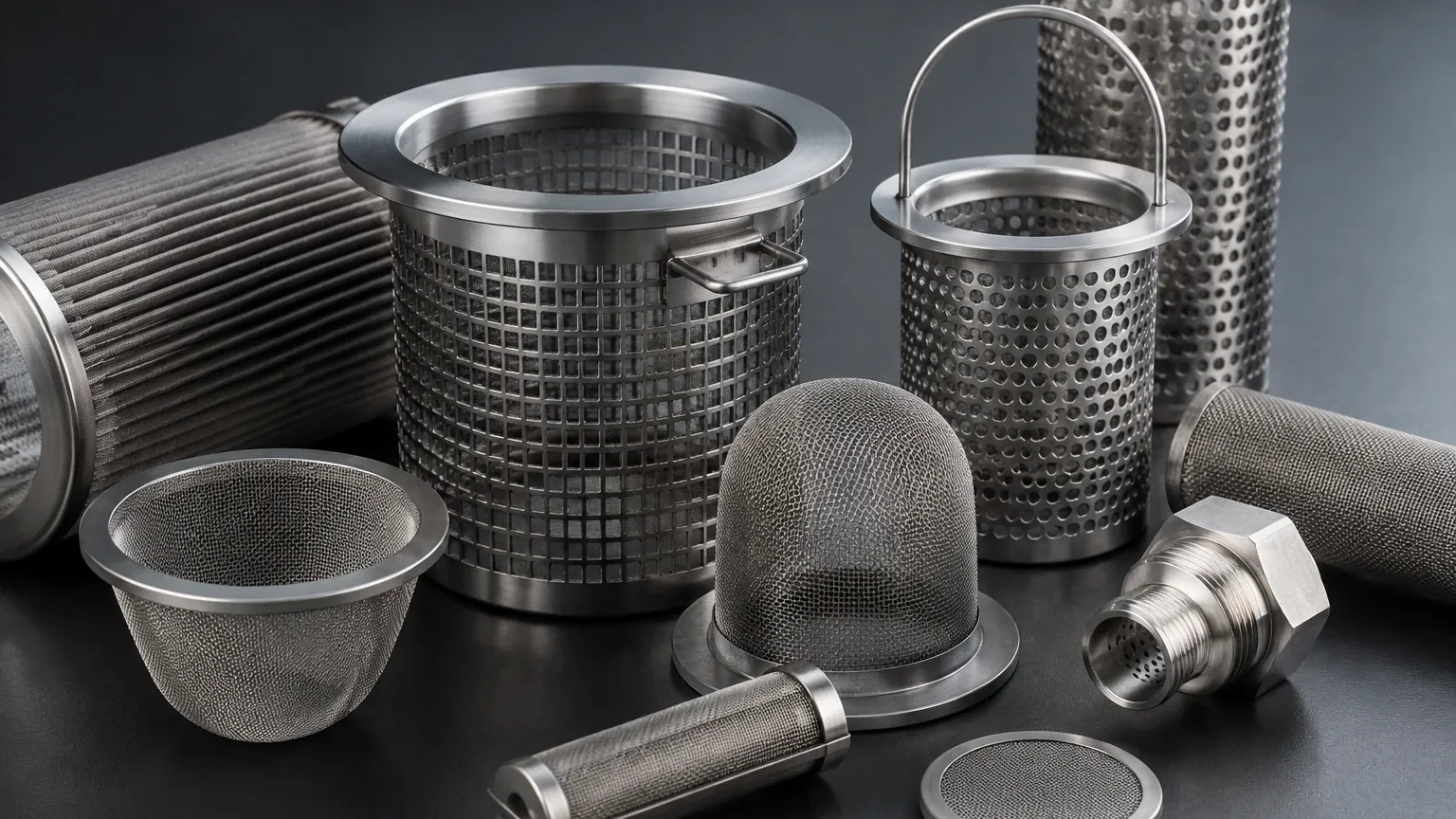
For engineers and procurement professionals, the distinction between a simple domestic strainer and high-performance Strainers & Baskets is found in the technical specifications: micron ratings, pressure drop calculations, and alloy compatibility. Understanding these parameters is essential for ensuring system longevity and operational efficiency.
Beyond the Crossword: Defining Industrial Strainers
While a crossword enthusiast might be satisfied with a 9-letter synonym, a mechanical engineer views a strainer as a coarse filtration device used to remove solids from a flowing liquid or gas. Unlike fine filters, which often utilize disposable media to capture microscopic particles, strainers are typically permanent or semi-permanent components designed for the removal of larger debris.
Industrial strainers are categorized by their configuration and the specific role they play within a piping system. The primary goal is to protect pumps, valves, and instrumentation from "trash"—scale, weld beads, or foreign objects—that could cause mechanical failure or process contamination. In this context, the "strainers crossword clue 9 letters" serves as a reminder that nomenclature matters; in a B2B environment, we transition from "colanders" to "basket strainers," "Y-strainers," and "duplex systems."
Engineering Classifications of Strainers and Baskets
Industrial filtration systems utilize several distinct geometries to manage flow and debris collection. Selecting the correct type depends on the flow rate, the frequency of cleaning required, and the physical space available in the plant layout.
1. Simplex Basket Strainers
Simplex strainers are used in systems where the flow can be intermittently shut down for cleaning. They consist of a top-loading housing containing a removable basket. The basket design allows for a high dirt-holding capacity and a large open-area ratio, which minimizes pressure drop across the unit.
2. Duplex (Twin) Strainers
For continuous processes where flow cannot be interrupted, duplex strainers are the standard. These units consist of two separate strainer chambers connected by a diverter valve. When one basket becomes clogged, the flow is switched to the clean chamber, allowing the operator to service the dirty basket without halting production. This is critical in applications like oil refining or continuous chemical synthesis.
3. Y-Strainers
Named for their shape, Y-strainers are typically used for pressurized lines, either for liquid or gas. They are more compact than basket strainers but generally have a lower dirt-holding capacity. They are often installed upstream of steam traps and control valves where the amount of debris is expected to be minimal.
Material Selection: The Role of Stainless Steel
In industrial environments, the material of construction is the primary determinant of a strainer’s lifespan. While plastic or carbon steel may suffice for non-critical water lines, stainless steel is the gold standard for demanding B2B applications. Kaifil specializes in manufacturing these components using high-grade alloys to withstand corrosive environments and high temperatures.
* 304 Stainless Steel: The most common grade, offering excellent corrosion resistance for food and beverage applications and general industrial use.
* 316/316L Stainless Steel: Contains molybdenum, providing superior resistance to chlorides and pitting. This is essential for pharmaceutical processing, marine environments, and aggressive chemical handling.
* Specialty Alloys: For highly acidic or high-heat environments, materials like Monel or Hastelloy may be utilized in custom basket designs.
Technical Specifications: Mesh vs. Perforation
When specifying Strainers & Baskets, engineers must choose between perforated metal and wire mesh media. This choice is dictated by the size of the particles that need to be captured.
Perforated Metal
Perforated metal is used for the structural body of the basket or for straining larger particles (typically 1/32" to 1/2"). The holes are punched into a metal sheet, providing high mechanical strength. Engineers must calculate the "Open Area Ratio" (OAR), which is the ratio of the total area of the holes to the total area of the pipe inlet. A higher OAR results in a lower initial pressure drop and longer intervals between cleanings.
Wire Mesh Lining
For finer filtration (down to 5 microns), a stainless steel wire mesh is lined inside the perforated basket. The mesh is defined by the "mesh count"—the number of openings per linear inch. As the mesh count increases, the wire diameter usually decreases, and the filtration becomes finer. However, finer mesh is more delicate and requires the structural support of a perforated metal backup to prevent collapsing under high differential pressure.
Performance Metrics: Pressure Drop and Flow Rate
One of the most common questions engineers face is how to size a strainer to avoid excessive pressure drop ($ΔP$). A strainer is essentially a restriction in the pipeline. As debris accumulates in the basket, the $ΔP$ increases. If the pressure drop becomes too high, it can lead to cavitation in pumps or mechanical failure of the strainer basket itself.
To optimize performance, the following factors must be evaluated:
1. Viscosity: Thicker fluids (like heavy oils or syrups) require larger strainers with more surface area to maintain flow.
2. Specific Gravity: The density of the fluid affects the velocity and the resulting pressure drop.
3. Velocity: Higher flow velocities increase the risk of turbulence and rapid pressure loss.
Industrial designers typically aim for a clean pressure drop of less than 2 PSI. When the $ΔP$ reaches 5-10 PSI, it is generally time to clean or replace the basket.
Customization and OEM Solutions in Filtration
In many industrial setups, off-the-shelf strainers do not meet the specific spatial or performance constraints of a project. This is where custom manufacturing becomes vital. OEM filtration solutions allow for the adjustment of flange types (ANSI, DIN, or JIS), housing dimensions, and specialized basket handles for easier extraction.
Kaifil’s manufacturing capabilities include precision TIG welding and plasma cutting, ensuring that custom-designed baskets maintain structural integrity under high-stress conditions. Whether it is a pleated basket to increase surface area or a magnetic insert to capture fine ferrous particles, customization ensures that the filtration component is perfectly matched to the application.
Maintenance and Total Cost of Ownership (TCO)
While the initial purchase price is a factor, the total cost of ownership for industrial strainers is driven by maintenance efficiency and durability. A cheaply made strainer may suffer from "bypass"—where fluid leaks around the edges of the basket—or may require frequent replacement due to corrosion.
Maintenance Best Practices:
* Differential Pressure Monitoring: Installing gauges upstream and downstream of the strainer allows operators to monitor the exact state of the basket.
* Gasket and Seal Inspection: In chemical and food-grade applications, the integrity of O-rings and gaskets is paramount to prevent external leaks and cross-contamination.
* Cleaning Protocols: Stainless steel baskets are reusable. Cleaning methods include back-flushing, ultrasonic cleaning, or chemical soaking, depending on the nature of the contaminant.
Conclusion: Selecting the Right Solution
While the "strainers crossword clue 9 letters" might lead you to "colanders" in a game, in the industrial sector, the answer is always a precisely engineered component designed for reliability. Selecting the right Strainers & Baskets requires a deep dive into fluid dynamics, material science, and process requirements.
For engineers and purchasing teams, the goal is to find a manufacturing partner that understands these technical boundaries. By focusing on high-quality stainless steel construction, accurate micron ratings, and robust mechanical design, facilities can ensure their equipment remains protected, their downtime is minimized, and their processes remain efficient. Whether you are dealing with water treatment, hydraulic oil, or pharmaceutical grade fluids, the right strainer is a critical investment in the health of your industrial system.
