


How Does a Basket Strainer Work
In industrial fluid handling systems, protecting downstream equipment from particulate matter is critical for operational longevity and process integrity. One of the most common and effective tools for this task is the basket strainer. To understand how a basket strainer works, one must look beyond its simple exterior and examine the fluid dynamics, mechanical design, and engineering principles that allow it to remove solids from liquids while maintaining system pressure.
A basket strainer is a closed vessel with a removable screen element—the basket—designed to trap debris. Unlike Y-strainers, which are often used for smaller amounts of particulate in high-pressure steam lines, basket strainers are typically used in horizontal pipelines where high flow rates and a higher dirt-holding capacity are required. They are essential components in chemical processing, food and beverage production, pharmaceutical manufacturing, and hydraulic systems.
The Fundamental Mechanism of Basket Filtration
When analyzing how does a basket strainer work, the process can be broken down into three distinct phases: entry, separation, and exit.
1. Fluid Entry: The process begins when the process fluid enters the strainer housing through the inlet nozzle. In most industrial designs, the inlet is positioned higher than the bottom of the internal basket. This design utilizes gravity to help settle larger particles toward the bottom of the basket immediately upon entry.
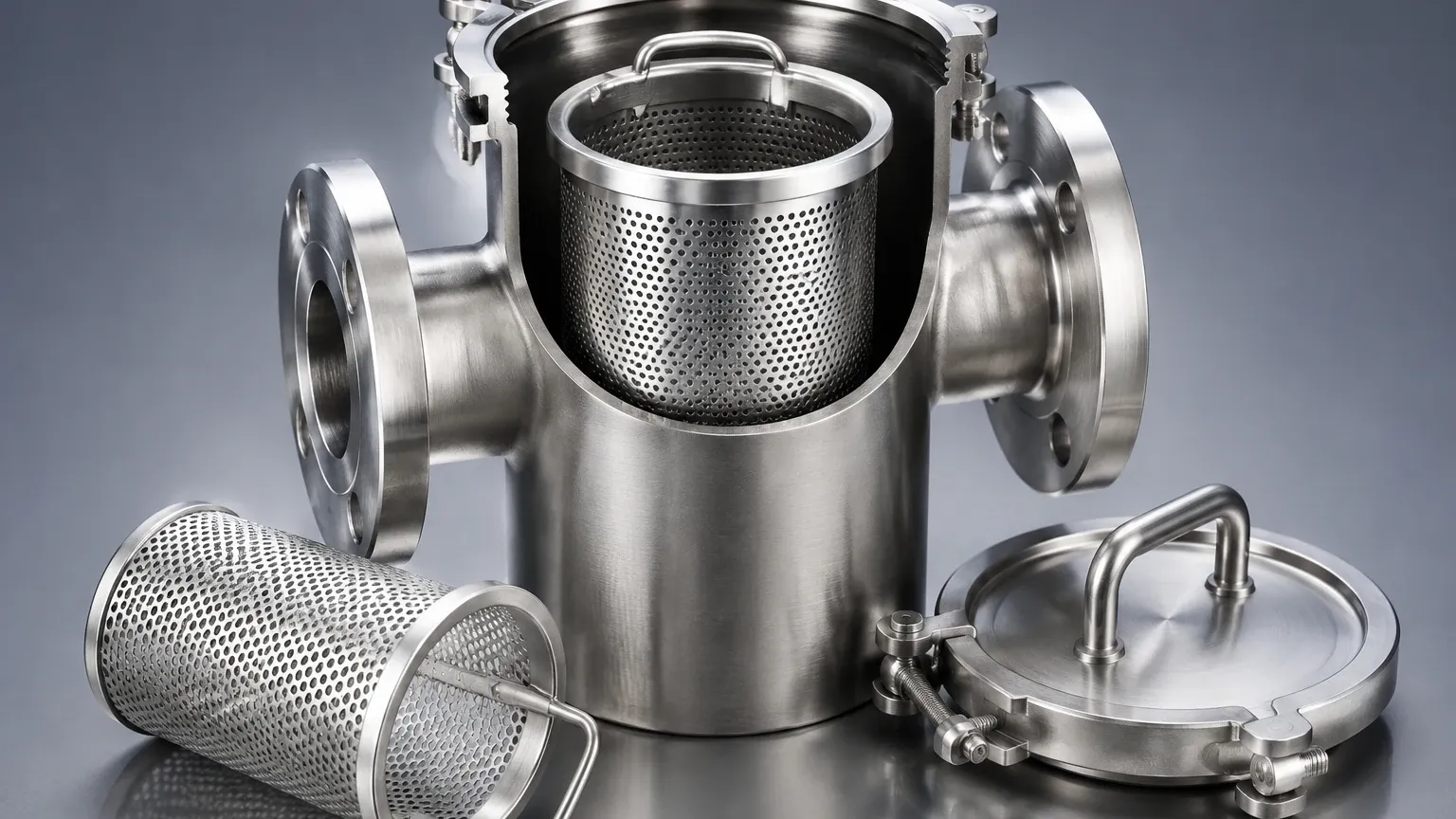
2. Mechanical Separation: As the fluid fills the housing, it is forced to pass through the walls of the internal basket. This basket is typically constructed from perforated metal or a combination of perforated metal and fine wire mesh. The size of the openings in the mesh or perforations determines the "filtration rating." Any solid particles larger than these openings are mechanically trapped inside the basket, while the clean fluid passes through.
3. Fluid Exit: After passing through the basket media, the filtered fluid flows toward the outlet nozzle. Because the basket has a significantly larger surface area than the diameter of the pipe, the fluid velocity slows down within the housing, which helps minimize the pressure drop across the unit.
Because the debris is collected *inside* the basket, it is easily contained. When the strainer is opened for cleaning, the debris is removed along with the basket, preventing it from falling back into the downstream piping.
Key Components and Structural Design
The efficiency of Strainers & Baskets depends heavily on the quality and configuration of their internal components. A standard industrial unit consists of several critical parts:
The Housing (Vessel)
The housing is the outer shell that contains the pressure of the system. It must be rated for the specific temperature and pressure of the application. In heavy-duty industrial environments, these are typically made from cast iron, carbon steel, or stainless steel.
The Filter Basket
This is the heart of the strainer. Baskets are often custom-engineered to meet specific filtration requirements. They can be made of a single layer of perforated stainless steel for coarse straining or lined with a fine stainless steel wire mesh for removing smaller particles. The "open area ratio"—the ratio of the total area of the holes in the basket to the cross-sectional area of the inlet pipe—is a key performance metric. A higher ratio (such as 6:1 or 8:1) ensures that the strainer can operate longer before requiring cleaning.
The Cover and Seals
The cover allows access to the basket for maintenance. In many B2B applications, "quick-opening" covers are preferred to reduce downtime. Seals and gaskets (typically made of EPDM, Viton, or PTFE) are essential to prevent leaks and ensure that fluid does not bypass the basket.
Simplex vs. Duplex Configurations: Operational Differences
Understanding how a basket strainer works also requires distinguishing between the two primary configurations used in industrial settings: Simplex and Duplex.
Simplex Strainers
A simplex strainer consists of a single housing and one basket. It is used in batch processes or systems where the flow can be temporarily shut down to clean or replace the basket. When the pressure drop indicates the basket is full, the system is valved off, the cover is removed, and the basket is cleaned. These are cost-effective solutions for non-critical systems or applications with low contamination levels.
Duplex Strainers
In continuous-flow applications—such as oil refineries, power plants, or chemical processing lines—shutting down the system is not an option. A duplex strainer consists of two separate housings connected by a diverter valve. When one basket becomes clogged, the operator shifts the valve to divert flow to the clean second housing. This allows the first basket to be cleaned without interrupting the process. This design is critical for maintaining 24/7 operations and protecting sensitive equipment like high-speed pumps.
Engineering Considerations: Pressure Drop and Flow Dynamics
Engineers must consider several technical factors when integrating a basket strainer into a system. The most significant of these is the Differential Pressure (ΔP).
As a basket strainer works and begins to collect debris, the available open area for fluid to pass through decreases. This causes an increase in resistance, leading to a higher pressure drop between the inlet and the outlet. If the pressure drop becomes too high, it can lead to several problems:
* Pump Cavitation: If the strainer is on the suction side of a pump, a high pressure drop can starve the pump, leading to cavitation and mechanical failure.
* Basket Collapse: Excessive pressure can physically deform or burst the stainless steel basket if it is not reinforced properly.
* Reduced Flow Rates: The overall efficiency of the process line will drop as the system struggles to push fluid through the clogged media.
To manage this, engineers typically install differential pressure gauges. A common industry standard is to clean the basket when the pressure drop reaches 5 to 10 psi over the "clean" pressure drop.
Another consideration is viscosity. Highly viscous fluids (like heavy oils or syrups) create a higher natural pressure drop than water. For these applications, larger strainers with more surface area are required to maintain acceptable flow rates.
Material Selection for Industrial Environments
Choosing the right material for the basket and housing is vital for durability. In most B2B industrial applications, stainless steel is the material of choice due to its corrosion resistance and mechanical strength.
* 304 Stainless Steel: Suitable for general-purpose applications, including water treatment and many food-grade processes. It offers good resistance to atmospheric corrosion and many organic and inorganic chemicals.
* 316/316L Stainless Steel: Contains molybdenum, which provides superior resistance to chlorides and pitting. This is essential for pharmaceutical manufacturing, chemical processing involving acids, and marine environments.
* Specialty Alloys: For highly aggressive environments, materials like Monel or Hastelloy may be used for the internal mesh to prevent premature failure due to chemical attack.
Customization plays a large role here. Manufacturers like Kaifil provide OEM solutions where the mesh count, perforation size, and structural reinforcement of the basket are tailored to the specific particle size and chemical profile of the process fluid.
Maintenance, Cleaning, and Performance Monitoring
A basket strainer is only as effective as its maintenance schedule. Because the device is designed to fail "safe" by clogging (rather than letting debris through), regular cleaning is mandatory.
The Cleaning Process
1. Isolation: Close the inlet and outlet valves.
2. Venting and Draining: Open the vent valve to relieve internal pressure and use the drain plug to empty the housing of fluid.
3. Removal: Open the cover and lift the basket out using the handle.
4. Cleaning: Use a high-pressure water jet or chemical soak to remove debris from the mesh. It is important to clean from the outside in to push particles out of the mesh openings.
5. Inspection: Check the basket for signs of thinning metal, broken welds, or torn mesh. Also, inspect the cover gasket for wear.
6. Reinstallation: Place the basket back into the housing, ensuring it is properly seated to prevent bypass.
Total Cost of Ownership (TCO)
When evaluating how does a basket strainer work in the context of a budget, purchasing teams should look at the Total Cost of Ownership. A cheaper strainer with a smaller basket might have a lower initial price but will require more frequent cleaning, leading to higher labor costs and more frequent gasket replacements. Investing in a high-capacity stainless steel basket often results in lower long-term costs due to extended service intervals.
Technical Checklist for Selecting Industrial Strainers
Before finalizing a purchase or specifying a design, engineering teams should confirm the following data points to ensure the strainer will perform as expected:
* Flow Rate (GPM/LPM): What is the maximum and normal operating flow?
* Operating Pressure and Temperature: Does the housing meet ASME or other relevant pressure vessel codes for the application?
* Particle Size: What is the smallest particle that must be removed? This determines the mesh or micron rating.
* Allowable Pressure Drop: What is the maximum ΔP the system can tolerate before performance degrades?
* Fluid Compatibility: Are the housing, basket material, and seals compatible with the chemical properties of the fluid?
* Installation Space: Is there enough overhead clearance to lift the basket out of the housing for cleaning?
* Redundancy Requirements: Does the process require a duplex design for continuous operation, or is a simplex unit sufficient?
By understanding the mechanical principles of how a basket strainer works and carefully selecting materials and configurations, industrial operators can significantly reduce equipment wear and optimize the efficiency of their fluid systems. Whether it is protecting a high-value pump or ensuring the purity of a food product, the basket strainer remains a cornerstone of industrial filtration technology.
