


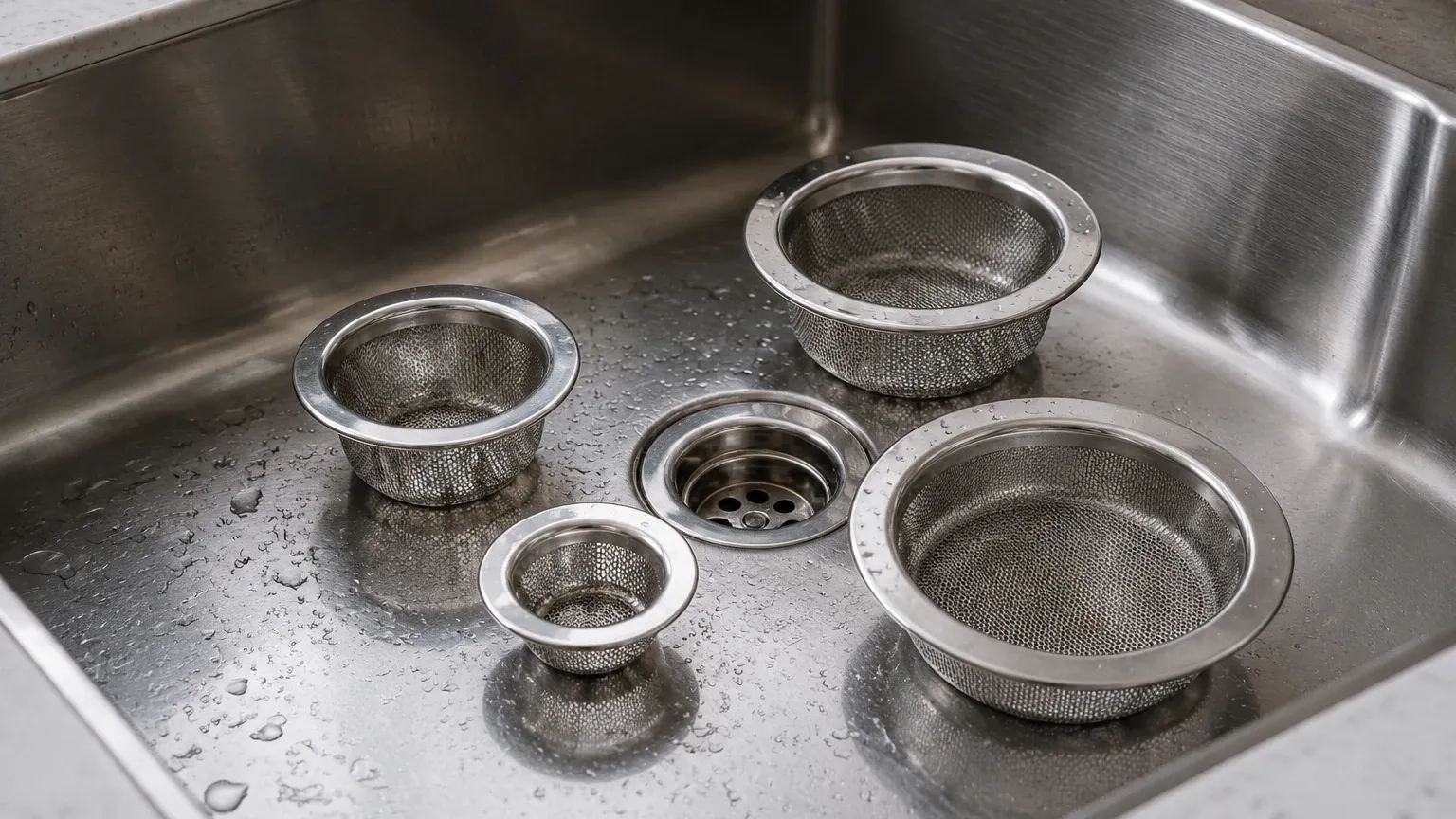
Strainer Baskets for Sinks
In industrial and commercial environments, the primary filtration stage often begins at the point of drainage. While often overlooked, the selection of high-performance strainer baskets for sinks is a critical engineering decision that impacts the longevity of downstream plumbing, the efficiency of wastewater treatment systems, and compliance with environmental regulations. Unlike standard residential components, industrial-grade Strainers & Baskets must withstand corrosive chemicals, high-temperature effluents, and heavy mechanical loads while maintaining precise filtration performance.
For engineers and facility managers, understanding the technical nuances of strainer design—ranging from material metallurgy to mesh configurations—is essential for optimizing fluid handling systems. This guide explores the technical specifications, selection criteria, and application-specific requirements for industrial sink filtration components.
Engineering Fundamentals of Industrial Strainer Baskets
At its core, a strainer basket serves as a mechanical barrier designed to remove solid contaminants from a liquid stream. In sink applications, these solids can range from food waste and organic matter to metal shavings, chemical precipitates, and laboratory debris. The effectiveness of the strainer is determined by its geometry, structural integrity, and the ratio of open area to the total surface area.
The Importance of Open Area Ratio
One of the most critical engineering metrics for strainer baskets for sinks is the "Open Area Ratio" (OAR). This is the ratio of the total area of the holes or mesh openings to the area of the inlet pipe. For industrial applications, a minimum OAR of 3:1 or 4:1 is typically recommended. A higher OAR ensures that as the basket collects debris, the pressure drop across the strainer remains low, preventing drainage backups and reducing the frequency of required cleaning cycles.
Structural Reinforcement
Industrial sinks often handle high volumes of water or heavy debris. Consequently, the basket must be engineered to resist deformation. This is achieved through reinforced rims, heavy-gauge perforated metal backings, and precision welding. For fine filtration requirements, a dual-layer design is often employed: an outer perforated metal basket provides structural strength, while an inner fine wire mesh liner achieves the necessary filtration accuracy.
Material Science: Selecting the Right Alloy
The durability of a sink strainer is directly tied to its material composition. In industrial settings, standard plastics or low-grade plated metals are insufficient due to their susceptibility to chemical attack and thermal stress. Stainless steel remains the industry standard for high-performance filtration.
Type 304 Stainless Steel
SS304 is the most common material for commercial kitchen and general industrial sink strainers. It offers excellent resistance to atmospheric corrosion and is suitable for most food and beverage applications. Its mechanical properties allow for precise fabrication of perforated patterns and fine wire meshes.
Type 316 and 316L Stainless Steel
For environments involving high chloride concentrations, acidic cleaning agents, or pharmaceutical processing, SS316 or its low-carbon variant, SS316L, is required. The addition of molybdenum in SS316 provides superior resistance to pitting and crevice corrosion. In pharmaceutical and chemical laboratories, where the effluent may contain aggressive reagents, using SS316L strainer baskets for sinks ensures a longer service life and prevents metallic contamination of the waste stream.
Specialized Coatings and Finishes
In certain applications, stainless steel may be electropolished. This process removes surface impurities and creates a microscopically smooth finish, which is essential in sanitary applications to prevent bacterial growth and facilitate easier cleaning.
Filtration Precision and Mesh Selection
Choosing the correct filtration level is a balance between capturing necessary particles and maintaining flow rates. Industrial strainers utilize two primary types of filtration media: perforated metal and woven wire mesh.
Perforated Metal Strainers
Perforated baskets are ideal for coarse filtration (typically 1/32" to 1/4" hole diameters). They are highly durable and easy to clean. Common patterns include staggered round holes, which maximize the open area while maintaining the structural rigidity of the basket. These are frequently used in heavy-duty industrial wash stations where large debris is common.
Woven Wire Mesh Liners
When finer filtration is required—such as in laboratory sinks or precision manufacturing—woven wire mesh is integrated into the basket design. Mesh sizes are defined by the number of openings per linear inch. For example, a 100-mesh screen has 100 openings per inch, capable of capturing very fine particulates. When specifying mesh for strainer baskets for sinks, engineers must consider the "micrometer rating" to ensure compatibility with downstream sensitive equipment like high-pressure pumps or fine-membrane water treatment systems.
Application-Specific Design Requirements
Industrial sink filtration is not a one-size-fits-all solution. Different sectors demand specific design features to meet operational goals.
Food and Beverage Processing
In the food industry, hygiene is paramount. Strainer baskets must be designed with "sanitary" features, meaning they lack sharp corners or crevices where organic matter can accumulate. TIG (Tungsten Inert Gas) welding is preferred over spot welding to ensure smooth, continuous joints. Furthermore, the materials must be FDA-compliant and capable of withstanding Clean-in-Place (CIP) chemicals and high-temperature steam sterilization.
Chemical and Pharmaceutical Laboratories
Laboratory sinks often encounter a wide variety of solvents and reagents. The strainer must not only be chemically inert but also designed to capture specialized debris, such as glass fragments or precipitated solids. In these settings, deep-basket designs are often used to increase the holding capacity, allowing for longer intervals between maintenance in facilities that operate 24/7.
Heavy Industrial and Maintenance Facilities
In workshops or automotive maintenance bays, sink strainers are the first line of defense against metal chips, swarf, and heavy grease. These baskets require high mechanical strength and are often equipped with heavy-duty handles to allow for safe removal and emptying when filled with dense metal waste.
Performance Evaluation and Total Cost of Ownership
When evaluating Strainers & Baskets for a facility, it is important to look beyond the initial purchase price and consider the Total Cost of Ownership (TCO). A low-quality strainer may fail prematurely due to corrosion or structural collapse, leading to expensive plumbing repairs and operational downtime.
Pressure Drop and Flow Efficiency
A well-designed strainer minimizes the "clean pressure drop." If a strainer is too restrictive, it will cause slow drainage, leading to standing water in the sink which can be a safety hazard or a source of contamination. Engineers should request flow data or OAR calculations from manufacturers to ensure the component matches the sink's maximum discharge rate.
Cleaning and Maintenance Cycles
The ease of maintenance is a major factor in operational efficiency. Baskets should be designed for quick removal without the need for specialized tools. Features such as ergonomic lift handles, non-stick surface finishes, and robust construction that allows for aggressive mechanical cleaning (such as pressure washing or wire brushing) are essential for reducing labor costs.
Replacement Cycles
While stainless steel is exceptionally durable, it is not indestructible. In highly corrosive environments, a planned replacement cycle should be established. Regularly inspecting strainer baskets for signs of thinning metal, broken welds, or blinded mesh (where pores are permanently clogged) prevents catastrophic failure of the filtration system.
Customization and OEM Capabilities
Many industrial sinks do not conform to standard commercial dimensions. In these cases, custom-engineered strainer baskets are the only viable solution. Customization allows for the optimization of every parameter:
- Dimensions: Tailoring the diameter, depth, and flange width to fit unique drain housings.
- Multi-Stage Filtration: Designing nested baskets with different mesh sizes to capture a range of particle sizes in a single unit.
- Specialized Materials: Utilizing exotic alloys like Monel or Hastelloy for extremely aggressive chemical environments.
- Handle Configurations: Adding extended handles or locking mechanisms for specialized safety requirements.
Working with a manufacturer that offers OEM services ensures that the filtration component is perfectly integrated into the overall system design, rather than being an after-thought that compromises performance.
Conclusion: Confirming Technical Specifications
Before finalizing a purchase for industrial strainer baskets for sinks, technical professionals should confirm several key data points with their supplier:
1. Material Grade: Ensure the stainless steel grade (304 vs 316) matches the chemical profile of the effluent.
2. Filtration Requirement: Define the smallest particle size that must be captured to protect downstream equipment.
3. Flow Rate Compatibility: Verify that the basket's open area can handle the maximum expected flow without significant backup.
4. Structural Integrity: Confirm the gauge of the metal and the type of welding used, especially for heavy-duty applications.
By focusing on these technical parameters, engineers can ensure that their choice of sink strainer provides reliable, long-term protection for their facility’s infrastructure, maintaining both operational efficiency and environmental compliance.
