


Strainer Basket Small
In industrial filtration, the term "small" is relative to the system's flow rate and pipe diameter, yet the performance requirements for a strainer basket small in scale are often more stringent than those for larger components. These precision-engineered components are critical for protecting sensitive downstream equipment such as high-pressure pumps, spray nozzles, and analytical instruments. Whether used in a pilot plant, a hydraulic power unit, or a specialized chemical dosing line, the selection of a small strainer basket requires a deep understanding of fluid dynamics, material science, and mechanical structural integrity.
Strainers & Baskets serve as the primary line of defense against particulate contamination. When dealing with smaller footprints, the engineering challenge lies in balancing high filtration efficiency with a manageable pressure drop. This article explores the technical nuances of small strainer baskets, providing engineers and procurement teams with the data needed to optimize their filtration systems.
Technical Specifications and Engineering Considerations
When specifying a strainer basket small enough for compact industrial applications, engineers must look beyond simple dimensions. The performance of the basket is dictated by its geometry, the type of mesh employed, and the structural reinforcement used to withstand differential pressure.
Micron Rating and Mesh Selection
Small baskets often utilize fine wire mesh to capture microscopic debris. Selection involves choosing between plain weave, twilled weave, or Dutch weave patterns. Plain weave is standard for general applications, while Dutch weave provides higher strength and finer filtration ratings, often down to 5 or 10 microns. The choice of mesh affects the "open area ratio," which is the ratio of the total area of the holes in the basket to the cross-sectional area of the inlet pipe. For a small strainer basket to function efficiently without frequent clogging, an open area ratio of at least 6:1 is typically recommended.
Structural Integrity and Reinforcement
Because small baskets have less surface area to distribute the force of the fluid flow, they can be susceptible to deformation under high pressure. To prevent the mesh from collapsing, industrial-grade small baskets are often constructed with a dual-layer design. An outer layer of heavy-duty perforated stainless steel provides the necessary mechanical strength, while an inner lining of fine wire mesh performs the actual filtration. This "supported mesh" construction ensures the basket maintains its shape even when it becomes partially loaded with contaminants.
Material Selection for Demanding Environments
The longevity of a strainer basket small in size is heavily dependent on its resistance to the process fluid. Stainless steel is the industry standard due to its durability and corrosion resistance, but the specific grade must be matched to the application.
* Grade 304 Stainless Steel: Suitable for general industrial use, water treatment, and applications where mild corrosion resistance is required. It is a cost-effective choice for non-acidic environments.
* Grade 316/316L Stainless Steel: The preferred choice for the pharmaceutical, food and beverage, and chemical industries. The addition of molybdenum provides superior resistance to chlorides and pitting. The "L" (low carbon) version is essential if the basket requires extensive welding during customization, as it prevents carbide precipitation that can lead to intergranular corrosion.
* Exotic Alloys: In highly aggressive environments involving hot acids or seawater, materials like Hastelloy or Monel may be required. While more expensive, these alloys prevent premature failure in critical small-scale systems.
Applications of Small Strainer Baskets in Specialized Industries
Small-scale filtration components are found in almost every sector where precision fluid handling is required. Their role is often to provide "point-of-use" protection immediately before a high-value component.
Hydraulic and Lubrication Systems
In hydraulic systems, even a small amount of particulate matter can cause a valve to stick or a pump to fail. A strainer basket small enough to fit into compact reservoir returns or suction lines ensures that the hydraulic fluid remains within ISO cleanliness standards. These baskets must be able to handle high-viscosity fluids without creating excessive backpressure.
Pharmaceutical and Biotech Processing
In laboratory and pilot-scale pharmaceutical production, filtration must be absolute. Small baskets used here often feature electropolished surfaces to prevent bacterial growth and ensure ease of sterilization. They are used to strain active pharmaceutical ingredients (APIs) or to protect chromatography columns from oversized particles.
Food and Beverage Production
Small strainers are frequently used in flavoring and dosing systems where precise amounts of liquid ingredients are added to a batch. These baskets must comply with FDA standards and are often designed for quick removal to facilitate frequent cleaning and inspection, minimizing the risk of cross-contamination between batches.
Design Customization for Compact Systems
One of the primary challenges with a strainer basket small in scale is fitting it into existing, often cramped, piping layouts. Customization is frequently necessary to ensure a perfect seal and ease of maintenance.
Flange and Seal Options
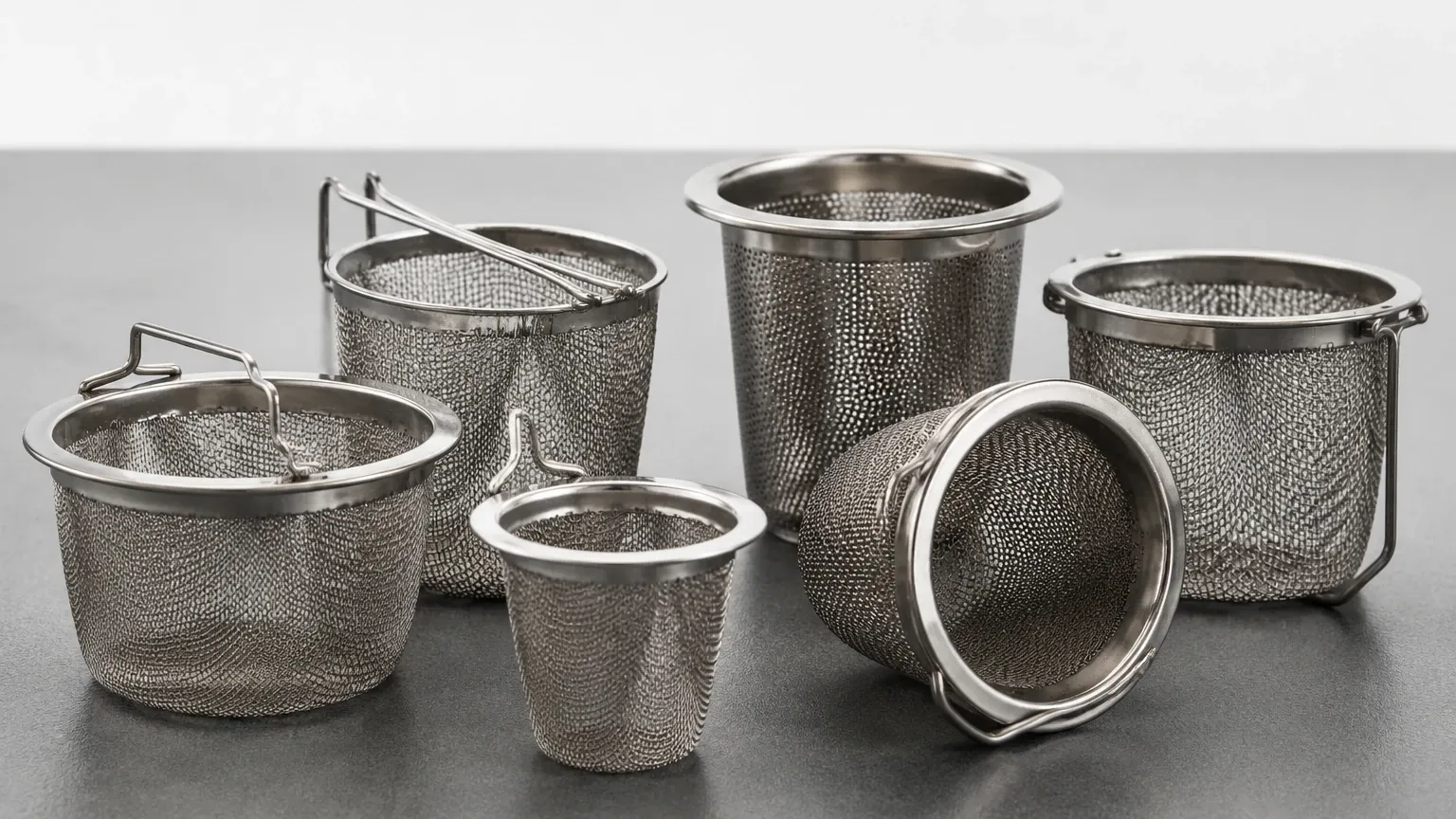
The interface between the basket and the strainer housing is a common point of bypass. Custom small baskets can be manufactured with various flange styles, including flat flanges, angled flanges, or O-ring grooves. A precision-machined flange ensures that 100% of the fluid passes through the filtration media, preventing "dirty" fluid from bypassing the basket.
Handle and Retrieval Mechanisms
In small housings, retrieving a full basket can be difficult. Custom designs include various handle types, such as bail handles, ear handles, or even threaded center posts for mechanical extraction. The handle must be robust enough to withstand the weight of the debris-laden basket without interfering with the housing cover's seal.
Conical vs. Flat Bottom Designs
The shape of the basket influences how debris is collected. A conical or "witch’s hat" design is often used for temporary filtration during system startup, as it offers a high surface area. For permanent installations, a flat-bottom or slanted-bottom basket is more common, as it allows for more uniform accumulation of solids and easier cleaning.
Performance Evaluation and Maintenance Cycles
To ensure the total cost of ownership remains low, engineers must establish clear maintenance protocols for their small strainer baskets. Because these baskets have a smaller holding capacity for solids, they can reach their maximum dirt-holding capacity faster than larger units.
Monitoring Pressure Drop (Delta P)
The most effective way to monitor a small basket's performance is by measuring the pressure drop across the strainer. As the mesh becomes blinded by debris, the pressure drop increases. It is critical to clean or replace the basket before the pressure differential reaches a point where the mesh could be damaged or the flow rate to downstream equipment is compromised.
Cleaning Procedures
Stainless steel baskets are designed for reuse, but the cleaning method must be appropriate for the mesh size. For a strainer basket small enough to have very fine mesh, manual scrubbing can damage the wires. Ultrasonic cleaning is often the preferred method for fine mesh, as it uses high-frequency sound waves to dislodge particles from deep within the weave without physical contact. For coarser baskets, high-pressure water or steam cleaning may be sufficient.
Selecting an OEM Partner for Small Filtration Components
When sourcing a strainer basket small in dimensions but high in technical requirements, the choice of manufacturer is paramount. A professional manufacturer like Kaifil provides the engineering expertise necessary to translate application requirements into a durable physical product.
Key factors to confirm with a supplier include:
1. Material Traceability: Ensure the manufacturer provides Mill Test Reports (MTRs) to verify the grade of stainless steel used.
2. Welding Standards: For industrial applications, TIG (Tungsten Inert Gas) welding is preferred for its precision and clean finish, especially on small components.
3. Quality Control: Ask about pressure testing and micron verification processes to ensure the basket meets the specified filtration accuracy.
4. Customization Capabilities: Confirm the manufacturer can work from CAD drawings or provide design assistance for unique housing geometries.
Conclusion
A strainer basket small in size does not imply a small role in industrial operations. These components are vital for the reliability of complex fluid systems. By focusing on material compatibility, structural reinforcement, and precise mesh selection, engineers can ensure their systems operate at peak efficiency with minimal downtime. When standard off-the-shelf options fall short, opting for customized Strainers & Baskets allows for a solution tailored to the specific pressures, temperatures, and chemical profiles of the application, ultimately protecting the bottom line by safeguarding expensive industrial machinery.
