


Strainer Basket Assembly
In industrial fluid processing, the integrity of downstream equipment—such as pumps, valves, heat exchangers, and spray nozzles—depends heavily on the efficiency of primary filtration. The strainer basket assembly serves as a critical mechanical component designed to remove large-scale particulate matter from liquid or gas streams. Unlike fine membrane filters, these assemblies are engineered for high-volume flow and high-dirt-holding capacity, making them indispensable in chemical processing, water treatment, and food production.
Selecting or designing a strainer basket assembly requires a deep understanding of fluid dynamics, material science, and mechanical engineering. This guide explores the technical specifications, design considerations, and maintenance protocols necessary for optimizing industrial filtration performance.
Understanding the Strainer Basket Assembly Architecture
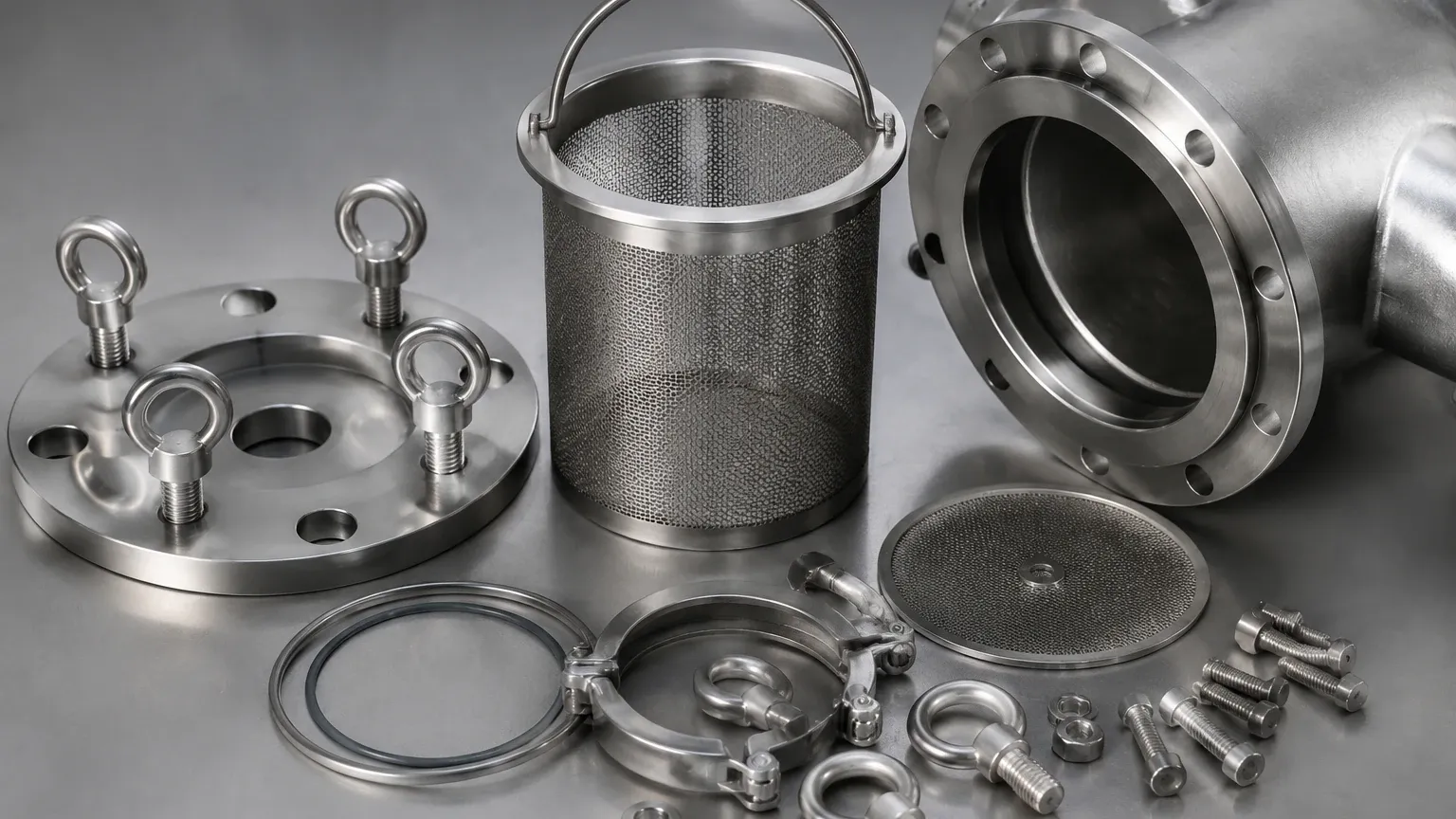
A complete strainer basket assembly is more than just a metal cage; it is a precision-engineered system consisting of several integrated components. Each part must be compatible with the process fluid and the operational environment to prevent bypass, corrosion, or mechanical failure.
The Strainer Housing
The housing is the pressure vessel that contains the fluid and the basket. In industrial B2B applications, these are typically constructed from heavy-duty stainless steel or carbon steel. The design must account for the inlet and outlet configurations (inline, offset, or right-angle) to minimize turbulence and pressure drop.
The Filter Basket
The basket is the removable element that performs the actual filtration. It usually consists of a perforated metal support structure, often lined with a finer wire mesh to achieve specific micron ratings. The "open area ratio" of the basket is a vital metric; a higher ratio allows for longer run times between cleaning cycles and lower initial pressure drops.
Sealing and Closure Mechanisms
To ensure that 100% of the fluid passes through the filtration media, the assembly utilizes high-performance seals (such as O-rings or gaskets made of Viton, EPDM, or PTFE). The closure—whether it is a bolted cover, a quick-opening clamp, or a threaded cap—must be rated for the system's maximum operating pressure and allow for safe, efficient access during maintenance.
Critical Design Parameters for Industrial Strainers & Baskets
When engineers evaluate Strainers & Baskets, they must look beyond simple dimensions. The performance of a strainer basket assembly is dictated by the relationship between the physical structure of the basket and the rheological properties of the fluid.
Perforation vs. Mesh Lining
Standard baskets are often made from perforated plate with hole diameters ranging from 1/32" to 1/2". For finer filtration requirements, a stainless steel wire mesh is welded to the interior or exterior of the perforated basket. This provides the mechanical strength of the plate with the precision of the mesh. Engineering teams must specify the required micron rating based on the smallest particle that could damage downstream components.
Flow Direction and Velocity
Most industrial basket strainers utilize an "inside-out" flow pattern. Debris is collected inside the basket, which simplifies the removal process and prevents contaminants from falling back into the clean side of the housing during maintenance. However, the velocity of the fluid must be controlled; excessive velocity can cause impingement erosion on the mesh or lead to "media migration," where the pressure forces particles through the filter media.
Structural Integrity and Differential Pressure
The basket must be able to withstand the maximum differential pressure ($ΔP$) that the system can generate. If a basket becomes completely clogged, the full system pressure is exerted against the basket walls. Without proper reinforcement—such as heavy-duty support ribs or thicker gauge metal—the basket may collapse, leading to catastrophic downstream contamination.
Material Selection: Durability in Demanding Environments
Material compatibility is a non-negotiable factor in the longevity of a strainer basket assembly. As a specialist manufacturer, Kaifil emphasizes the use of high-grade alloys to meet diverse industrial needs.
* Stainless Steel 304: The standard choice for general industrial applications, offering excellent strength and basic corrosion resistance for water and non-acidic fluids.
* Stainless Steel 316/316L: Preferred for chemical processing and marine environments due to the addition of molybdenum, which enhances resistance to pitting and chloride-induced stress corrosion cracking.
* Specialty Alloys: For highly aggressive environments involving concentrated acids or high temperatures, materials like Monel, Hastelloy, or Titanium may be required.
In the food and beverage or pharmaceutical sectors, the assembly must also meet sanitary standards. This involves high-grit polishing of the stainless steel surfaces and the elimination of "dead legs" where bacteria could proliferate.
Performance Metrics: Flow Rate and Pressure Drop
The primary goal of an optimized strainer basket assembly is to maximize filtration efficiency while minimizing the impact on system hydraulics. The two most important metrics for engineers are the flow coefficient ($Cv$) and the clean pressure drop.
Calculating Pressure Drop
The total pressure drop across an assembly is the sum of the drop across the housing and the drop across the clean basket. As the basket collects debris, the effective open area decreases, and the pressure drop increases exponentially. It is standard engineering practice to size the strainer so that the clean pressure drop does not exceed 2 PSI (0.14 bar) at the maximum design flow rate.
The Importance of the 6:1 Ratio
In high-performance industrial filtration, a common benchmark is the 6:1 ratio. This means the total open area of the strainer basket should be at least six times the cross-sectional area of the inlet pipe. This ensures that even as the basket begins to load with contaminants, the system can maintain its required flow rate without putting undue stress on the pumps.
Customization and OEM Strainer Basket Assembly Solutions
Off-the-shelf filtration products often fail to meet the specific spatial or performance constraints of complex industrial systems. Custom manufacturing allows for the optimization of the strainer basket assembly to fit unique footprints or target specific particle distributions.
Customization options typically include:
* Variable Micron Ratings: Tailoring the mesh lining to capture specific contaminants while allowing smaller, non-harmful particles to pass, thereby extending service life.
* Magnetic Inserts: Adding magnetic rods to the basket to capture fine ferrous particles that might otherwise pass through a standard mesh.
* Reinforced Structures: Designing baskets with extra-thick support frames for high-viscosity fluids or high-pressure hydraulic systems.
* Multi-Basket Configurations: For very high flow rates, multiple baskets can be housed within a single large vessel to distribute the load and simplify manual handling during cleaning.
Kaifil works closely with engineering teams to develop these customized solutions, ensuring that every component of the filtration system is aligned with the operational realities of the plant.
Maintenance and Operational Longevity
A strainer basket assembly is only as effective as its maintenance regime. Neglecting the cleaning cycle is the most common cause of basket failure and pump cavitation.
Monitoring Differential Pressure
Every industrial strainer should be equipped with differential pressure gauges or sensors. These provide real-time data on the state of the basket. A common set point for cleaning is when the $ΔP$ reaches 10-15 PSI, depending on the structural rating of the basket.
Cleaning Protocols
For manual assemblies, the system must be depressurized and drained before the basket is removed. For continuous processes, a duplex strainer assembly—which features two separate housings connected by a diverter valve—allows for cleaning one basket while the other remains in service. When cleaning the basket, it is essential to use soft brushes or ultrasonic cleaning to avoid damaging the delicate wire mesh lining.
Replacement Indicators
Baskets should be inspected for signs of fatigue, such as broken welds, thinning metal, or distorted mesh. Even with regular cleaning, the mechanical stress of flow and pressure will eventually necessitate the replacement of the basket. Keeping a stock of OEM-spec replacement baskets is vital for minimizing downtime.
Total Cost of Ownership Considerations
When procuring a strainer basket assembly, purchasing teams should look beyond the initial capital expenditure. The total cost of ownership (TCO) includes the cost of replacement parts, the labor required for cleaning, and the potential cost of system downtime.
Investing in a high-quality stainless steel assembly with a larger filtration area may have a higher upfront cost, but it significantly reduces the frequency of cleaning and the risk of component failure. Furthermore, a well-engineered assembly with a low pressure drop can lead to substantial energy savings over the life of the system by reducing the load on the pumps.
Conclusion
The strainer basket assembly is a fundamental element of industrial fluid management. By carefully considering material compatibility, flow dynamics, and structural requirements, engineers can ensure that their filtration systems provide reliable protection for years to come. Whether you are dealing with water treatment, chemical manufacturing, or hydraulic systems, the right combination of housing and basket design is essential for operational efficiency.
For technical support in selecting the appropriate filtration components or to discuss custom manufacturing requirements, reviewing specialized product options is the first step toward optimizing your system's performance.
