


Basket Strainer Catalogue
In industrial fluid handling, the integrity of downstream equipment—such as pumps, valves, and flow meters—depends heavily on the effective removal of particulate matter. A comprehensive basket strainer catalogue serves as more than just a list of products; it is a critical engineering resource used to match filtration hardware with specific operational requirements. For engineers and procurement teams, understanding the technical nuances within these catalogues is essential for ensuring system longevity and process efficiency.
Industrial Strainers & Baskets are designed to provide high-capacity filtration with a focus on ease of maintenance. Unlike Y-strainers, which are often used for smaller pipelines or steam applications, basket strainers are typically utilized in larger liquid systems where high flow rates and low pressure drops are mandatory. This guide examines the technical specifications, material considerations, and engineering variables that define a professional filtration catalogue.
Understanding the Role of Strainers & Baskets in Industrial Filtration
The primary function of a basket strainer is the mechanical removal of solids from a flowing fluid. This is achieved by passing the medium through a perforated metal or wire mesh basket. Because the basket is positioned vertically or at an angle within the housing, it can hold a significant volume of debris before requiring cleaning.
In the context of a basket strainer catalogue, products are categorized based on their structural configuration and filtration precision. For heavy-duty industrial environments, such as chemical processing or water treatment, the choice of strainer often dictates the maintenance interval of the entire system. A well-engineered basket provides a large surface area, which directly correlates to a lower "clean pressure drop" and extended service life between cleaning cycles.
Key Technical Parameters Found in a Basket Strainer Catalogue
When reviewing a catalogue, technical professionals must look beyond basic pipe sizes. Several engineering parameters determine whether a specific strainer is suitable for a given application.
Material Selection and Chemical Compatibility
Material science is at the core of durable filtration. Most industrial catalogues feature stainless steel as the primary material due to its corrosion resistance and structural integrity.
* SS304: Suitable for general industrial use, water treatment, and food processing where moderate corrosion resistance is required.
* SS316/SS316L: Preferred for chemical processing, pharmaceutical applications, and marine environments due to its superior resistance to chlorides and acids.
* Specialty Alloys: For highly aggressive environments, catalogues may include Hastelloy or Monel options, though stainless steel remains the industry standard for the majority of custom filtration solutions.
Filtration Accuracy: Mesh vs. Perforation
A professional catalogue will distinguish between the strainer housing and the internal basket media. The basket itself can be constructed in several ways:
1. Perforated Metal: Used for coarse straining (typically 1/32" to 1/2" holes). This provides maximum structural strength and is ideal for removing large debris like scale, welding slag, or stones.
2. Wire Mesh Lining: For finer filtration (down to 5 microns), a perforated metal basket is lined with a precision-woven stainless steel wire mesh. This combination provides both the necessary mechanical support and the required filtration fineness.
3. Wedge Wire: Often featured in high-end catalogues for applications involving sticky or fibrous materials, as the V-shaped profile of the wire helps prevent clogging and facilitates easier backwashing.
Evaluating Flow Dynamics and Pressure Drop
One of the most critical sections of any basket strainer catalogue is the flow data, often represented by the Cv factor (flow coefficient). The Cv factor indicates the volume of water at 60°F that will flow through the strainer with a pressure drop of 1 psi.
Engineers must calculate the "Clean Pressure Drop" to ensure the system pump can handle the resistance introduced by the strainer. As the basket collects debris, the pressure drop (Delta P) increases. A general rule of thumb in industrial design is to size the strainer so that the initial pressure drop does not exceed 2 psi. If the catalogue shows a high pressure drop for a specific pipe size, it may be necessary to select a larger strainer body or a basket with a higher "Open Area Ratio."
The Open Area Ratio (OAR)
The OAR is the ratio of the total open area of the basket to the internal cross-sectional area of the inlet pipe. A high-quality basket strainer typically offers an OAR of 6:1 or higher. A higher ratio means the strainer can operate longer before the accumulated debris causes a significant drop in flow rate, thereby reducing the frequency of manual intervention.
Structural Variations: Simplex vs. Duplex Systems
A comprehensive catalogue will offer different housing configurations to suit different process workflows.
Simplex Strainers
Simplex strainers are used in batch processes or systems that can be shut down periodically for cleaning. When the basket is full, the flow is stopped, the housing is opened, and the basket is removed and cleaned. These are cost-effective and compact, making them a staple in many industrial setups.
Duplex Strainers
For applications where the flow cannot be interrupted—such as cooling water for power plants or continuous chemical production—duplex strainers are required. These units consist of two separate strainer chambers connected by a diverter valve. When one basket becomes clogged, the flow is switched to the clean chamber, allowing the operator to service the dirty basket without stopping the process.
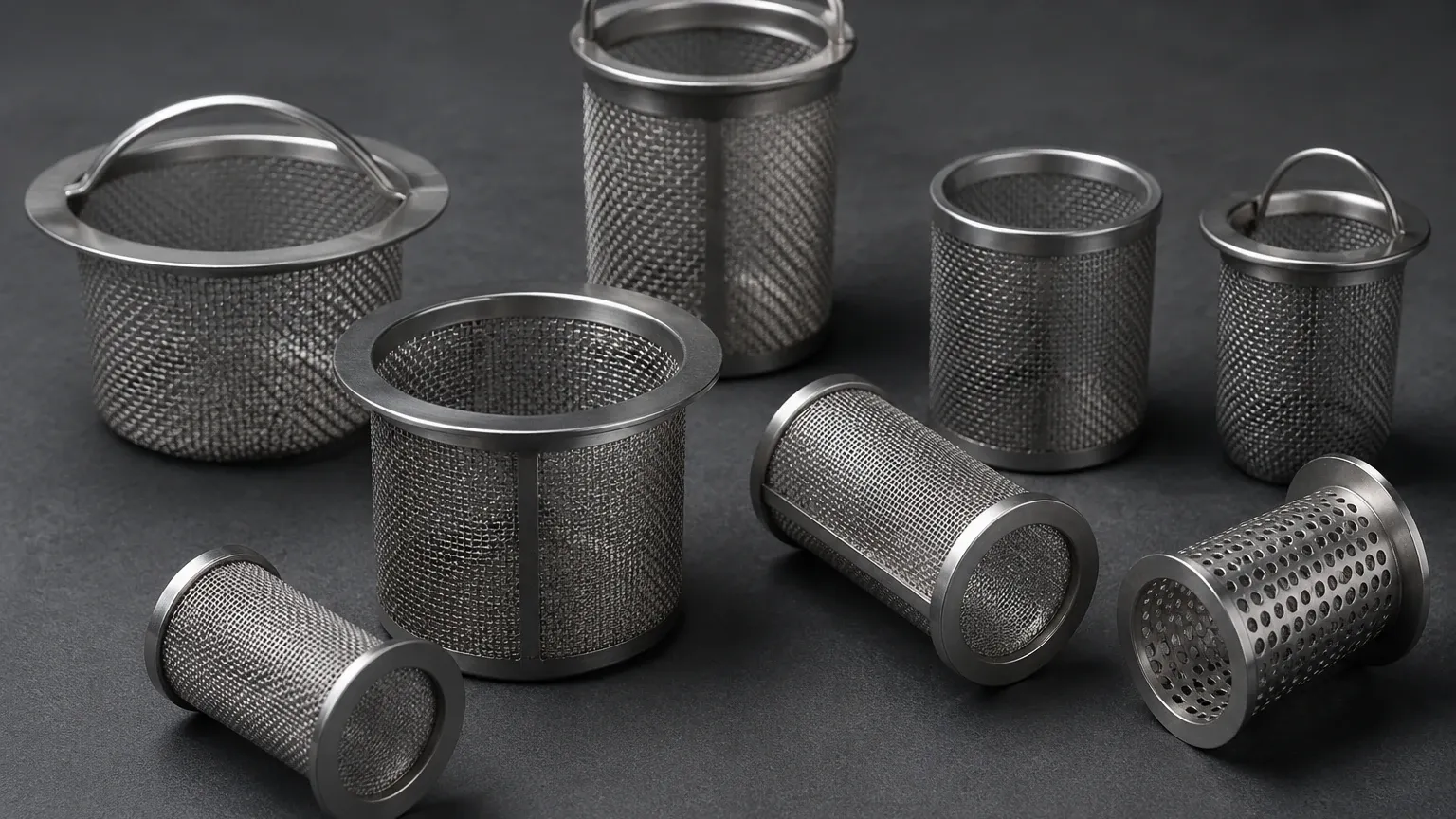
Customization and OEM Capabilities in Metal Filtration
Standard off-the-shelf components often fail to meet the specific demands of specialized industrial equipment. This is where the expertise of a manufacturer like Kaifil becomes invaluable. A robust basket strainer catalogue should highlight the ability to customize dimensions, connection types (flanged, NPT, or socket weld), and internal basket configurations.
Customization options often include:
* Magnetic Inserts: Used to capture fine iron and steel particles that might pass through a standard mesh.
* Reinforced Baskets: For high-pressure applications where the differential pressure might cause a standard basket to collapse.
* Specialized Coatings: Such as PTFE lining for extreme chemical resistance.
For those seeking precision-engineered components tailored to unique flow conditions, reviewing professional Strainers & Baskets options is the first step in the procurement process. Kaifil’s manufacturing capabilities allow for the production of OEM filter components that adhere to strict tolerances, ensuring seamless integration into existing industrial systems.
Maintenance Protocols and Service Life Optimization
The longevity of the components listed in a catalogue is heavily dependent on proper maintenance. Industrial filters are not "set and forget" components.
Differential Pressure Monitoring
Most professional installations include pressure gauges on both the inlet and outlet sides of the strainer. A significant difference between the two readings indicates that the basket is reaching its holding capacity. Catalogues often specify the maximum allowable differential pressure before the basket must be cleaned to prevent damage.
Cleaning Procedures
Stainless steel baskets are valued for their cleanability. Depending on the medium, cleaning may involve:
* Ultrasonic Cleaning: For removing fine particles embedded in the wire mesh.
* Chemical Soaking: For dissolving organic buildup or scaling.
* High-Pressure Air/Water: For routine removal of loose debris.
It is important to inspect the basket for any signs of wire fatigue or perforation damage during each cleaning cycle. Even the highest quality stainless steel components will eventually require replacement due to erosion or mechanical stress.
Selection Checklist for Engineers and Procurement Teams
Before finalizing a selection from a basket strainer catalogue, the following factors should be confirmed to ensure the chosen product meets the application's demands:
1. Fluid Properties: What is the viscosity, temperature, and chemical composition of the fluid? (Viscosity significantly impacts pressure drop calculations).
2. Contaminant Type: Are the solids hard, soft, fibrous, or abrasive? This determines the choice between mesh and wedge wire.
3. Flow Rate: What is the minimum, normal, and maximum flow rate?
4. Pressure Rating: Does the housing meet the ASME or DIN pressure rating required for the pipeline?
5. Space Constraints: Is there enough clearance above or beside the strainer to remove the basket for cleaning?
6. Certification Requirements: Does the application require FDA compliance (for food/beverage) or specific material traceability (MTRs)?
Conclusion
A basket strainer catalogue is an essential tool for maintaining the health of industrial fluid systems. By focusing on technical specifications such as material grade, filtration accuracy, and flow dynamics, engineers can select Strainers & Baskets that provide optimal protection for their equipment. Whether the application calls for a standard simplex unit or a highly customized OEM component, the key to success lies in understanding the engineering boundaries of the filtration media and the operational environment it must serve. Through precise manufacturing and a commitment to quality, Kaifil provides the durable filtration solutions necessary for today’s demanding industrial sectors.
