


Basket Strainer Dimensions
In industrial fluid handling systems, the efficiency of filtration and the protection of downstream equipment—such as pumps, valves, and heat exchangers—depend heavily on the precise specification of Strainers & Baskets. While the general function of a basket strainer is straightforward, the engineering nuances of basket strainer dimensions determine whether a system operates at peak efficiency or suffers from frequent downtime, excessive pressure drops, and mechanical failure.
For engineers and procurement specialists, understanding the relationship between physical dimensions and hydraulic performance is essential. This guide provides a technical overview of the critical dimensions required for proper selection, the impact of these measurements on system performance, and the considerations necessary for custom OEM filtration solutions.
Understanding the Criticality of Basket Strainer Dimensions
Basket strainers are closed vessels with a removable screen or basket that captures particulate matter from a flowing liquid. Unlike Y-strainers, basket strainers are typically used in horizontal pipelines where high flow capacity and easy maintenance are required. The "basket" design provides a larger surface area for debris collection, which is directly influenced by the internal basket strainer dimensions.
If the dimensions are incorrectly specified, several issues can arise:
1. Bypass Leakage: If the basket diameter is too small for the housing seat, unfiltered fluid can bypass the mesh, leading to contamination of sensitive downstream components.
2. Excessive Pressure Drop: A basket with insufficient surface area (often due to restricted height or diameter) will clog quickly, causing a rapid increase in differential pressure ($ΔP$).
3. Structural Failure: In high-pressure applications, a basket that does not fit securely within the housing guides may vibrate or shift, leading to mechanical fatigue and eventual rupture of the stainless steel mesh.
Primary External Dimensions for System Integration
When integrating a strainer into a new or existing piping layout, the external dimensions of the housing are the first priority. These dimensions ensure that the unit fits within the physical constraints of the facility and aligns with the piping standards.
Face-to-Face (FTF) Length
This is the total length of the strainer from the inlet flange to the outlet flange. For standard ANSI or ASME rated strainers, these lengths are often standardized to ensure interchangeability. However, in custom industrial applications, Kaifil can manufacture units with specific FTF lengths to match legacy piping without the need for expensive modifications.
Center-to-Bottom (CTB) and Center-to-Top (CTT)
The CTB dimension is critical for maintenance clearance. It defines how much space is required below the strainer to allow for drainage or the removal of a bottom-exit basket. Conversely, the CTT dimension determines the clearance needed to lift the basket out of the housing from the top. Engineers must ensure that overhead structures or adjacent piping do not obstruct the removal of the internal filtration element.
Flange and Connection Sizes
Standard pipe sizes (NPS) typically range from 1/2" to 24" or larger for industrial basket strainers. The flange rating (e.g., Class 150, 300, or 600) dictates the thickness and bolt hole pattern of the connections. Matching these dimensions is fundamental to leak-proof installation.
Internal Basket Geometry and Filtration Efficiency
The performance of the strainer is dictated by the internal basket strainer dimensions. These measurements are not just about "fitting" inside the housing; they are about maximizing the effective filtration area (EFA).
Basket Diameter and Height
The ratio between the basket diameter and its height determines the total volume available for debris collection. A taller basket generally offers a longer service life between cleaning cycles. In custom filtration design, the internal clearance between the basket's outer wall and the housing's inner wall must be minimized to prevent turbulence, yet sufficient enough to allow for easy removal even when the basket is heavily loaded with solids.
The Open Area Ratio (OAR)
One of the most critical engineering metrics is the Open Area Ratio. This is the ratio of the total open area of the basket (the sum of the areas of all the holes in the mesh or perforation) to the cross-sectional area of the inlet pipe.
* Standard OAR: Most industrial applications require an OAR of at least 6:1.
* High-Viscosity OAR: For thicker fluids or high-loading applications, an OAR of 8:1 or 10:1 may be necessary to maintain acceptable flow rates.
If the basket strainer dimensions result in a low OAR, the velocity of the fluid through the mesh increases significantly, which can force soft contaminants through the openings or cause premature blinding of the filter media.
Engineering Calculations: Flow Area and Pressure Drop
When selecting Strainers & Baskets, engineers must calculate the clean pressure drop to ensure the pump head is sufficient. The pressure drop is a function of the fluid's velocity, density, viscosity, and the geometry of the basket.
The Role of Perforation and Mesh
Basket strainer dimensions also include the size of the openings.
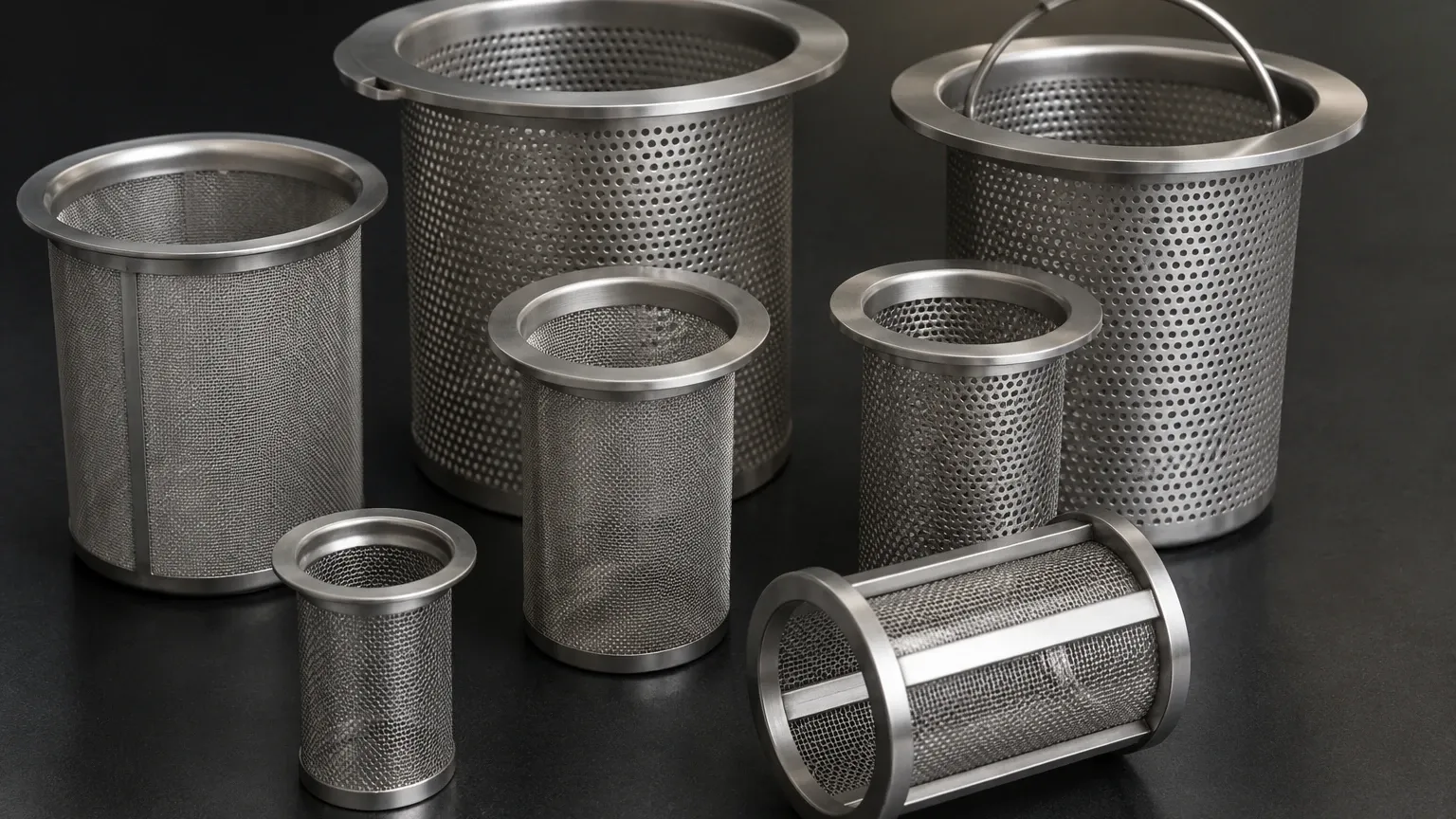
* Perforated Plate: Typically used for coarse filtration (e.g., 1/16" to 1/4" holes). The thickness of the plate must be balanced with the hole size to maintain structural integrity under high differential pressure.
* Wire Mesh Liners: For finer filtration (down to 5 microns), a stainless steel wire mesh is lined inside a perforated metal basket. The dimensions of the wire diameter and the weave type (plain, twilled, or dutch weave) affect the flow resistance.
Calculating Effective Filtration Area (EFA)
The EFA is calculated by taking the total surface area of the basket and multiplying it by the percentage of open area of the specific mesh or perforation used. For example, a perforated plate with 1/8" holes on 3/16" centers has approximately a 40% open area. If the physical basket strainer dimensions provide 100 square inches of surface area, the EFA is only 40 square inches.
Material Selection and Structural Integrity in Custom Designs
At Kaifil, we emphasize that dimensions cannot be viewed in isolation from material properties. A large basket with thin walls may collapse under the weight of collected debris or the force of a pressure surge.
Stainless Steel Grades
Most industrial baskets are manufactured from 304 or 316 stainless steel. 316L is often preferred in chemical processing and pharmaceutical applications due to its superior corrosion resistance. The gauge of the metal used for the basket walls must be thick enough to resist deformation, especially in high-viscosity or high-flow environments.
Reinforcement Features
For larger basket strainer dimensions, structural reinforcement is often required. This can include:
* Reinforcing Rings: Welded to the top and bottom of the basket to maintain circularity.
* Longitudinal Stiffeners: Vertical bars welded to the exterior of the basket to prevent collapse under high $ΔP$.
* Heavy-Duty Handles: Designed to withstand the force required to pull a clogged, heavy basket from the housing.
Specification Checklist for OEM Replacement Baskets
When ordering replacement components or designing a custom filtration system, providing accurate basket strainer dimensions is paramount. Use the following checklist to ensure all technical requirements are met:
1. Top Flange/Ring Diameter: The outer diameter of the lip that seats the basket in the housing.
2. Body Diameter: The outer diameter of the main cylinder of the basket.
3. Overall Height: From the top of the seating ring to the very bottom of the basket.
4. Bottom Style: Is the bottom flat, slanted, or dished? Does it have a hole for a blow-down connection?
5. Handle Type: Does it require a fixed handle, a drop handle, or a cross-bar for extraction?
6. Filtration Level: Specify the perforation size and, if applicable, the mesh count of the liner.
7. Operating Conditions: Maximum flow rate, operating pressure, temperature, and fluid viscosity.
Conclusion: Optimizing Performance through Dimensional Accuracy
Selecting the right Strainers & Baskets involves more than just matching a pipe size. It requires a deep dive into the basket strainer dimensions to ensure the unit can handle the required flow capacity while providing a sustainable service life.
As a specialist manufacturer, Kaifil provides the engineering expertise necessary to navigate these technical specifications. Whether you are replacing a standard basket or requiring a custom-engineered filtration solution for a complex industrial process, focusing on dimensional accuracy is the most effective way to reduce total cost of ownership and protect your critical infrastructure. By optimizing the relationship between housing size, basket geometry, and mesh selection, facilities can achieve reliable, high-performance filtration that meets the rigorous demands of modern industry.
