


Basket Strainer Drawing
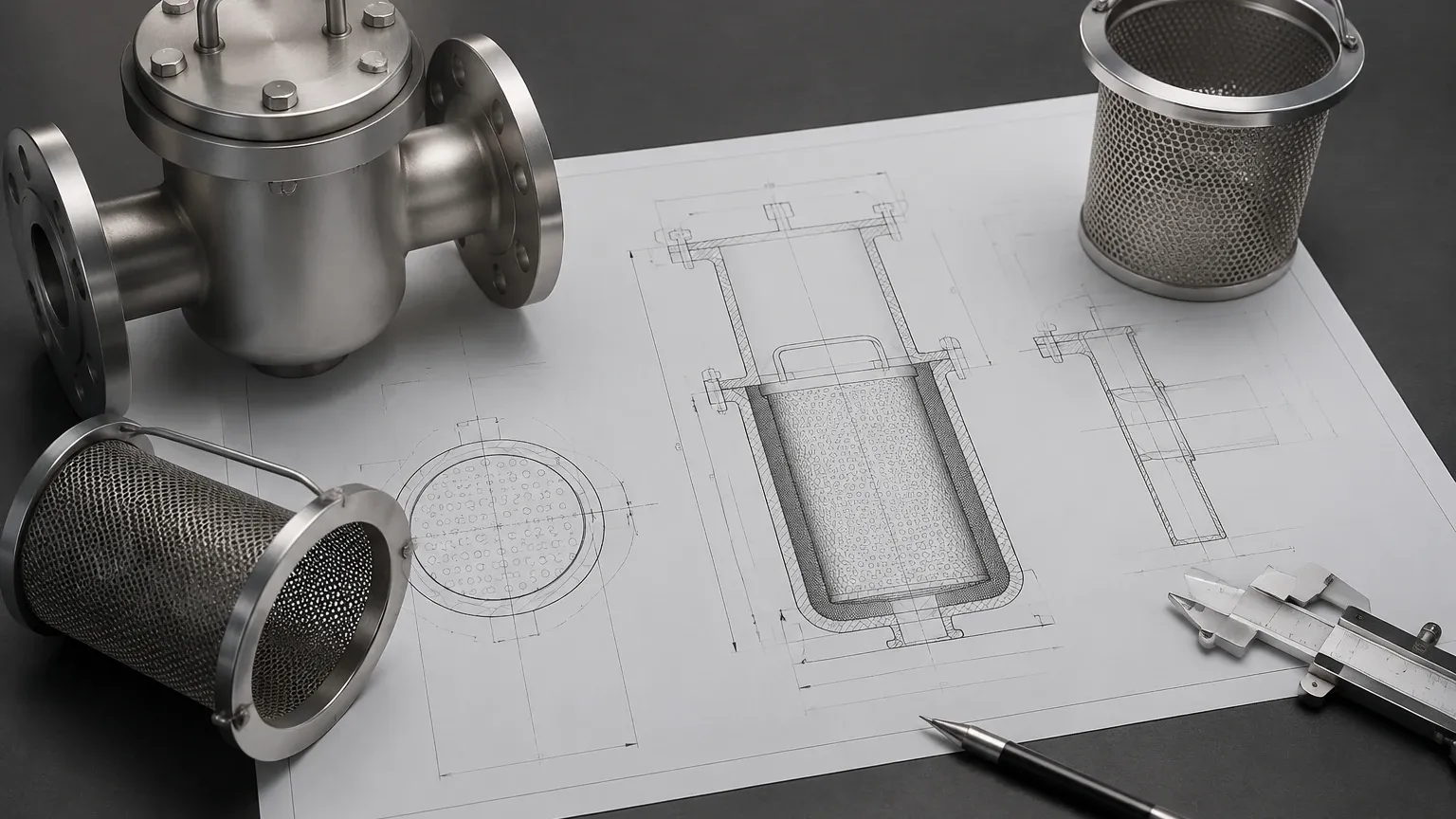
In the landscape of industrial fluid handling, the technical drawing serves as the definitive bridge between engineering intent and physical reality. For procurement managers, plant engineers, and system designers, a basket strainer drawing is more than a simple schematic; it is a critical document that dictates the compatibility, performance, and maintenance lifecycle of a filtration system. Whether integrating a standard unit or a custom-engineered solution, understanding the nuances of these drawings is essential for ensuring the protection of downstream equipment like pumps, valves, and heat exchangers.
Industrial Strainers & Baskets are designed to remove large particles from liquid streams. Because these components are often pressure-rated and subject to rigorous chemical or thermal stress, the accuracy of the initial drawing directly impacts the safety and efficiency of the entire process line. This article explores the technical requirements, engineering considerations, and critical data points that must be verified within a professional drawing before moving to production or installation.
The Role of Technical Drawings in Industrial Filtration
A comprehensive basket strainer drawing serves several functions within a B2B engineering workflow. First, it provides the spatial layout required for piping designers to allocate footprint and clearance. Second, it acts as a quality control benchmark, ensuring that the manufactured unit adheres to the specified tolerances and material requirements. Finally, it serves as a long-term reference for maintenance teams when identifying replacement parts or gaskets.
For manufacturers like Kaifil, receiving or providing a detailed drawing is the first step in the OEM process. It allows for the verification of flange alignments, the assessment of weld procedures, and the confirmation of internal basket geometry. In complex industries such as chemical processing or pharmaceutical manufacturing, even a minor discrepancy in the drawing—such as an incorrect face-to-face dimension—can lead to significant downtime and costly field modifications.
Essential Elements of a Comprehensive Basket Strainer Drawing
A professional-grade engineering drawing for a basket strainer should include several distinct views and datasets. Engineers should look for the following components to ensure the drawing is actionable:
General Arrangement (GA) View
The GA view provides the overall dimensions of the strainer, including the total height, the distance from the center line to the floor, and the face-to-face dimensions of the inlet and outlet ports. This view is critical for determining if the unit will fit within the existing piping envelope.
Sectional Details
Cross-sectional views reveal the internal configuration of the strainer. This includes the seating arrangement of the basket, the location of the support bridge (if applicable), and the flow path of the fluid. It is here that the "dirty side" and "clean side" of the filter are clearly demarcated, showing how the fluid enters the basket and exits through the mesh.
Bill of Materials (BOM)
A complete drawing must include a BOM table. This table lists every component of the assembly, from the housing body and cover to the specific alloy used for the basket and the elastomer material for the O-rings or gaskets. For high-performance applications, specifying materials like SS316L or Hastelloy within the BOM is vital for corrosion resistance.
Engineering Considerations: Dimensions and Connection Standards
Precision in a basket strainer drawing is paramount when it comes to connection points. Industrial systems rely on standardized interfaces to ensure leak-proof operation under pressure. The drawing must specify the following:
* Flange Specifications: If the strainer is flanged, the drawing must indicate the standard (e.g., ASME B16.5), the pressure class (e.g., Class 150, 300, or 600), and the flange face type (Raised Face or Flat Face).
* Threaded or Socket Weld Connections: For smaller units, NPT or BSPT threads must be clearly labeled, along with the nominal pipe size.
* Face-to-Face (F-F) Dimensions: This is the distance between the inlet and outlet connection faces. In replacement scenarios, the F-F dimension must match the existing piping gap exactly to avoid expensive pipe re-work.
* Wall Thickness: Especially in high-pressure or corrosive environments, the drawing should specify the minimum wall thickness of the housing to comply with pressure vessel codes like ASME Section VIII.
Material Selection and Filtration Media Specifications
The heart of any strainer is the internal basket. A detailed basket strainer drawing must provide specific engineering data regarding the filtration media. Kaifil specializes in custom stainless steel filtration solutions, where the selection of the basket media is tailored to the specific particle size and flow rate of the application.
Perforated Plate vs. Wire Mesh
The drawing should specify whether the basket is constructed from a perforated plate, a wire mesh, or a combination of both (mesh-lined perforated plate). For perforated plates, the hole diameter and pitch (staggered or square) must be defined. For wire mesh, the mesh count, wire diameter, and weave type (plain, twilled, or Dutch weave) are required.
Micron Ratings and Filtration Accuracy
Engineers must confirm that the filtration accuracy specified in the drawing aligns with the protection requirements of downstream equipment. If a pump requires protection from particles larger than 200 microns, the basket drawing should reflect a mesh size that provides a safety margin below that threshold.
Performance Metrics: Open Area Ratio and Pressure Drop
One of the most technical aspects of a basket strainer drawing is the calculation of the Open Area Ratio (OAR). The OAR is the ratio of the total open area of the basket's holes to the cross-sectional area of the inlet pipe. A well-designed basket strainer typically maintains an OAR of at least 6:1 or 8:1.
Why does this matter? A higher OAR results in a lower initial pressure drop (Delta P) across the strainer. It also extends the service interval, as the strainer can accumulate more debris before the pressure drop reaches a critical level. The drawing should ideally provide the total surface area of the basket, allowing engineers to calculate the expected flow velocity and ensure it remains within laminar or acceptable turbulent limits.
Maintenance Planning: Clearance and Porting
A common mistake in system design is failing to account for the physical requirements of servicing the equipment. A professional drawing will include "Clearance Required for Basket Removal." This dimension indicates how much vertical or horizontal space is needed to pull the basket out of the housing for cleaning.
Furthermore, the drawing should specify the location and size of auxiliary ports:
* Drain Port: Located at the bottom of the housing to allow for the removal of liquid before opening the cover.
* Vent Port: Located at the highest point to bleed off trapped air during start-up.
* Differential Pressure Ports: Critical for installing gauges that monitor the clogging status of the basket. The drawing should show these ports on both the upstream and downstream sides of the basket.
Customization and OEM Integration with Kaifil
At Kaifil, we understand that standard off-the-shelf Strainers & Baskets do not always meet the rigorous demands of specialized industrial processes. Our engineering team works closely with clients to refine their basket strainer drawing or develop new designs from scratch.
Customization options often include:
* Specialty Alloys: Utilizing SS316, SS316L, or Duplex stainless steel for enhanced chemical resistance.
* Reinforced Baskets: Designing baskets with internal or external support cages to withstand high differential pressures without collapsing.
* Cover Mechanisms: Options for bolted covers, quick-opening swing bolts, or davit assemblies for larger, heavier units.
* Magnetic Inserts: Adding magnetic rods within the basket to capture fine ferrous particles that might otherwise pass through the mesh.
By ensuring that every detail is captured in the drawing—from the weld type to the surface finish (e.g., pickling, passivating, or electro-polishing)—we help our partners achieve reliable and cost-effective filtration performance.
Common Risks and Verification Steps
Before finalizing a purchase based on a drawing, engineering teams should perform a final verification to mitigate common risks:
1. Flow Direction: Ensure the inlet and outlet are correctly oriented for the intended piping layout. Some strainers are uni-directional.
2. Gasket Compatibility: Verify that the gasket material specified in the BOM is compatible with the process fluid and operating temperature.
3. Weight Considerations: For large-scale strainers, the dry weight and the operating (fluid-filled) weight must be noted to ensure the piping supports are adequate.
4. Compliance Standards: Confirm that the drawing references the necessary certifications, such as CE, PED, or ASME, as required by local regulations or corporate safety standards.
Conclusion
The basket strainer drawing is the foundational document for any successful industrial filtration project. It provides the technical clarity needed to ensure that the equipment performs its primary function: protecting the integrity of the fluid system. By focusing on dimensional accuracy, material specifications, and performance metrics like the open area ratio, engineers can select and implement filtration solutions that offer long-term reliability and minimal total cost of ownership.
For those seeking high-performance, customized filtration components, partnering with a manufacturer that prioritizes technical precision is essential. Kaifil provides the engineering expertise and manufacturing capabilities to turn complex drawings into durable, high-efficiency filtration hardware tailored to the most demanding industrial environments.
