


Basket Strainer Elbow
In industrial piping systems, protecting downstream equipment from particulate contamination is a critical engineering requirement. While standard inline strainers are common, space constraints and piping geometry often necessitate a more specialized solution. The basket strainer elbow serves as a dual-purpose component, functioning both as a 90-degree directional fitting and a high-capacity filtration point. By integrating the straining mechanism directly into a corner or bend, engineers can optimize plant layouts while ensuring the longevity of pumps, valves, and heat exchangers.
For technical professionals and purchasing teams, selecting the correct Strainers & Baskets involves understanding the fluid dynamics of elbow configurations, the material properties of stainless steel alloys, and the specific maintenance requirements of the application. This guide examines the technical nuances of the basket strainer elbow and the criteria necessary for successful industrial implementation.
Engineering Fundamentals of the Basket Strainer Elbow
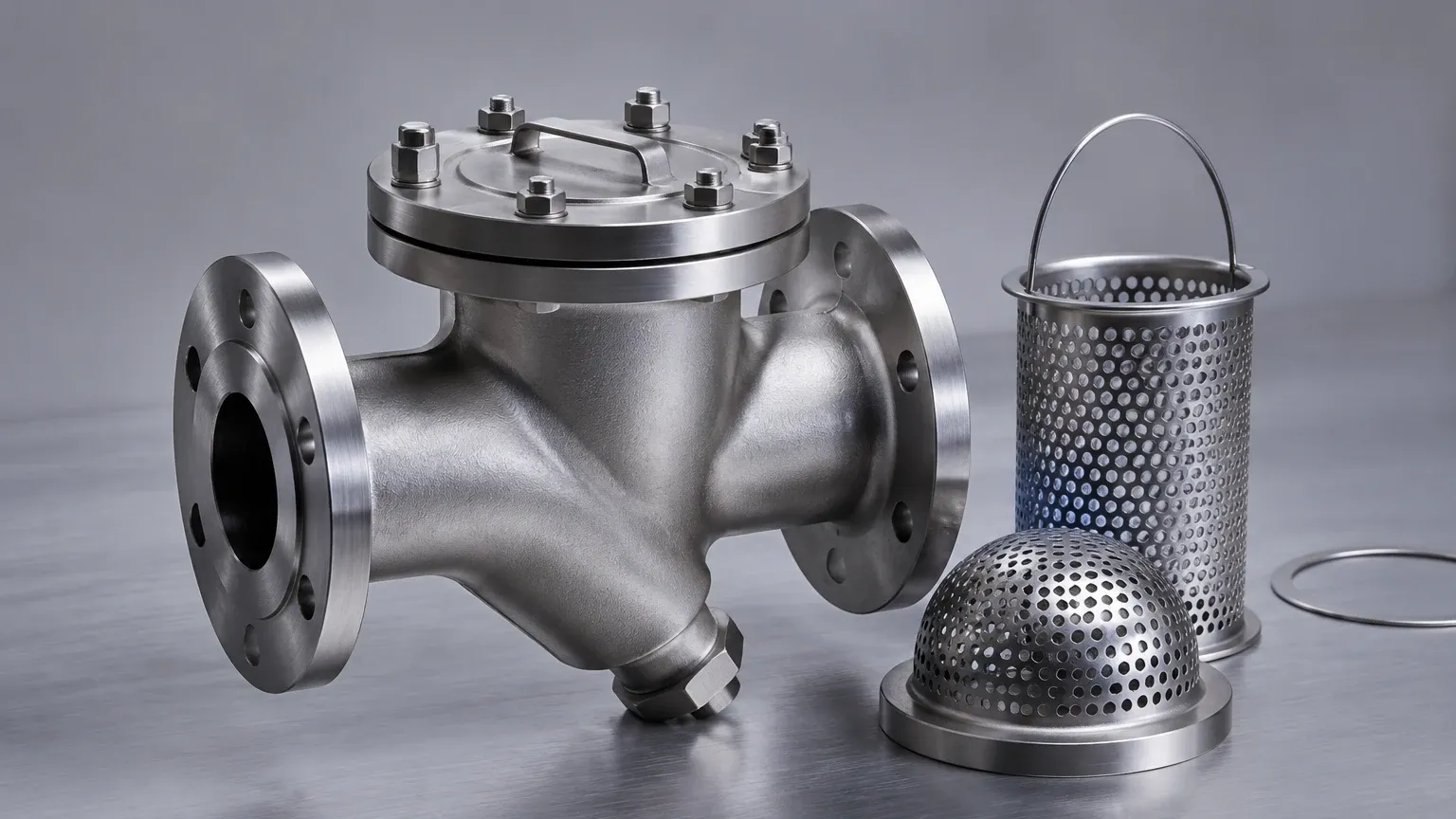
A basket strainer elbow is designed to be installed at a 90-degree turn in a pipeline. Unlike a standard long-radius elbow, which simply redirects flow, the strainer version features an enlarged housing that accommodates a removable basket. This design is particularly advantageous in modular skid manufacturing and compact processing plants where horizontal or vertical space is at a premium.
Flow Dynamics and Turbulence
In a standard elbow, fluid velocity profiles are disrupted, often creating turbulence at the outer radius. When a basket is introduced into this geometry, the internal volume must be carefully engineered to prevent excessive pressure drop. High-quality designs ensure that the "open area ratio" (the ratio of the total area of the basket holes to the cross-sectional area of the inlet pipe) is significantly higher than 1:1—often reaching 6:1 or 8:1 in high-performance models. This high ratio compensates for the flow resistance inherent in a 90-degree turn.
Structural Integrity
Because these components are often placed at points of high stress within a piping system, the housing must withstand both internal hydraulic pressure and external mechanical loads. Industrial-grade basket strainer elbows are typically fabricated from heavy-gauge stainless steel or cast alloys to ensure they do not deform under pressure surges or thermal expansion.
Material Selection for Industrial Environments
Material compatibility is the most significant factor in determining the service life of a basket strainer elbow. Kaifil specializes in stainless steel solutions, as these offer the necessary corrosion resistance and mechanical strength for demanding sectors like chemical processing and pharmaceutical manufacturing.
* Grade 304 Stainless Steel: Suitable for general industrial applications, water treatment, and mildly corrosive environments. It provides excellent strength and cost-effectiveness for non-acidic fluids.
* Grade 316/316L Stainless Steel: The standard for chemical processing and marine environments. The addition of molybdenum enhances resistance to pitting and crevice corrosion, particularly in the presence of chlorides.
* Surface Finishes: In food and beverage or pharmaceutical applications, the internal and external surfaces may require specific Ra (Roughness Average) values. Electropolishing or mechanical polishing prevents bacterial growth and ensures compliance with sanitary standards.
When specifying a basket strainer elbow, engineers must also consider the gasket and seal materials. Common options include EPDM, Viton (FKM), and PTFE, each selected based on the chemical composition and temperature of the process fluid.
Performance Criteria: Filtration Rating and Pressure Drop
The primary function of the strainer is to remove solids of a specific size. This is achieved through the selection of the basket media, which typically consists of a perforated metal sheet, often reinforced with a fine wire mesh liner.
Micron vs. Mesh Ratings
Filtration accuracy is defined by the size of the openings in the basket. For coarse filtration (protecting large pumps), a perforated plate with 1/8" or 1/16" holes may suffice. For finer protection, a stainless steel wire mesh liner is added. It is vital to distinguish between "nominal" and "absolute" filtration ratings; nominal ratings indicate the average pore size, while absolute ratings define the largest particle that can pass through the media.
Managing Differential Pressure ($ΔP$)
Every strainer introduces a pressure drop into the system. As the basket collects debris, the $ΔP$ increases. Engineers must calculate the "clean pressure drop" based on the fluid's viscosity and specific gravity. If the pressure drop is too high, it can lead to cavitation in downstream pumps. Monitoring this via differential pressure gauges is a standard industry practice to determine when the basket requires cleaning.
Customization and OEM Solutions
Standard off-the-shelf strainers do not always meet the unique requirements of specialized industrial equipment. Customization is often necessary to match existing pipe schedules, flange types, or specific filtration targets.
Kaifil provides extensive OEM capabilities for Strainers & Baskets, allowing for modifications such as:
* Custom Connection Types: While flanged connections (ANSI, DIN, or JIS) are standard, some systems may require NPT threads, socket welds, or sanitary tri-clamp fittings.
* Bespoke Basket Geometry: Depending on the particulate load, a basket may be designed with a deeper profile to increase holding capacity, extending the time between maintenance cycles.
* Venting and Draining: Custom housings can include additional ports for air release valves or bottom drains to facilitate easier liquid removal before servicing.
Working with a manufacturer that understands the nuances of stainless steel fabrication ensures that the final basket strainer elbow integrates seamlessly into the larger mechanical assembly.
Installation and Maintenance Best Practices
The effectiveness of a basket strainer elbow is highly dependent on its installation and the rigors of its maintenance schedule. Improper placement can lead to air pockets or inefficient debris collection.
Orientation and Support
Basket strainers at elbows should ideally be installed in a position where the basket is easily accessible. If the flow is vertical-to-horizontal, the strainer housing must be oriented so that gravity assists in settling the debris into the basket. Furthermore, because a full strainer basket can be heavy, the surrounding piping must be adequately supported to prevent flange misalignment.
Maintenance Protocols
Maintenance frequency is dictated by the cleanliness of the process fluid. A standard protocol includes:
1. Isolation: Closing the upstream and downstream valves.
2. Depressurization: Using the vent valve to release internal pressure.
3. Removal: Opening the cover (bolted or quick-release) and lifting the basket.
4. Cleaning: Using high-pressure water or chemical baths to clear the mesh. For stainless steel baskets, ultrasonic cleaning is an effective method for removing fine particulates trapped in the wire mesh.
5. Inspection: Checking the basket for signs of mechanical fatigue or bypass. A damaged basket allows contaminants to pass, defeating the purpose of the strainer.
Total Cost of Ownership and Selection Guide
When evaluating a basket strainer elbow, procurement teams should look beyond the initial purchase price and consider the Total Cost of Ownership (TCO). A lower-quality strainer may have a lower upfront cost but can lead to higher expenses through frequent basket replacements, increased energy costs due to high pressure drops, or catastrophic downstream equipment failure.
Key Information for Technical Confirmation
Before finalizing a purchase, engineers should confirm the following data points with the manufacturer:
* Maximum Operating Pressure and Temperature: Ensure the housing and seals are rated for the system’s peak conditions.
* Fluid Characteristics: Confirm material compatibility with the specific chemicals or oils being filtered.
* Flow Rate (GPM or m³/h): Verify that the strainer size can handle the maximum flow without exceeding the recommended velocity limits.
* Particle Size Distribution: Identify the smallest particle that must be removed to protect downstream components.
By focusing on these technical boundaries, industrial operators can ensure they select a filtration solution that provides reliable performance over a long service life. The basket strainer elbow remains a vital component for space-efficient, robust filtration in modern industrial infrastructure.
