


What Are Basket Strainers
In industrial fluid handling systems, the protection of expensive downstream equipment—such as pumps, valves, flow meters, and heat exchangers—is a critical engineering priority. Contaminants, debris, and suspended solids can cause catastrophic mechanical failure, leading to unplanned downtime and significant repair costs. To mitigate these risks, engineers rely on specialized filtration components. Among the most common and effective solutions are Strainers & Baskets, which serve as the first line of defense in piping systems.
Understanding what are basket strainers involves more than just identifying a piece of hardware; it requires an analysis of fluid dynamics, material compatibility, and maintenance protocols. This guide provides a technical overview of basket strainers, their design variations, and the engineering considerations necessary for selecting the right filtration solution for industrial applications.
Defining the Basket Strainer: Mechanics and Design
At its core, a basket strainer is a closed vessel with a removable internal screen or "basket" designed to collect and retain solid particles from a flowing liquid. Unlike simple inline filters, basket strainers are typically used in applications where high volumes of debris are expected, or where the process requires a low pressure drop across the filtration media.
When asking what are basket strainers, it is essential to look at the physical configuration. The fluid enters the strainer housing, passes through the perforated or mesh-lined basket, and exits through the outlet. The solids are trapped inside the basket, which can then be removed for cleaning or replacement. Because the basket is shaped like a deep cup, it has a much larger surface area and holding capacity than a standard Y-strainer. This design allows for longer intervals between cleaning cycles and minimizes the risk of the filter becoming clogged and restricting flow.
Key Components and Engineering Materials
The performance of a basket strainer is largely determined by its construction materials and the precision of its internal components. For demanding industrial environments, stainless steel is the industry standard due to its mechanical strength and resistance to corrosion.
The Strainer Housing
The housing must withstand the operating pressure and temperature of the system. In chemical processing or offshore applications, high-grade stainless steel (such as 316L) is preferred to prevent pitting and stress corrosion cracking. The housing design also dictates how the basket is accessed—top-entry designs with bolted or quick-release covers are common to facilitate rapid maintenance.
The Filtration Basket
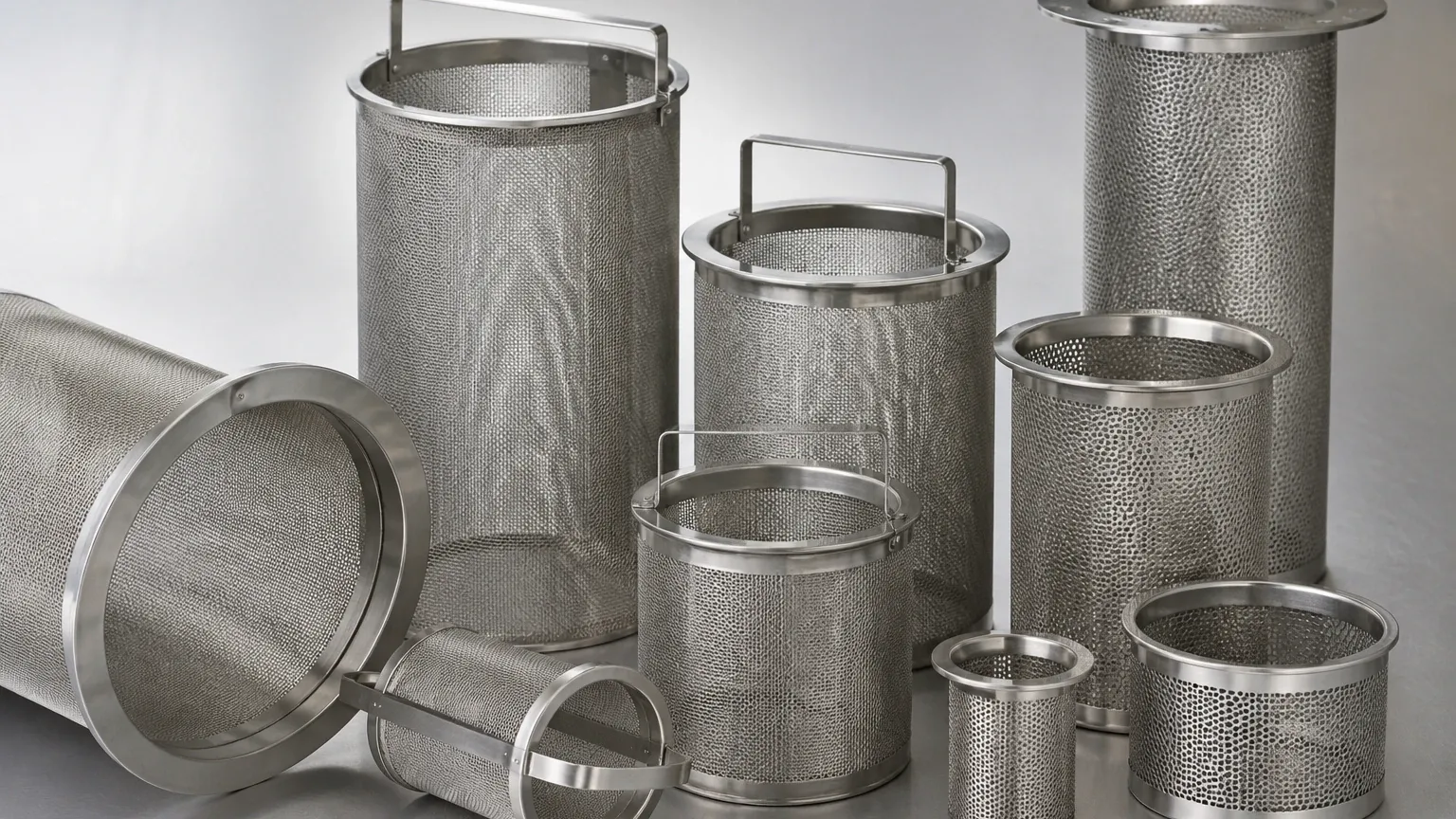
The basket itself is the heart of the system. It is usually constructed from perforated metal, which provides the structural integrity needed to withstand the differential pressure as debris accumulates. To achieve finer filtration, the perforated metal is often lined with a precision wire mesh.
* Perforated Metal: Provides coarse filtration (typically 1/32" to 1/4" holes) and acts as a support cage.
* Wire Mesh: Provides fine filtration, measured in microns or mesh count. Stainless steel wire mesh allows for precise control over particle retention while maintaining high flow rates.
Sealing and Gaskets
To prevent fluid bypass, the basket must be properly seated within the housing. Engineers must select gasket materials (such as EPDM, Viton, or PTFE) that are chemically compatible with the process fluid and capable of maintaining a seal under varying thermal conditions.
Comparing Basket Strainers and Y-Strainers
One of the most frequent questions engineers face is when to specify a basket strainer versus a Y-strainer. While both serve the purpose of removing solids, their applications differ significantly based on the debris load and the orientation of the piping.
1. Debris Capacity: Basket strainers have a larger internal volume. If the fluid contains a high concentration of solids, a basket strainer is the more efficient choice because it requires less frequent cleaning.
2. Pressure Drop: Due to the larger open area of the basket, these strainers typically exhibit a lower pressure drop (ΔP) than Y-strainers of the same pipe size. This is critical in systems where pump head is limited.
3. Installation Orientation: Y-strainers can be installed in both horizontal and vertical lines. In contrast, basket strainers are designed strictly for horizontal piping. The "basket" must be oriented vertically so that gravity helps retain the debris within the container during removal.
4. Ease of Maintenance: Basket strainers are generally easier to clean. Because they are installed in horizontal lines, the cover can be removed without the fluid draining out of the pipe, and the basket can be lifted straight out.
Types of Strainers & Baskets: Simplex vs. Duplex
When evaluating what are basket strainers, it is important to distinguish between simplex and duplex configurations, as this choice directly impacts system uptime.
Simplex Basket Strainers
A simplex strainer consists of a single housing and basket. It is used in batch processes or systems where the flow can be temporarily shut down to clean the filter. These are cost-effective solutions for applications like water treatment or intermittent chemical dosing where a brief interruption in flow does not compromise the entire operation.
Duplex (Twin) Basket Strainers
In continuous-flow applications—such as oil refineries, power plants, or cooling water systems—shutting down the process for maintenance is not an option. Duplex strainers consist of two separate strainer housings connected by a diverting valve. When one basket becomes full, the flow is diverted to the clean chamber, allowing the operator to service the dirty basket without stopping the process. This ensures 24/7 operation and protects critical machinery from debris at all times.
Selection Criteria for Industrial Applications
Selecting the correct strainer requires a detailed understanding of the application's parameters. Engineers should confirm the following data before finalizing a specification:
Flow Rate and Viscosity
The flow rate (GPM or m³/h) and the viscosity of the fluid are the primary drivers of pressure drop. Highly viscous fluids, such as heavy oils or syrups, require larger strainers or coarser mesh to prevent excessive resistance. If the pressure drop across the strainer is too high, it can lead to cavitation in downstream pumps.
Micron Rating and Particle Size
What is the smallest particle that must be removed to protect the equipment? Over-specifying (choosing a mesh that is too fine) will lead to rapid clogging and frequent maintenance. Under-specifying will allow harmful particles to pass through. The goal is to find the balance between protection and flow efficiency.
Open Area Ratio (OAR)
The Open Area Ratio is the relationship between the internal cross-sectional area of the pipe and the total open area of the holes in the strainer basket. A well-designed basket strainer typically offers an OAR of at least 6:1. A higher ratio ensures that even as the basket begins to fill with debris, the flow remains relatively unrestricted.
Chemical Compatibility
In industries like pharmaceutical or food and beverage processing, the material of the strainer must not react with the fluid. Stainless steel is often mandatory for its inert properties and ease of sterilization. Furthermore, the surface finish of the internal components may need to be polished to prevent bacterial growth in "dead zones."
Maintenance and Performance Monitoring
Even the best-engineered basket strainer will fail if it is not maintained correctly. The most effective way to monitor a strainer's performance is through differential pressure (DP) monitoring. By installing pressure gauges upstream and downstream of the strainer, operators can see exactly how much pressure is being lost across the basket.
As debris accumulates, the DP will rise. Manufacturers typically provide a "clean" DP and a "dirty" DP limit. Exceeding the dirty DP limit can cause the basket to collapse or the mesh to tear, allowing all the collected debris to rush downstream into the protected equipment. Regular cleaning cycles, based on DP readings rather than just a calendar schedule, ensure the longevity of both the strainer and the system it protects.
Customization and OEM Solutions
Many industrial applications have unique constraints that standard off-the-shelf strainers cannot meet. This is where customized filtration solutions become essential. Customization may involve:
* Specialized Dimensions: Fitting a strainer into a tight mechanical room or an existing piping footprint.
* Unique Mesh Weaves: Using specific weave patterns (such as Dutch weave) for high-pressure or high-temperature filtration.
* Reinforced Baskets: Adding internal supports or heavier perforated metal for high-viscosity applications where the basket is subject to extreme mechanical stress.
* Integrated Features: Adding magnetic inserts to capture fine iron particles or heating jackets for fluids that must be kept at a specific temperature to remain pumpable.
Conclusion
Understanding what are basket strainers is fundamental for any engineer tasked with maintaining the integrity of a fluid handling system. These components are more than just simple sieves; they are precision-engineered tools designed to balance filtration efficiency with system performance. By selecting the appropriate materials, sizing the unit for the correct flow parameters, and implementing a robust maintenance strategy, industrial facilities can significantly reduce equipment wear and operational costs.
For those seeking reliable, high-performance filtration, Strainers & Baskets manufactured from high-grade stainless steel offer the durability and precision required for the most demanding environments. Whether in chemical processing, water treatment, or hydraulic systems, the right basket strainer is an investment in the long-term reliability of the entire industrial process.
