


Strainer Basket for Cooking
In the context of industrial food processing and large-scale commercial kitchens, a strainer basket for cooking is far more than a simple kitchen utensil. It is a precision-engineered filtration component designed to withstand high temperatures, corrosive environments, and rigorous sanitation protocols. For engineers and procurement specialists in the food and beverage industry, selecting the right Strainers & Baskets is critical to ensuring product consistency, protecting downstream equipment, and maintaining compliance with global food safety standards.
Industrial cooking processes—ranging from deep frying and blanching to broth clarification and sauce production—require filtration solutions that can handle high flow rates while maintaining structural integrity. This article explores the technical specifications, material considerations, and engineering factors involved in selecting high-performance strainer baskets for industrial cooking applications.
Engineering Requirements for Industrial Food Strainers
The primary function of a strainer basket in an industrial cooking environment is the separation of solids from liquids. However, the mechanical demands of a production line necessitate specific engineering choices that differ significantly from consumer-grade products.
Material Selection and Corrosion Resistance
Stainless steel is the industry standard for food-grade filtration due to its non-reactive properties and durability. Most industrial strainer baskets are manufactured from either Type 304 or Type 316L stainless steel.
* Type 304 Stainless Steel: Suitable for general food applications involving water, oils, and non-acidic ingredients. It offers excellent formability and cost-effectiveness.
* Type 316L Stainless Steel: Preferred for environments involving high salt concentrations, acidic ingredients (such as tomato-based sauces or vinegars), or aggressive cleaning chemicals. The addition of molybdenum provides superior resistance to pitting and crevice corrosion.
Structural Integrity and Reinforcement
In high-volume cooking, strainer baskets are often subjected to heavy loads and mechanical stress. A standard wire mesh may fail under the weight of several hundred kilograms of product or the pressure of high-velocity fluid flow. To prevent deformation, industrial baskets often feature a dual-layer design: a fine inner wire mesh for filtration supported by a heavy-duty perforated metal outer shell. This combination ensures that the basket maintains its shape even under significant hydraulic pressure.
Filtration Efficiency and Mesh Selection
Choosing the correct mesh size for a strainer basket for cooking depends entirely on the specific application and the particle size of the solids being removed. Engineers must balance the need for fine filtration with the requirement for high flow rates.
Micron Ratings and Mesh Counts
For coarse applications, such as removing large vegetable pieces from a stock, a perforated plate with 2mm to 5mm holes may be sufficient. However, for finer applications like clarifying oils or straining fine spices, a woven wire mesh with a specific micron rating is required.
* Coarse Filtration: Used for initial separation or protecting pumps from large debris.
* Fine Filtration: Used for final product polishing or ensuring the smooth texture of sauces and purees.
Open Area Ratio
The "open area" refers to the percentage of the basket surface that allows fluid to pass through. A higher open area results in a lower pressure drop and higher flow capacity. However, increasing the open area often requires thinner wires or larger holes, which can compromise the basket's strength. Engineering a custom strainer involves calculating the optimal open area to maximize throughput without risking structural failure.
Performance Metrics: Flow Rate and Pressure Drop
In a continuous production line, the performance of the strainer basket directly impacts the efficiency of the entire system. Two key metrics must be evaluated during the selection process: flow rate and pressure drop.
Managing Pressure Drop (ΔP)
As a strainer basket captures solids, the available open area decreases, leading to an increase in pressure drop across the filter. If the pressure drop becomes too high, it can starve downstream pumps or cause the basket to collapse. Industrial systems often incorporate pressure gauges before and after the strainer to monitor this delta. Selecting a basket with a larger surface area (such as a multi-basket housing or a pleated design) can extend the time between cleaning cycles by providing more space for solids to accumulate before the pressure drop reaches a critical level.
Flow Velocity Considerations
High flow velocities can cause turbulence and erosion within the strainer. For delicate food products, high velocity might also cause "extruding," where soft solids are forced through the mesh pores, defeating the purpose of the strainer. Engineers must size the strainer housing and the basket itself to ensure that the fluid velocity remains within acceptable limits for both the equipment and the product.
Applications in Industrial Cooking and Processing
The utility of a specialized strainer basket for cooking spans various segments of the food industry. Each application presents unique challenges that influence the design of the filtration component.
Industrial Deep Frying
In large-scale frying operations, maintaining oil quality is paramount. A strainer basket must remove carbonized food particles (fines) that can degrade the oil and affect the flavor of the product. These baskets must withstand constant immersion in oils exceeding 180°C (350°F) and are often designed for easy removal and rapid cleaning to minimize downtime.
Blanching and Boiling Lines
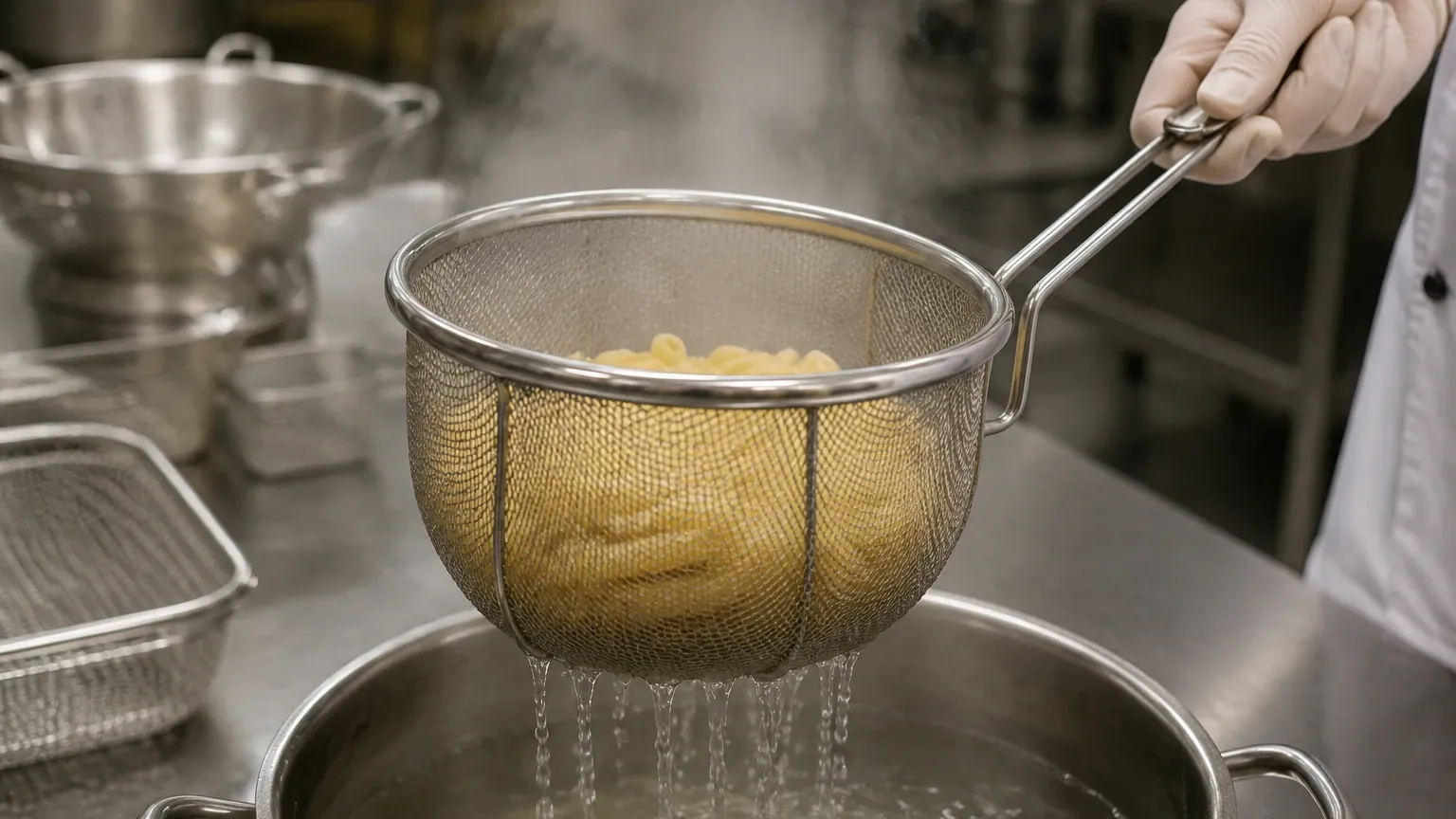
For pasta, vegetables, and proteins, strainer baskets are used to lift products out of boiling water or steam tunnels. These baskets require large open areas for rapid drainage and are often equipped with specialized lifting lugs or automated handling attachments to integrate with robotic or conveyor-driven systems.
Sauce and Broth Clarification
Producing clear broths or smooth sauces requires multi-stage straining. A primary coarse strainer removes bones and large aromatics, while a secondary fine-mesh basket removes smaller particulates. In these applications, the basket design must prevent "blinding" (clogging) caused by fats or viscous fluids, often requiring specialized coatings or wedge wire designs that are easier to clean.
Customization and OEM Capabilities
Standard off-the-shelf strainers rarely meet the specific needs of a custom-built industrial cooking line. Customization is often necessary to ensure the strainer fits the existing housing and meets the specific performance requirements of the process.
Dimensional Customization
Baskets can be manufactured in a wide range of shapes, including cylindrical, conical, or rectangular, to fit specific vessel geometries. Custom heights, diameters, and flange types ensure a leak-proof seal within the strainer housing, preventing "bypass," where unfiltered fluid escapes around the edges of the basket.
Handle and Lifting Configurations
Safety and ergonomics are vital in B2B environments. Custom Strainers & Baskets can be equipped with various handle styles—such as fixed bails, folding handles, or heavy-duty lifting eyes—to facilitate safe removal by operators or overhead cranes, especially when the baskets are heavy with saturated food waste.
Maintenance and Sanitation in Food Environments
In the food industry, the ability to clean a component is as important as its filtration performance. A strainer basket for cooking must be designed with sanitation in mind to prevent bacterial growth and cross-contamination.
Clean-in-Place (CIP) Compatibility
Many modern food processing lines utilize CIP systems, where cleaning agents are circulated through the equipment without disassembly. Strainer baskets must be constructed with smooth welds (often ground flush) and no dead zones where food particles could become trapped. Electropolishing is a common surface treatment used to enhance the smoothness of the stainless steel, making it more resistant to organic buildup and easier to sanitize.
Replacement Cycles and Durability
While high-quality stainless steel baskets are designed for longevity, they are considered wear parts. Factors that influence the replacement cycle include the abrasiveness of the food product, the frequency of cleaning, and the mechanical handling of the basket. Engineers should establish a regular inspection schedule to check for mesh fatigue, broken wires, or compromised seals, as these can lead to product contamination.
Selection Criteria for Procurement and Engineering Teams
When sourcing a strainer basket for cooking, technical professionals should confirm the following details to ensure the component is fit for purpose:
1. Fluid Characteristics: What is the viscosity, temperature, and chemical composition of the cooking liquid?
2. Solid Characteristics: What is the particle size, shape, and concentration of the solids to be removed?
3. Flow Requirements: What is the maximum and operating flow rate of the system?
4. Housing Compatibility: What are the exact dimensions, seating surfaces, and sealing requirements of the strainer housing?
5. Regulatory Compliance: Does the material and manufacturing process meet the required food safety standards (e.g., FDA, 3-A, or EU 1935/2004)?
By focusing on these technical parameters, manufacturers can ensure they invest in filtration solutions that optimize production efficiency and maintain the highest levels of food quality. Whether for a new installation or a replacement for an existing line, a well-engineered strainer basket is a fundamental component of a successful industrial cooking process.
