


Strainer Basket Hvac
In large-scale commercial and industrial HVAC systems, the integrity of the hydronic circuit is paramount to operational efficiency and equipment longevity. Central to this protection is the filtration and straining assembly, specifically the strainer basket. A strainer basket hvac component serves as the primary line of defense against particulate matter—such as welding slag, pipe scale, sediment, and biological growth—that can compromise the performance of chillers, boilers, pumps, and heat exchangers.
For engineers and facility managers, selecting the correct Strainers & Baskets involves more than just matching pipe diameters. It requires a deep understanding of fluid dynamics, material compatibility, and the specific debris profile of the HVAC loop. As a professional manufacturer, Kaifil provides precision-engineered stainless steel filtration solutions designed to meet these rigorous industrial demands.
The Critical Role of Strainer Baskets in HVAC Systems
HVAC systems are often closed-loop or open-loop hydronic circuits where water or a water-glycol mixture acts as the heat transfer medium. Any contaminant introduced into these loops can lead to catastrophic failure or significant efficiency losses. Strainer baskets are typically installed on the suction side of pumps or upstream of sensitive components like plate-and-frame heat exchangers.
In cooling tower applications (open loops), the strainer basket hvac assembly must handle atmospheric contaminants, including organic matter and wind-blown debris. In closed loops, the focus shifts to internal corrosion products and installation debris. Without effective straining, these particles can erode pump impellers, clog narrow heat exchanger channels, and settle in low-flow areas of the piping network, leading to localized corrosion and reduced thermal transfer.
Engineering Fundamentals: Design and Construction
The performance of a strainer basket is determined by its physical geometry and the media used for filtration. Industrial HVAC strainers generally fall into several categories, including simplex, duplex, and Y-type configurations, but the basket itself is the functional core.
Perforated Metal vs. Wire Mesh
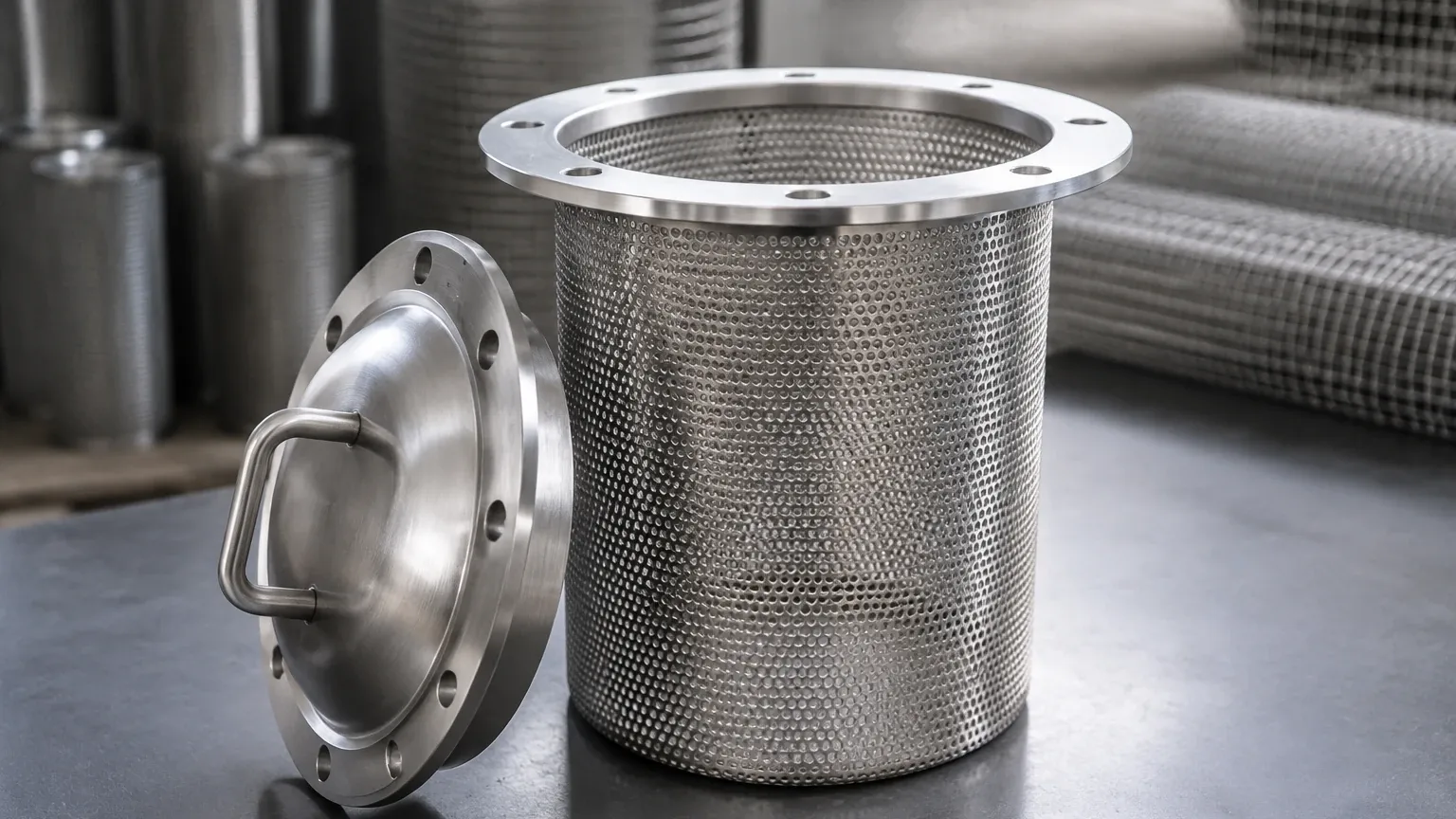
Most industrial strainer baskets utilize a two-stage construction. The outer structure is typically a heavy-gauge perforated metal cylinder that provides mechanical strength and resists the pressure of the fluid flow. For finer filtration, a layer of stainless steel wire mesh is lined or pleated inside the perforated shell. This combination allows for high-pressure durability while achieving precise micron ratings.
Open Area Ratio
A critical engineering metric for any strainer basket hvac application is the "Open Area Ratio" (OAR). This is the ratio of the total area of the holes in the basket to the cross-sectional area of the inlet pipe. A high OAR (typically 4:1 or higher) ensures that the strainer does not cause an excessive pressure drop and provides a larger dirt-holding capacity, which extends the intervals between cleaning cycles.
Material Engineering: Why Stainless Steel Dominates HVAC Filtration
While some low-pressure residential systems might utilize plastic or cast iron components, industrial HVAC environments demand the durability of stainless steel. Kaifil specializes in 304 and 316-grade stainless steel for its filtration components, offering distinct advantages for HVAC applications.
1. Corrosion Resistance: HVAC fluids often contain chemical additives for scale and corrosion inhibition. Stainless steel remains inert to most treatment chemicals and resists the oxidative environment found in cooling tower loops.
2. Structural Integrity: High-rise HVAC systems can operate at significant static pressures. Stainless steel baskets maintain their shape and filtration accuracy under high differential pressures, where inferior materials might collapse or bypass.
3. Temperature Stability: From steam condensate return lines to chilled water loops, stainless steel handles wide temperature fluctuations without becoming brittle or losing its mechanical properties.
4. Longevity: The total cost of ownership is significantly reduced when using stainless steel, as the baskets can be cleaned and reused for years, unlike disposable filter cartridges.
Understanding Pressure Drop and Filtration Efficiency
One of the most common challenges engineers face is balancing filtration fineness with system pressure drop. A finer mesh will capture smaller particles but will also increase the resistance to flow (Delta P). In HVAC systems, excessive pressure drop at the strainer can lead to pump cavitation, especially if the strainer is located on the suction side.
When specifying a strainer basket hvac solution, it is essential to calculate the clean pressure drop and the maximum allowable pressure drop before cleaning is required. Modern HVAC systems often utilize differential pressure sensors across the strainer housing to provide real-time data to the Building Management System (BMS). If the pressure drop exceeds a predetermined threshold, it triggers a maintenance alert, ensuring the pump does not operate under starved conditions.
Custom Design Considerations for OEM and Retrofit Projects
Not every HVAC system can utilize off-the-shelf filtration components. Customization is often required to address specific space constraints, flow rates, or unique debris types. As an OEM-capable manufacturer, Kaifil works with engineering teams to develop bespoke Strainers & Baskets tailored to specific project requirements.
Customization Options Include:
* Reinforced Structures: For high-flow systems where the basket is subject to turbulence, additional support ribs or heavier gauge materials can be integrated to prevent fatigue.
* Handle and Lifting Configurations: In large industrial strainers, the weight of a debris-filled basket can be substantial. Custom handles, lifting eyes, or ergonomic grips facilitate safer and faster maintenance.
* Specific Micron Ratings: Depending on the sensitivity of the downstream equipment (e.g., high-efficiency boilers with narrow water tubes), the mesh size can be customized to capture particles as small as 50 microns or as large as 1/4 inch.
* Magnetic Inserts: For systems with high concentrations of ferrous pipe scale, magnetic rods can be added to the center of the basket to capture fine iron particles that might otherwise pass through the mesh.
Operational Maintenance: Cleaning and Replacement Cycles
The effectiveness of a strainer basket hvac component is directly tied to the maintenance regime. Unlike disposable filters, stainless steel baskets are designed to be cleaned and returned to service. However, the cleaning process must be handled correctly to avoid damaging the mesh.
Cleaning Procedures
Baskets should be rinsed with high-pressure water or air from the outside in (backwashing) to dislodge trapped particles. For systems with biological fouling or scale buildup, chemical cleaning agents compatible with stainless steel may be used. It is vital to inspect the mesh for signs of "blinding" (permanent clogging) or mechanical tears during every maintenance cycle.
Replacement Indicators
While stainless steel is durable, it is not indestructible. Baskets should be replaced if:
* The wire mesh has separated from the perforated support.
* There are visible holes or bypass routes in the filtration media.
* The basket frame has become distorted, preventing a proper seal within the strainer housing.
* The pressure drop remains high even after a thorough cleaning, indicating deep-seated fouling within the mesh weave.
Total Cost of Ownership and Procurement Strategies
When evaluating strainer basket hvac options, purchasing teams should look beyond the initial acquisition cost. A low-quality basket that fails prematurely or allows debris to pass through can cause tens of thousands of dollars in damage to pumps and chillers.
Evaluation Criteria for Purchasing Teams:
* Material Certification: Ensure the manufacturer provides material test reports (MTRs) to verify the grade of stainless steel.
* Manufacturing Precision: Check for high-quality welds and the absence of sharp edges that could cause injury during maintenance.
* Compatibility: Confirm that the basket dimensions and flange interfaces are exact matches for the existing housings, especially in retrofit scenarios.
* Lead Times and Support: For critical HVAC infrastructure, working with a manufacturer like Kaifil that offers reliable production timelines and technical engineering support is essential for minimizing system downtime.
Conclusion
In the demanding world of industrial HVAC, the strainer basket is a small but vital component that ensures the reliability of the entire thermal management system. By selecting high-quality stainless steel Strainers & Baskets, engineers can protect expensive equipment, maintain high heat-transfer efficiency, and reduce long-term maintenance costs.
Whether you are designing a new cooling loop for a data center or retrofitting an aging boiler plant, understanding the technical nuances of strainer basket hvac design—from open area ratios to material selection—is key to achieving optimal system performance. Kaifil remains committed to providing the precision-manufactured filtration solutions necessary to keep these critical systems running smoothly in even the most demanding industrial environments.
