


Ks Basket Strainer
In industrial fluid handling, the protection of downstream equipment such as pumps, valves, and heat exchangers is a critical engineering priority. The ks basket strainer serves as a primary line of defense, designed to remove coarse particles and debris from liquid or gas streams through a mechanical straining process. Unlike fine filtration systems that target sub-micron particles, basket strainers are engineered for high-volume flow and significant dirt-holding capacity, making them indispensable in chemical processing, water treatment, and power generation sectors.
Selecting the correct Strainers & Baskets requires a deep understanding of fluid dynamics, material compatibility, and the specific mechanical stresses of the application environment. For engineers and procurement teams, the decision-making process involves balancing initial pressure drop against the required filtration accuracy and maintenance frequency.
Understanding the Role of Ks Basket Strainers in Industrial Filtration
A ks basket strainer is a closed vessel with a cleanable screen element designed to remove and retain foreign particles. The "basket" design is particularly advantageous because it provides a larger surface area than Y-strainers, allowing for a greater volume of debris to be collected before the pressure drop necessitates cleaning. This makes them the preferred choice for horizontal piping systems where high flow rates are common.
From a technical perspective, the strainer functions by forcing the fluid through a perforated metal or wire mesh basket. The solids are trapped inside the basket, while the clean fluid continues through the outlet. Because the debris is contained within the basket, removal and cleaning are simplified, preventing the contaminants from falling back into the line during the maintenance process. This "top-loading" or "side-entry" configuration is a hallmark of industrial-grade basket strainers, ensuring that the system can be serviced with minimal risk of downstream contamination.
Engineering Specifications and Material Selection
The performance of a ks basket strainer is largely dictated by its materials of construction. In demanding industrial environments, stainless steel is the standard due to its corrosion resistance and structural integrity under high pressure.
Stainless Steel Grades (304 vs. 316L)
Most industrial strainers are fabricated from SS304 or SS316L. SS304 is suitable for general-purpose applications, including water treatment and mild chemical processing. However, for environments involving chlorides, high temperatures, or aggressive chemicals (such as those found in the pharmaceutical or marine industries), SS316L is required. The addition of molybdenum in 316L provides superior resistance to pitting and crevice corrosion, extending the service life of the strainer basket.
Pressure Ratings and Temperature Limits
Engineers must confirm that the strainer housing and the internal basket can withstand the maximum operating pressure (MAOP) of the system. Strainers are typically rated according to ASME or KS (Korean Industrial Standards) pressure classes. It is vital to account for pressure spikes and thermal expansion, especially in steam or high-temperature oil applications. A failure to match the strainer’s pressure rating to the system requirements can lead to housing rupture or basket collapse.
Design Variations: Perforated Metal vs. Wire Mesh Linings
The internal element of a ks basket strainer is not a one-size-fits-all component. It is usually a composite structure designed to balance mechanical strength with filtration precision.
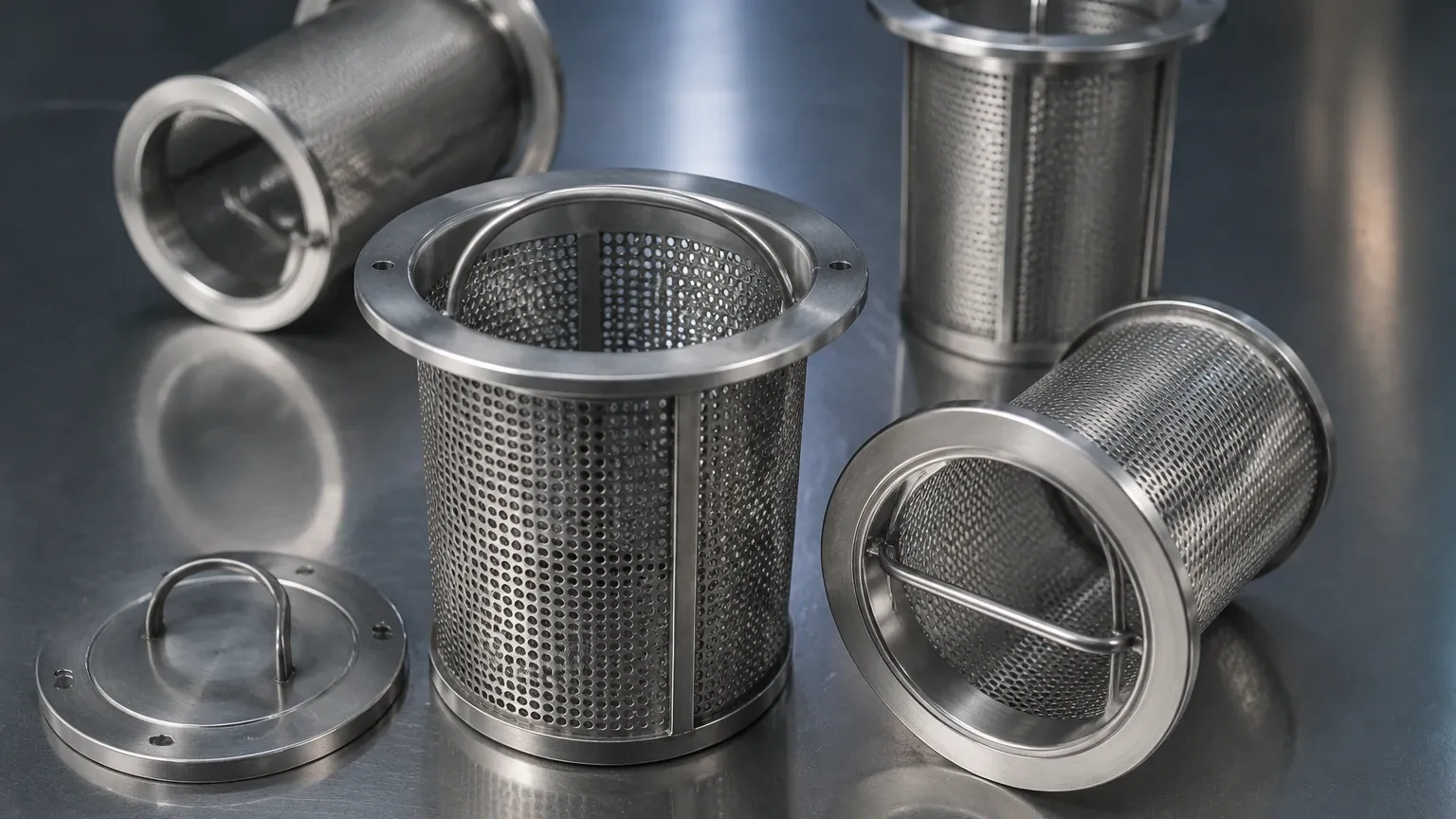
1. Perforated Metal Baskets: These serve as the primary support structure. They are made from heavy-gauge stainless steel sheets with punched holes. While they can act as a coarse strainer on their own (removing particles 1/2" to 1/32"), their primary role in high-precision applications is to provide a rigid frame for finer mesh linings.
2. Wire Mesh Linings: For finer filtration requirements, a stainless steel wire mesh is sintered or welded to the inside of the perforated basket. This allows the strainer to capture much smaller particles, often down to 40 microns (approx. 325 mesh). The choice of mesh weave—such as plain weave or twilled weave—affects the flow resistance and the ease of backwashing or manual cleaning.
3. Magnetic Inserts: In applications where metallic fines (such as iron or steel shavings) are prevalent, magnetic inserts can be added to the basket. These magnets capture sub-micron ferrous particles that might otherwise pass through the mesh, providing an extra layer of protection for sensitive downstream components like high-speed turbines.
Key Selection Criteria for Engineers and Purchasing Teams
When specifying a ks basket strainer for a new or existing system, several variables must be calculated to ensure optimal performance. A mismatched strainer can lead to excessive energy consumption due to high pressure drops or frequent system shutdowns for cleaning.
Flow Rate and Pressure Drop (Delta P)
The most critical calculation is the clean pressure drop. As fluid passes through the mesh, a certain amount of energy is lost. If the mesh is too fine for the flow rate, the pressure drop will be high from the start, leaving very little room for debris accumulation before the system reaches its critical pressure limit. Engineers should aim for a clean pressure drop of less than 2 PSI in most liquid applications.
Viscosity Considerations
High-viscosity fluids, such as heavy oils or syrups, require larger strainer surface areas and coarser mesh to maintain flow. The "ks basket strainer" must be sized specifically for the fluid's viscosity at its lowest operating temperature, as thickness increases significantly when cold, potentially blinding the strainer.
Area Ratio
A high-quality industrial strainer often features an "open area ratio" of at least 6:1. This means the total open area of the basket holes is six times the cross-sectional area of the inlet pipe. A higher ratio ensures longer run times between cleaning cycles and lower internal velocities, which reduces wear on the mesh.
Maintenance, Cleaning, and Operational Efficiency
The total cost of ownership for Strainers & Baskets is heavily influenced by how easily they can be maintained. In many industrial processes, downtime is the most significant expense. Therefore, the design of the strainer should facilitate rapid servicing.
* Quick-Opening Covers: For systems that require frequent cleaning, bolted covers can be replaced with clamp-style or swing-bolt covers. This allows operators to access the basket without specialized tools, reducing the time the process is offline.
* Differential Pressure Gauges: Installing gauges at the inlet and outlet of the ks basket strainer is a best practice. By monitoring the pressure differential, maintenance teams can clean the basket based on actual debris loading rather than an arbitrary schedule, preventing both unnecessary labor and potential basket failure due to over-pressurization.
* Cleaning Protocols: Stainless steel baskets are reusable. Cleaning typically involves high-pressure water washing or ultrasonic cleaning for fine mesh linings. It is essential to inspect the basket for signs of "wire drawing" or mechanical fatigue during every cleaning cycle. If the mesh is frayed or the perforated support is bowed, the basket must be replaced to prevent bypass.
Customization and OEM Solutions for Specialized Applications
Standard off-the-shelf strainers often fail to meet the specific spatial or chemical requirements of complex industrial skids. This is where custom manufacturing becomes essential. A professional manufacturer like Kaifil provides tailored solutions that go beyond standard catalog dimensions.
Customization options for a ks basket strainer include:
* Non-Standard Dimensions: Fitting a strainer into a compact piping layout where standard face-to-face dimensions do not work.
* Specialized Coatings: Applying PTFE or other chemical-resistant linings to the stainless steel body for handling highly corrosive acids.
* Multi-Basket Designs: For very high flow rates, a single large basket may be too heavy for a single operator to lift. Multi-basket strainers distribute the surface area across several smaller, manageable baskets.
* Steam Jacketing: For fluids that solidify at room temperature (like bitumen or certain resins), a steam jacket can be added to the strainer housing to maintain the fluid in a liquid state during the straining process.
Conclusion: Ensuring Long-Term Reliability
The ks basket strainer is a fundamental component in industrial fluid management. By selecting high-quality materials, calculating the correct pressure drop, and ensuring a robust maintenance strategy, engineers can significantly extend the life of their entire piping system. Whether you are dealing with water treatment, chemical processing, or oil and gas, the choice of strainer basket directly impacts the efficiency and safety of the operation.
When evaluating suppliers, it is important to look for manufacturers who understand the nuances of mesh selection and structural reinforcement. A well-engineered basket not only filters effectively but also survives the rigors of high-pressure surges and repeated cleaning cycles, providing a reliable solution for demanding industrial environments.
