


Basket Strainers Kitchen Sink
In industrial and high-volume commercial environments, the standard basket strainers kitchen sink components are often the first line of defense in maintaining the integrity of drainage and fluid processing systems. While the term often brings to mind residential plumbing, the engineering requirements for strainers used in commercial kitchens, food processing facilities, and industrial laboratories are significantly more demanding. These environments require filtration solutions that can withstand corrosive cleaning agents, high temperatures, and constant debris loading without compromising flow rates or structural integrity.
Selecting the correct strainer involves understanding the intersection of material science, hydraulic flow, and mechanical durability. For engineers and facility managers, a basket strainer is not merely a drain plug; it is a precision-engineered component designed to protect downstream infrastructure and ensure compliance with environmental and safety standards.
Understanding the Engineering of Basket Strainers for Commercial Use
The primary function of a basket strainer is the separation of solids from a liquid stream. In a commercial or industrial "kitchen sink" context, this means capturing organic waste, packaging debris, and other particulates before they enter the wastewater system. The "basket" design is preferred over flat discs because it significantly increases the available surface area for filtration.
The Importance of Surface Area
By utilizing a three-dimensional basket structure, the strainer can accumulate a larger volume of debris before the effective open area is reduced enough to cause a significant pressure drop or slow drainage. This is critical in high-paced environments where downtime for cleaning must be minimized. Engineers often calculate the "open area ratio," which is the ratio of the total area of the holes in the basket to the cross-sectional area of the inlet pipe. A high-performance basket strainer typically maintains a ratio of at least 4:1 to ensure efficient flow even when partially full.
Structural Integrity and Load Bearing
Unlike residential versions, industrial-grade Strainers & Baskets must handle mechanical stress. This includes the weight of the debris, the force of high-pressure water streams, and the thermal expansion and contraction caused by alternating between boiling water and cold rinse cycles. High-quality manufacturing processes, such as TIG welding and precision punching, ensure that the basket remains seated correctly and does not warp over time.
Material Selection: Why Stainless Steel is the Standard
For any professional application involving a basket strainers kitchen sink, stainless steel is the non-negotiable material of choice. Its combination of mechanical strength and chemical resistance makes it ideal for the harsh conditions of industrial food service and chemical processing.
304 vs. 316 Stainless Steel
Most standard commercial strainers are fabricated from Grade 304 stainless steel. It offers excellent corrosion resistance to most oxidizing acids and is generally sufficient for standard food and beverage applications. However, in environments where the strainer is exposed to high concentrations of chlorides (such as saline solutions in food prep) or aggressive cleaning chemicals, Grade 316 stainless steel is recommended. Grade 316 contains molybdenum, which provides superior resistance to pitting and crevice corrosion.
Durability and Hygiene
Stainless steel is inherently non-porous, meaning it does not harbor bacteria or odors. This is a critical requirement for food safety compliance (such as FDA or EHEDG standards). Furthermore, the material's resistance to abrasion ensures that the filtration apertures remain precise over years of use, preventing larger particles from "bypassing" the filter as the material wears down.
Key Performance Criteria for High-Volume Filtration
When specifying basket strainers for industrial or commercial sinks, engineers must look beyond basic dimensions. The performance of the unit is defined by its ability to balance filtration accuracy with hydraulic efficiency.
1. Filtration Accuracy (Micron Rating): The size of the perforations or the mesh count determines what size particles are captured. In a kitchen environment, perforations are typically larger (e.g., 2mm to 5mm) to allow for rapid drainage, whereas laboratory or specialized processing sinks may require fine wire mesh liners to capture microscopic particulates.
2. Pressure Drop: Every strainer introduces some resistance to flow. A well-designed basket minimizes this resistance. If the pressure drop is too high, it can lead to backup in the sink, which is a significant hygiene and safety risk in commercial operations.
3. Ease of Maintenance: In a B2B context, labor costs are a major factor. A basket strainer should be designed for rapid removal, cleaning, and re-insertion. Features like ergonomic handles, quick-release mechanisms, and non-stick surface finishes contribute to lower total cost of ownership.
Comparison of Perforated vs. Mesh Basket Designs
The choice between a perforated metal basket and a wire mesh basket depends entirely on the specific application within the facility.
Perforated Metal Baskets
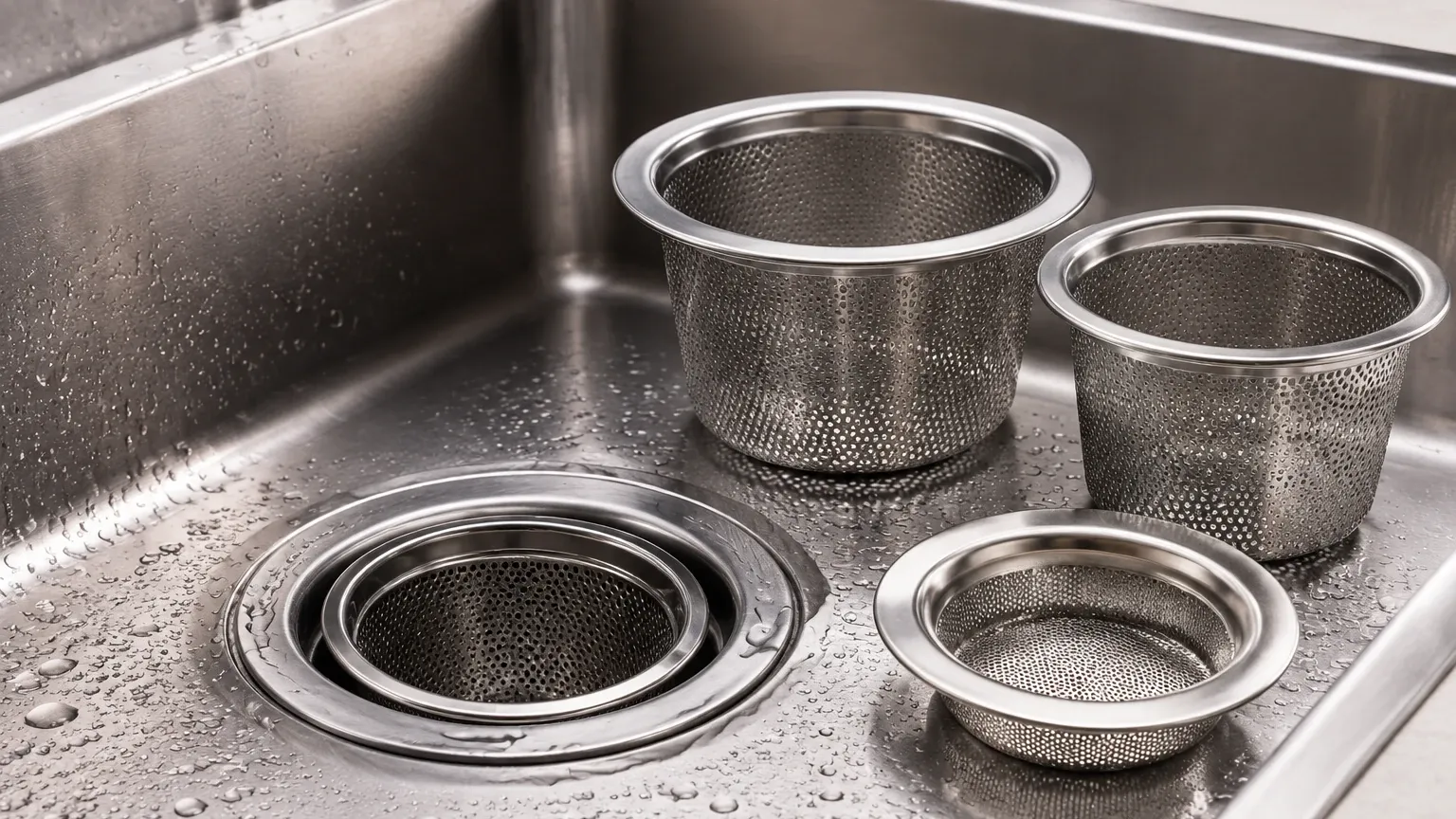
Perforated baskets are created by punching holes into a solid sheet of stainless steel. These are the workhorses of the industry. They are exceptionally rugged and can be cleaned with heavy-duty brushes or high-pressure hoses without fear of tearing. They are ideal for capturing large food scraps, bones, and plastic waste. However, the smallest hole size is limited by the thickness of the metal, meaning they are not suitable for fine filtration.
Wire Mesh Baskets
Wire mesh baskets consist of woven stainless steel wires. This design allows for much finer filtration (down to the micron level). They are often used as secondary liners within a perforated basket or in specialized sinks where chemical precipitates or fine powders must be recovered. While they offer superior filtration, they are more delicate than perforated sheets and require more careful handling during the cleaning process.
Common Risks and Mitigation in Industrial Drainage
Failure to select the appropriate basket strainers kitchen sink components can lead to several operational risks that impact the bottom line of a facility.
* Bypass: If a strainer does not fit perfectly within its housing, fluid and debris will take the path of least resistance around the edges. This allows solids to enter the plumbing, leading to clogs and expensive hydro-jetting services. Precision manufacturing and the use of high-quality gaskets are essential to prevent bypass.
* Corrosion and Fatigue: Low-grade materials or poor weld quality can lead to stress corrosion cracking. Once a basket fails, it can actually become a source of contamination itself, shedding metal shards into the waste stream.
* Clogging and Overflow: If the strainer is undersized for the flow rate of the facility, it will clog too frequently. This leads to standing water, which is a violation of health codes in food preparation areas and a slip hazard for staff.
To mitigate these risks, it is vital to work with a manufacturer that provides detailed technical specifications and can offer customized designs tailored to the specific flow and debris characteristics of your site.
Customization Options for Specific Industrial Applications
One size rarely fits all in industrial filtration. Customization is often necessary to integrate a basket strainer into an existing specialized system or to meet unique process requirements. Professional manufacturers like Kaifil offer several paths for customization:
* Dimensional Tailoring: Custom diameters, depths, and flange configurations to fit non-standard sink drains or industrial sumps.
* Handle and Lifting Options: For large baskets that may become heavy when full, specialized lifting handles or mechanical assist points can be engineered into the design.
* Surface Treatments: Electropolishing can be applied to the stainless steel to create an ultra-smooth surface that resists the adhesion of fats, oils, and greases (FOG), making cleaning significantly faster.
* Multi-Stage Filtration: Designing baskets with multiple layers of different mesh sizes to capture a range of particle sizes in a single pass.
Evaluating Total Cost of Ownership (TCO)
When purchasing basket strainers for a large-scale project, the initial purchase price is only a small fraction of the total cost. A B2B procurement strategy should focus on TCO, which includes:
* Replacement Frequency: A high-quality stainless steel basket can last for years, whereas cheap alternatives may need replacement every few months due to rust or mechanical failure.
* Labor Costs: How much time does staff spend cleaning the strainer? A design that resists clogging and is easy to empty can save hundreds of labor hours over its lifespan.
* Downstream Protection: The most significant cost saving comes from preventing clogs in the main sewage lines or damage to expensive grease interceptors and pumps.
By investing in precision-engineered Strainers & Baskets, facilities can ensure reliable operation and long-term cost efficiency.
Conclusion: Selecting the Right Partner
For engineers and purchasing teams, the humble basket strainer is a critical component that requires careful technical evaluation. Whether you are outfitting a commercial kitchen, a pharmaceutical lab, or a food processing plant, the choice of material, filtration accuracy, and structural design will dictate the efficiency of your drainage system.
Before making a selection, confirm the chemical compatibility of the stainless steel grade with your cleaning protocols, verify the required flow rates, and consider the benefits of a customized solution that fits your specific infrastructure. Working with a dedicated manufacturer ensures that you receive a product designed for the rigors of industrial use, providing peace of mind and operational continuity.
