


Strainer Basket Large
In industrial filtration systems, the efficiency of fluid processing often depends on the capacity and structural integrity of the primary filtration components. A strainer basket large enough to accommodate high flow rates while maintaining low differential pressure is a critical requirement for heavy-duty applications. These components serve as the first line of defense, protecting downstream equipment such as pumps, valves, and heat exchangers from particulate contamination. For engineers and procurement teams, selecting the correct large-scale strainer involves balancing filtration accuracy, mechanical strength, and long-term maintenance requirements.
Industrial Strainers & Baskets are engineered to handle significant volumes of liquid or gas. Unlike standard-sized filters, a strainer basket large in scale must withstand higher mechanical loads and potential pressure surges. This article explores the technical specifications, material considerations, and engineering parameters essential for integrating large strainer baskets into industrial processes.
Structural Integrity in Large-Scale Filtration
When scaling up a strainer basket, the mechanical stresses on the component increase exponentially. A large basket has a greater surface area, which is beneficial for flow, but it also faces higher total force when the filter becomes loaded with debris. Structural integrity is the most critical factor in preventing basket collapse or bypass.
Reinforcement Techniques
To maintain shape under pressure, large baskets often require supplemental reinforcement. This typically includes:
* Support Rods and Bands: Vertical rods or horizontal rings welded to the exterior of the perforated metal to prevent deformation.
* Heavy-Gauge Perforated Bases: The bottom of the basket often bears the brunt of the fluid impact and accumulated weight. Using a thicker gauge material for the base ensures the basket does not bow or rupture.
* Reinforced Flanges: The top ring or flange must provide a precision fit within the strainer housing to prevent fluid bypass. In large-scale systems, these flanges are often machined to tight tolerances to ensure a metal-to-metal seal or a secure seat for gaskets.
Burst Pressure and Differential Pressure (ΔP)
Engineers must calculate the maximum allowable differential pressure. As a strainer basket large in volume collects contaminants, the resistance to flow increases. If the ΔP exceeds the structural limits of the basket, the mesh or perforated metal may fail. High-capacity baskets are typically designed with a safety factor that accounts for unexpected surges in flow or rapid loading of solids.
Material Specifications for Industrial Durability
Material selection is dictated by the chemical compatibility of the fluid, the operating temperature, and the required lifespan of the component. For most industrial applications, stainless steel is the standard due to its corrosion resistance and mechanical properties.
Stainless Steel 304 vs. 316L
* Type 304: Suitable for general industrial use, water treatment, and food and beverage applications where high-level corrosion resistance is not the primary concern. It offers excellent strength and cost-effectiveness.
* Type 316L: Recommended for chemical processing, pharmaceutical manufacturing, and marine environments. The addition of molybdenum provides superior resistance to chlorides and acidic environments, preventing pitting and crevice corrosion that can occur in large, stagnant areas of a filtration system.
Specialized Alloys
In extreme environments involving high-temperature steam or highly corrosive chemicals, specialized alloys like Monel, Hastelloy, or Duplex Stainless Steel may be required. These materials ensure that the strainer basket large-scale dimensions do not become a liability due to accelerated corrosion rates over a large surface area.
Custom Design Parameters for OEM Applications
Standard off-the-shelf baskets often fail to meet the specific needs of specialized industrial equipment. Customization allows for the optimization of flow dynamics and filtration efficiency.
Perforation and Mesh Combinations
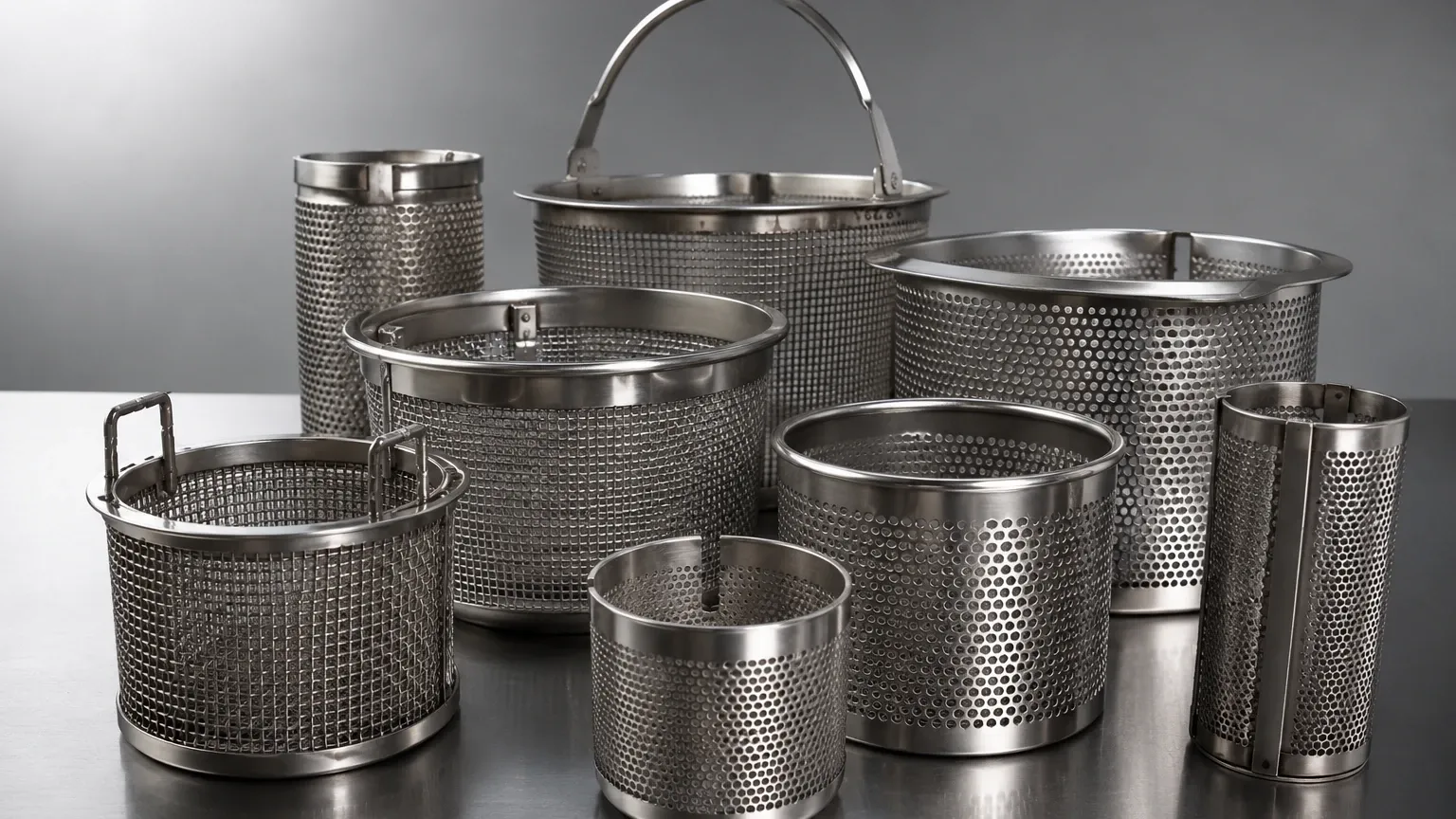
A common configuration for a large strainer basket involves a two-layer design. The outer layer consists of heavy-duty perforated metal which provides the necessary structural cage. The inner layer is a fine wire mesh that dictates the filtration accuracy.
* Perforation Patterns: Round holes are the most common due to their structural stability, but square or slotted holes may be used to increase the open area percentage.
* Micron Ratings: Large baskets can be lined with mesh ranging from coarse (40 mesh) to very fine (5 micron), depending on the downstream requirements. The challenge with a strainer basket large in surface area is ensuring the mesh is uniformly bonded to the support structure to prevent "blind spots" or areas of high stress.
Handling and Ergonomics
Because large baskets can be heavy—especially when filled with wet debris—designing for ease of maintenance is essential. Custom features include:
* Lifting Lugs and Heavy-Duty Handles: Designed to interface with overhead cranes or specialized lifting tools.
* Tapered Designs: A slight taper in the basket walls can make removal from the housing easier, reducing the risk of the basket becoming wedged due to thermal expansion or debris buildup.
Performance Evaluation: Flow Dynamics and Dirt Holding
The primary advantage of a strainer basket large in size is the increased "dirt-holding capacity." This refers to the volume of contaminants the basket can retain before the pressure drop reaches a critical level.
Open Area Ratio
The ratio of the total open area of the basket holes to the area of the inlet pipe is a key performance metric. A well-designed large basket typically maintains an open area ratio of at least 6:1. This high ratio ensures that even when the basket is 50% clogged, the pressure drop remains within acceptable operational limits, thereby extending the interval between cleaning cycles.
Flow Distribution
In very large strainer housings, fluid velocity can be unevenly distributed. If the fluid enters at a high velocity and hits only one side of the basket, it can cause localized wear and premature clogging. Engineering solutions such as internal baffles or flow distributors help ensure that the entire surface area of the strainer basket large-scale surface is utilized, maximizing the efficiency of the filtration media.
Maintenance Protocols for Heavy-Duty Strainers
Maintenance of large filtration components requires a structured approach to ensure safety and longevity. Unlike small filters that are easily replaced, large baskets are significant assets that are typically cleaned and reused.
Cleaning Methods
* Manual Cleaning: For coarse debris, high-pressure water washing is often sufficient. However, care must be taken not to damage fine mesh linings.
* Ultrasonic Cleaning: For baskets used in the pharmaceutical or food industries, ultrasonic baths can remove microscopic particles trapped within the wire mesh weave that manual cleaning cannot reach.
* Chemical Soaking: In applications involving resins, oils, or scale, chemical cleaning agents may be used to dissolve contaminants without abrading the stainless steel surface.
Inspection Intervals
Regular inspection of the basket's structural welds and the integrity of the mesh-to-perforation bond is necessary. In high-vibration environments, fatigue cracks can develop at the stress points where the handle or reinforcement bands are attached. Early detection of these issues prevents catastrophic failure and downstream contamination.
Selecting the Right Configuration for Your Process
When specifying a strainer basket large enough for a specific industrial application, purchasing teams and engineers should confirm several technical details with the manufacturer:
1. Fluid Characteristics: Viscosity, temperature, and chemical composition directly impact material and mesh selection.
2. Flow Rate (GPM/LPM): This determines the required surface area to maintain a low initial pressure drop.
3. Contaminant Type: Is the debris hard and abrasive, or soft and gelatinous? This influences whether a simple perforated basket or a complex mesh-lined basket is required.
4. Housing Dimensions: Precise measurements of the internal seat, depth, and diameter are required to ensure a proper seal and prevent bypass.
5. Total Cost of Ownership: While a high-quality stainless steel basket may have a higher initial cost, its durability, cleanability, and protection of expensive downstream pumps often result in a lower total cost over the system's lifecycle.
By focusing on these engineering realities, industrial operators can ensure their filtration systems remain reliable and efficient. Whether for water treatment, chemical processing, or hydraulic systems, the implementation of a precision-engineered strainer basket large in capacity is a foundational step in process optimization.
