


Strainer Basket Lowes
When searching for a "strainer basket lowes," most users are looking for immediate, off-the-shelf solutions for residential plumbing or standard pool maintenance. While retail hardware stores provide accessible options for domestic applications, industrial environments demand a significantly higher level of engineering precision, material durability, and customization. For engineers and procurement professionals in sectors such as chemical processing, pharmaceuticals, and food production, the transition from consumer-grade components to industrial-grade Strainers & Baskets is a critical step in ensuring system integrity and operational efficiency.
Industrial filtration is not merely about catching debris; it is about protecting high-value downstream equipment—such as pumps, heat exchangers, and spray nozzles—from damage and clogging. This article explores the technical distinctions between retail-level strainers and industrial filtration solutions, focusing on the engineering considerations that drive professional selection processes.
Understanding the Gap: Retail vs. Industrial Strainers
The primary difference between a standard strainer basket found at a retail outlet and an industrial component manufactured by a specialist like Kaifil lies in the design intent. Retail products are designed for low-pressure, non-corrosive environments with standard sizing. In contrast, industrial strainers must withstand high flow rates, extreme temperatures, and chemically aggressive fluids.
Material Integrity
While a common "strainer basket lowes" search might yield plastic or light-gauge stainless steel options, industrial baskets are typically fabricated from heavy-duty 304 or 316L stainless steel. These materials offer superior resistance to pitting and stress corrosion cracking. In pharmaceutical or food-grade applications, the surface finish (often electropolished) is essential to prevent bacterial growth and ensure compliance with hygiene standards.
Structural Reinforcement
Industrial baskets often incorporate perforated metal backings or internal frames to support fine wire mesh. This multi-layer construction prevents the mesh from collapsing under high differential pressure—a common failure point for lighter, retail-grade baskets when they become partially blinded by contaminants.
Engineering Considerations for Industrial Strainer Baskets
Selecting the right filtration component requires a deep dive into the physics of the fluid system. Engineers must evaluate several variables to ensure the basket performs its role without becoming a bottleneck in the process.
1. Micron Rating and Mesh Selection
Filtration accuracy is defined by the size of the particles the basket is intended to retain. Industrial wire mesh is woven to precise tolerances, allowing for filtration levels ranging from coarse (several millimeters) to fine (down to 5 microns). When selecting a basket, engineers must balance the need for fine filtration with the risk of rapid clogging. A mesh that is too fine for the particulate load will require frequent cleaning, leading to increased downtime.
2. Open Area Ratio
The "open area" of a strainer basket refers to the total area of the holes or mesh openings relative to the total surface area of the basket. A high open area ratio is desirable because it results in a lower initial pressure drop ($ΔP$). Industrial designs typically aim for an open area that is at least 4 to 6 times the cross-sectional area of the inlet pipe. This ensures that even as the basket collects debris, the system maintains sufficient flow.
3. Pressure Drop and Flow Velocity
Every component in a piping system introduces resistance. A well-engineered strainer basket minimizes this resistance. If the pressure drop across the strainer becomes too high, it can cause cavitation in pumps or reduce the overall efficiency of the system. Professionals use flow coefficient ($Cv$) values to calculate the expected pressure drop based on the fluid's viscosity and flow rate.
Customization: Beyond Standard Dimensions
One of the primary limitations of retail-sourced components is the lack of customization. In industrial settings, piping configurations are rarely "standard." Customization is often necessary to fit existing housings or to meet specific process requirements.
Tailored Geometry
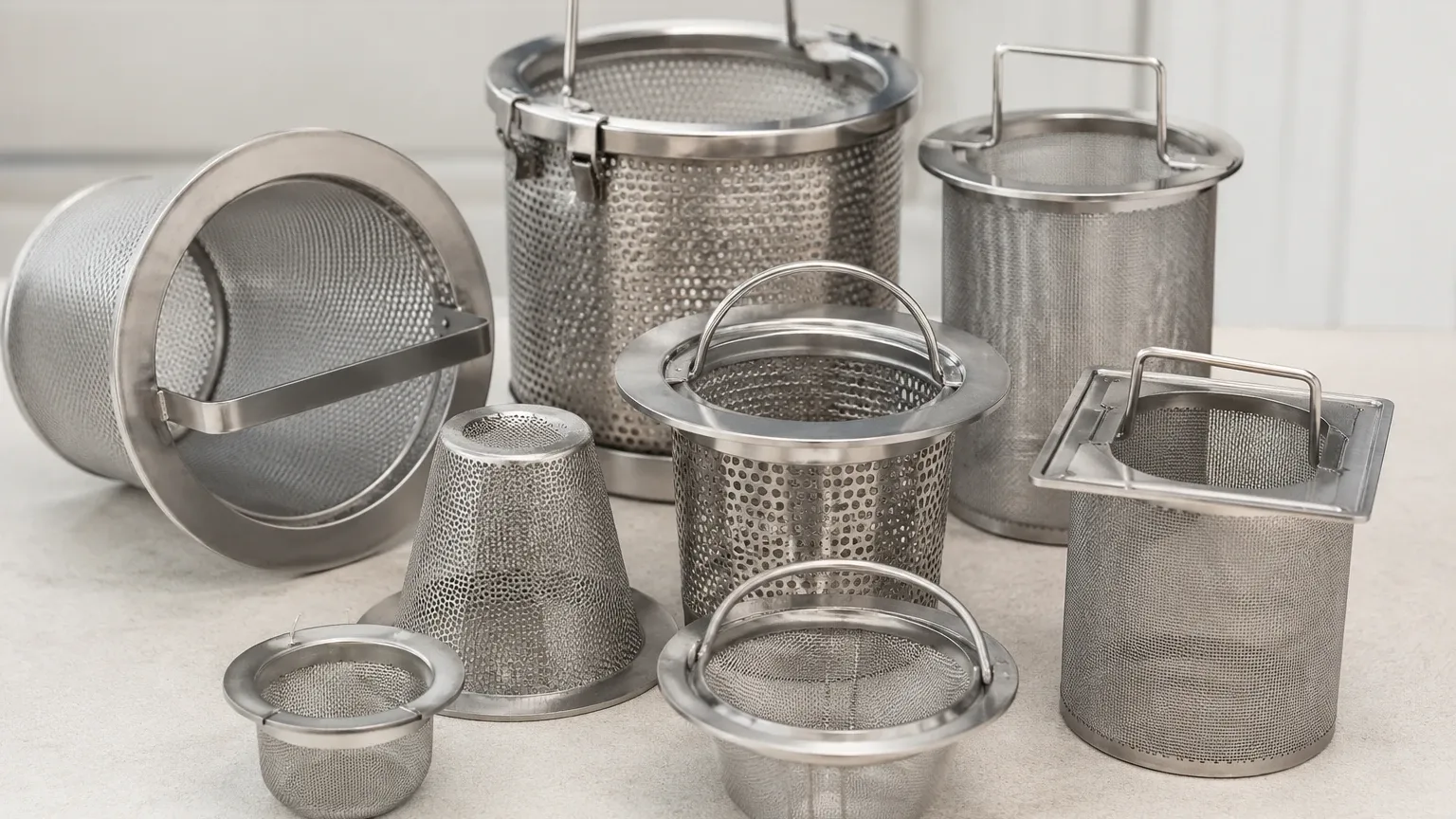
Industrial manufacturers like Kaifil can produce baskets in various shapes, including conical, cylindrical, and pleated designs. Pleated baskets are particularly effective when the installation space is limited but a high surface area is required to manage high dirt-loading capacities.
Specialized Fittings and Handles
Ease of maintenance is a major factor in total cost of ownership. Industrial baskets can be equipped with heavy-duty lifting handles, reinforced flanges, or magnetic inserts to capture fine ferrous particles that might otherwise pass through the mesh. These features are rarely found in consumer-grade products but are essential for protecting precision machinery.
Application-Specific Requirements
The choice of a strainer basket is heavily influenced by the industry in which it operates. A solution that works for a water treatment plant may fail rapidly in a chemical refinery.
* Chemical Processing: Requires high-grade alloys (like 316L) to resist corrosive acids and bases. The integrity of the welds is paramount to prevent structural failure.
* Food and Beverage: Demands "clean-in-place" (CIP) capabilities. The baskets must have smooth surfaces and no dead zones where organic matter can accumulate.
* Hydraulic Systems: Focuses on high-pressure ratings. Baskets must be able to withstand the surges and pulses inherent in hydraulic circuits without shedding fibers or collapsing.
* Water Treatment: Often deals with large volumes of water and varying debris sizes. Multi-stage baskets (coarse outer layer, fine inner layer) are frequently utilized here.
Maintenance and Replacement Cycles
A common question among maintenance engineers is: "When should we replace the strainer basket?" Unlike a simple "strainer basket lowes" replacement that might happen only when the part breaks, industrial maintenance is proactive.
Differential Pressure Monitoring
The most reliable way to determine if a basket needs cleaning or replacement is by monitoring the differential pressure. Most industrial housings are equipped with gauges. Once the $ΔP$ reaches a pre-set limit (often 5-10 psi over the clean pressure drop), the basket must be serviced. Continuous operation at high differential pressure can deform the basket or force contaminants through the media.
Inspection for Fatigue
Repeated cleaning cycles and exposure to flow-induced vibration can cause metal fatigue. During routine maintenance, baskets should be inspected for broken wires, thinning metal, or compromised welds. In high-stakes environments, keeping a stock of custom-manufactured spares is standard practice to prevent extended outages.
Total Cost of Ownership (TCO)
While the initial price of a retail strainer might be lower, the Total Cost of Ownership for an industrial-grade component is often lower in the long run. A cheap basket that fails can lead to:
1. Downstream Equipment Damage: Replacing a pump impeller or a set of spray nozzles is far more expensive than investing in a high-quality strainer.
2. Unscheduled Downtime: In many industries, an hour of lost production can cost thousands of dollars.
3. Labor Costs: Frequent replacements of low-quality parts consume maintenance hours that could be better spent on high-value tasks.
By selecting a precision-engineered solution, facilities ensure that their filtration system remains a reliable asset rather than a recurring liability.
Technical Support and Selection Guidance
Choosing the correct strainer basket involves more than just matching a diameter. It requires an understanding of the fluid dynamics and the specific challenges of the application. When moving beyond the basic options available at retail stores, it is essential to work with a manufacturer that provides technical consultation.
For those managing industrial systems, the focus should be on durability, filtration accuracy, and structural integrity. Whether you need a standard replacement or a completely custom-designed component for a new project, professional-grade manufacturing ensures that the part will perform under pressure.
To explore the full range of industrial filtration components and to find the right fit for your specific engineering requirements, you can Review product options and application support at Kaifil. Our expertise in stainless steel fabrication and industrial filtration principles allows us to support demanding applications across the global industrial landscape.
