


What Is Mesh Filter
In industrial engineering, the integrity of a fluid or gas system often depends on the precision of its filtration components. When engineers ask, "what is mesh filter?" they are typically looking beyond a simple definition. They are seeking a technical understanding of a mechanical separation barrier designed to remove particulate matter from a medium while maintaining specific flow characteristics. For technical professionals, a mesh filter is a critical engineered component that ensures equipment longevity, product purity, and process efficiency.
At its core, a mesh filter consists of a network of interconnected wires or fibers that create uniform openings. In heavy-duty industrial applications, these are most commonly constructed from stainless steel due to the material’s mechanical strength and resistance to environmental degradation. This guide explores the technical nuances of mesh filtration, focusing on the selection, application, and engineering specifications of Wire Mesh Filter Cylinders & Tubes.
Understanding the Fundamentals: What is Mesh Filter?
To define what is mesh filter in an industrial context, one must examine the weave and the material. Unlike disposable paper or polymer filters, industrial wire mesh filters are precision-engineered tools. They are typically made by weaving metallic wires—usually stainless steel—into various patterns such as plain weave, twilled weave, or Dutch weave.
The Geometry of the Weave
The performance of a mesh filter is dictated by its geometry. The "mesh count" refers to the number of openings per linear inch. However, for engineering purposes, the more critical value is the pore size or micron rating, which determines the smallest particle the mesh can reliably intercept.
* Plain Weave: The simplest form where wires cross over and under each other. It provides high flow rates but lower mechanical strength compared to complex weaves.
* Dutch Weave: Uses different wire diameters for the warp and shute, resulting in a denser, stronger mesh with higher filtration precision.
* Sintered Mesh: For extreme environments, multiple layers of mesh are bonded through a heat-and-pressure process (sintering) to create a monolithic structure that will not delaminate under high pressure.
Structural Variations: Wire Mesh Filter Cylinders & Tubes
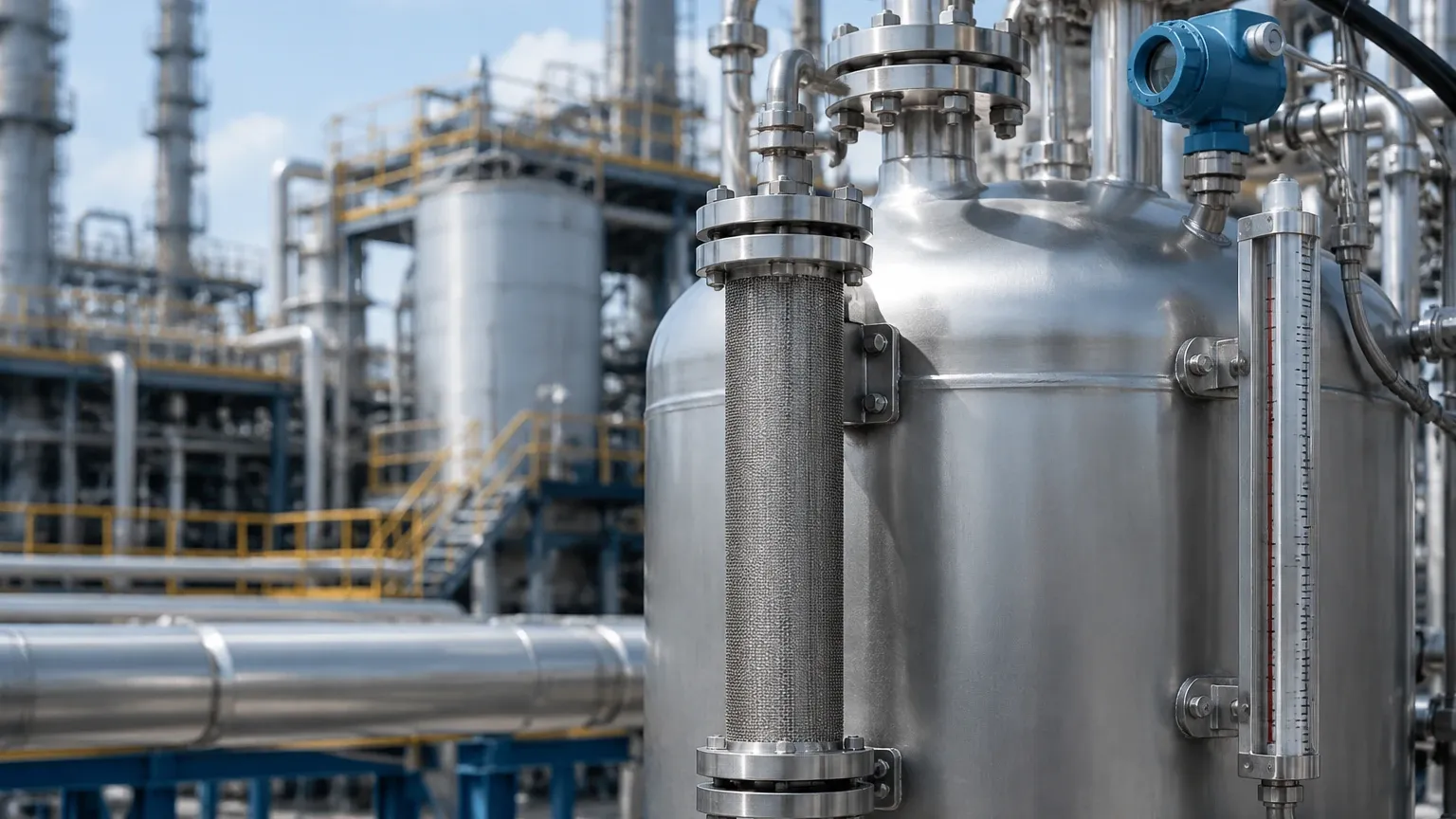
When integrating filtration into a pressurized system or a pipeline, the geometry of the filter element is as important as the mesh itself. Wire Mesh Filter Cylinders & Tubes are the primary configurations used in industrial housings. These cylindrical shapes are preferred because they provide a high surface-area-to-volume ratio and can withstand significant internal or external pressure.
Cylindrical Design Advantages
Cylindrical filters are often used as suction strainers, inline filters, or core components of larger filtration assemblies. Their structural rigidity allows them to be used in high-viscosity fluid processing where a flat mesh would likely deform. In hydraulic systems, for instance, a cylindrical tube ensures that the fluid is forced through the mesh uniformly, preventing localized clogging and extending the service interval.
Construction Methods
Industrial-grade cylinders are manufactured using advanced welding techniques. Longitudinal seams are typically plasma or TIG welded to ensure a smooth, burr-free finish that does not compromise the filtration integrity. Depending on the application, these cylinders may feature perforated metal inner cores for additional support or specialized end fittings (such as flanges, threads, or O-ring grooves) for secure installation.
Material Selection for Demanding Industrial Environments
Identifying what is mesh filter capability also involves analyzing the metallurgy. In the chemical, pharmaceutical, and food processing industries, the choice of material is non-negotiable. Stainless steel is the industry standard, but the specific grade must be matched to the operating environment.
1. AISI 304 Stainless Steel: Suitable for general industrial use, providing good corrosion resistance and durability in non-acidic environments.
2. AISI 316/316L Stainless Steel: Contains molybdenum, which significantly enhances resistance to pitting and crevice corrosion in chloride-rich environments (e.g., seawater or chemical processing).
3. Specialty Alloys: For extreme temperatures or highly aggressive chemicals, materials like Monel, Inconel, or Hastelloy may be employed.
Engineers must also consider the "L" (low carbon) variants, such as 316L, when the filter requires extensive welding. Low carbon content prevents carbide precipitation during the welding process, maintaining the corrosion resistance of the heat-affected zones.
Engineering Parameters: Micron Ratings and Filtration Efficiency
When selecting Wire Mesh Filter Cylinders & Tubes, the distinction between nominal and absolute filtration ratings is a common point of confusion for purchasing teams.
Nominal vs. Absolute Ratings
* Nominal Rating: This is an approximate value indicating the ability of the filter to retain a majority of particles of a certain size (usually 60% to 90%). It is often used for pre-filtration stages.
* Absolute Rating: This refers to the diameter of the largest hard spherical particle that will pass through the filter under specific test conditions. For critical applications, such as pharmaceutical sterile filtration or high-precision hydraulic protection, an absolute rating is required to guarantee system safety.
Effective Filtration Area (EFA)
The EFA is the total area of the mesh that is actually available for fluid passage. In pleated designs, the EFA is significantly increased within the same cylindrical footprint, allowing for lower face velocities and longer life cycles. When calculating the required size of a filter tube, engineers must balance the EFA against the housing constraints and the desired cleaning interval.
Hydraulic Performance: Flow Rate and Pressure Drop Considerations
A common mistake in filter selection is over-specifying the filtration fineness, which can lead to excessive pressure drops (Delta P). Every mesh filter introduces a resistance to flow. As the filter captures contaminants, this resistance increases.
Calculating Initial Pressure Drop
The initial pressure drop is a function of the fluid's viscosity, the flow velocity, and the open area of the mesh. A well-designed system typically targets an initial pressure drop of less than 2-3 PSI. If the initial Delta P is too high, the system will reach its terminal pressure drop (the point where cleaning or replacement is required) too quickly, leading to increased operational costs.
The Impact of Viscosity
In applications involving oils, polymers, or food products like honey, viscosity plays a dominant role. Higher viscosity fluids require larger mesh openings or increased surface area (through longer or wider tubes) to maintain acceptable flow rates without causing cavitation in pumps or structural failure of the filter element.
Customization and OEM Integration for Industrial Systems
For many B2B applications, off-the-shelf solutions are insufficient. This is where custom manufacturing becomes essential. When defining what is mesh filter requirements for a specific project, engineers should look for OEM partners capable of bespoke designs.
Layering and Support
Custom Wire Mesh Filter Cylinders & Tubes can be engineered with multiple layers. A common configuration includes:
* Filtration Layer: The fine mesh that determines the micron rating.
* Support Layer: A coarser mesh that provides mechanical backing to the fine mesh.
* Protective Layer: An outer layer (often perforated metal) that protects the delicate mesh from physical damage during handling or high-velocity flow surges.
Custom End Fittings
To ensure a leak-proof seal, the end caps of the filter must be compatible with the existing housing. Options include NPT/BSP threads, sanitary Tri-Clamp fittings for food and pharma, or custom-machined flanges. Ensuring a precise fit is critical; even a micron-scale gap around the seal can allow bypass, rendering the entire filtration process ineffective.
Maintenance, Cleaning, and Replacement Cycles
One of the primary advantages of stainless steel mesh filters is their cleanability. Unlike depth filters (like melt-blown or string-wound cartridges), mesh filters are surface filters. This means the contaminants are trapped on the surface of the mesh, making them easier to remove.
Cleaning Methods
* Backwashing: Reversing the flow of the fluid to flush particles off the mesh surface.
* Ultrasonic Cleaning: Using high-frequency sound waves in a solvent bath to dislodge fine particles from the mesh intersections.
* Chemical Cleaning: Using acids or alkalis to dissolve organic or mineral scale (provided the mesh material is compatible).
Total Cost of Ownership (TCO)
While the initial cost of a high-quality stainless steel Wire Mesh Filter Cylinders & Tubes is higher than disposable alternatives, the TCO is often lower. The ability to clean and reuse the filter hundreds of times reduces waste, lowers replacement inventory costs, and minimizes system downtime.
Conclusion: Making an Informed Selection
Understanding what is mesh filter technology requires a comprehensive look at material science, hydraulic engineering, and manufacturing precision. For an international buyer or a systems engineer, the goal is to find a balance between filtration fineness, structural durability, and cost-effectiveness.
When specifying filters for your next project, ensure you have confirmed the following with your manufacturer:
1. The exact medium (chemical composition, temperature, and viscosity).
2. The required micron rating (absolute vs. nominal).
3. The maximum allowable pressure drop at peak flow.
4. The mechanical constraints of the installation environment.
By focusing on these factual boundaries and leveraging the durability of stainless steel wire mesh, industrial operations can achieve reliable, long-term filtration performance in even the most demanding environments.
