


Wire Mesh Filters
In industrial process engineering, the selection of filtration media directly impacts system efficiency, equipment longevity, and product purity. Among the various technologies available, wire mesh filters remain a cornerstone for applications requiring high mechanical strength, thermal stability, and precise aperture control. This guide examines the technical specifications, engineering considerations, and selection criteria for integrating these components into industrial systems.
Understanding Wire Mesh Filtration Technology
Wire mesh filters are surface-type filtration media constructed from metallic wires woven into specific patterns. Unlike depth filters (such as felt or melt-blown cartridges) that trap particles within a thick matrix, wire mesh captures contaminants on the surface of the screen. This characteristic allows for easier cleaning and predictable flow performance.
Weave Patterns and Their Engineering Impact
The performance of a filter is largely determined by its weave pattern. Engineers must select a weave that balances filtration fineness with structural integrity:
* Plain Weave: The simplest pattern where each warp wire crosses over and under each shute wire. It provides high flow rates and is suitable for coarse filtration tasks.
* Twill Weave: Each shute wire passes over and under two warp wires. This allows for the use of heavier wires in a given mesh count, increasing the strength and durability of the filter.
* Plain Dutch Weave: This pattern uses a limited number of warp wires and a maximum number of shute wires woven together. It creates a dense, strong mesh with small, triangular openings, ideal for high-pressure applications and fine filtration.
* Dutch Twill Weave: Combining the benefits of twill and Dutch weaves, this produces the finest filtration levels (down to 5-10 microns) while maintaining a robust structure capable of withstanding significant differential pressure.
Material Selection for Demanding Environments
Industrial filtration often occurs in aggressive chemical environments or at extreme temperatures. Material selection is the primary defense against corrosion and mechanical failure.
Stainless Steel Alloys
Stainless steel is the standard material for industrial wire mesh filters due to its versatility and resistance to oxidation.
* AISI 304: The most common grade, providing excellent cost-to-performance ratio for general industrial water treatment and food processing applications.
* AISI 316L: Containing molybdenum, 316L offers superior resistance to chlorides and organic acids. The "L" denotes low carbon content, which prevents carbide precipitation during welding—a critical factor for maintaining the structural integrity of custom-fabricated filter components.
* Specialty Alloys: For highly specialized environments, materials such as Monel, Inconel, or Hastelloy may be specified to handle high-concentration acids or temperatures exceeding 500°C.
Structural Design: Wire Mesh Filter Cylinders & Tubes
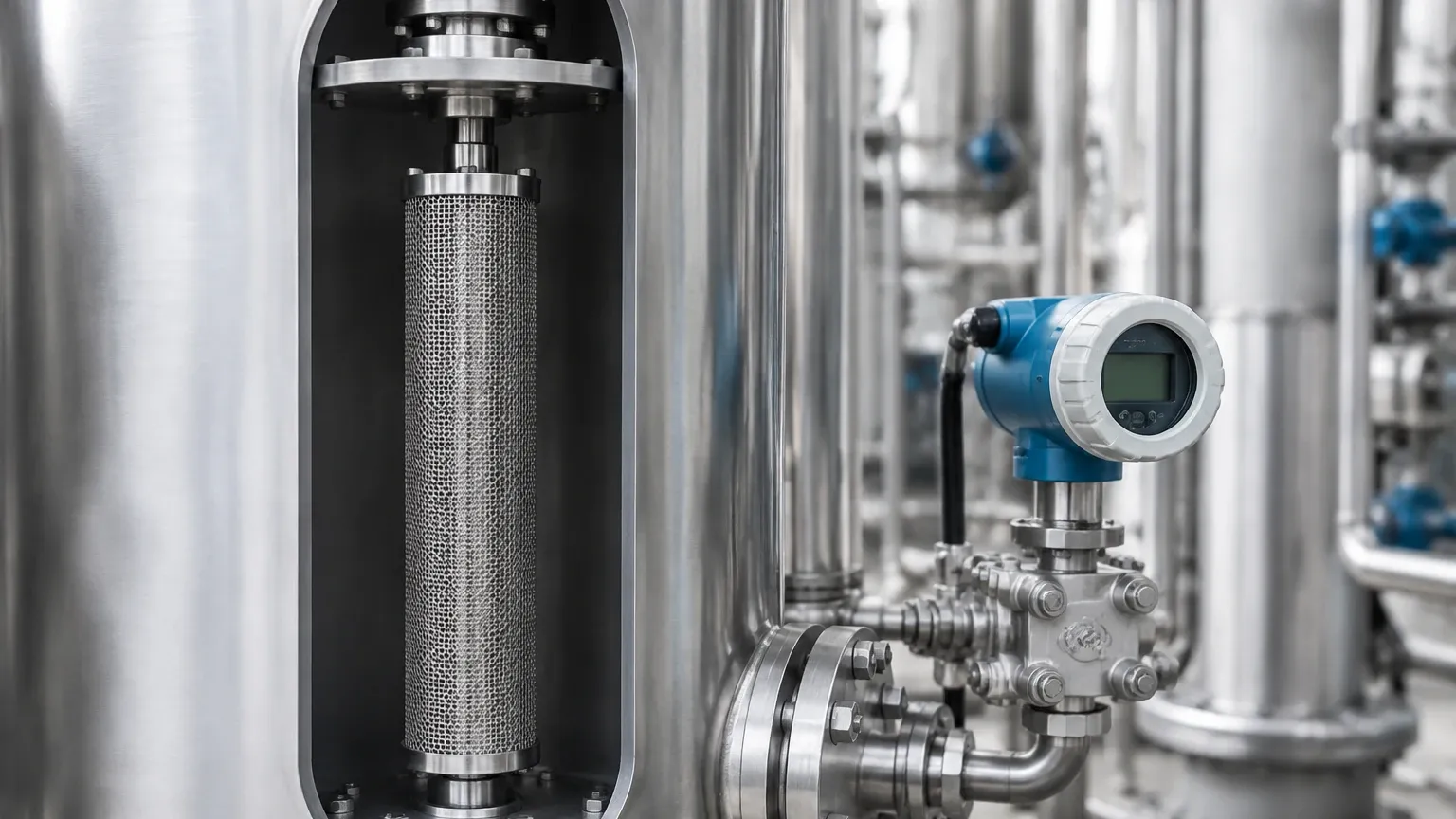
The physical geometry of the filter element must align with the housing design and the fluid dynamics of the system. Wire Mesh Filter Cylinders & Tubes are the most common configurations in industrial hydraulics, chemical processing, and water treatment.
Single-Layer vs. Multi-Layer Construction
For low-pressure applications where the primary goal is simple straining, a single-layer mesh cylinder may suffice. However, in high-pressure or high-flow environments, multi-layer designs are engineered to provide structural support. Typically, a fine filtration mesh is sandwiched between coarser "support" and "drainage" layers. These layers are often sintered together to create a monolithic structure that prevents mesh migration and maintains pore geometry under stress.
Reinforcement and End Fittings
To ensure the filter can be securely installed within a housing, cylinders and tubes are equipped with various end fittings, including:
* Threaded Connectors: For high-pressure hydraulic systems.
* Flanges: For large-scale chemical process piping.
* DOE (Double Open End) or SOE (Single Open End): Standard configurations for cartridge-style housings.
* Internal Support Cores: Perforated metal tubes placed inside the mesh cylinder to prevent collapse during high-differential pressure events.
Key Performance Metrics for Engineers
When specifying wire mesh filters, engineers must evaluate several quantitative factors to ensure the component meets the application's operational requirements.
Micron Rating: Absolute vs. Nominal
It is critical to distinguish between nominal and absolute micron ratings. A nominal rating refers to the ability of the filter to retain a percentage of particles of a certain size. An absolute rating, which is more common for high-precision wire mesh, indicates the diameter of the largest hard spherical particle that will pass through the mesh under laboratory conditions. For critical pharmaceutical or hydraulic applications, absolute ratings are mandatory to prevent downstream contamination.
Clean Pressure Drop (ΔP)
The pressure drop across a clean filter is a function of the mesh open area, fluid viscosity, and flow velocity. A high open area reduces energy consumption by minimizing the resistance to flow. Engineers should calculate the maximum allowable pressure drop before the filter requires cleaning or replacement to avoid system downtime.
Dirt Holding Capacity
While wire mesh filters are surface-loading, pleated designs can significantly increase the available surface area within the same footprint. Increasing the surface area lowers the flux (flow per unit area), which reduces the rate of pressure buildup and extends the service interval between cleanings.
Industrial Applications and Compatibility
Wire mesh filters are utilized across a broad spectrum of industries, each with unique regulatory and technical demands.
Chemical and Petrochemical Processing
In these sectors, filters must resist aggressive solvents and high temperatures. Stainless steel mesh is used for catalyst recovery, polymer filtration, and removing particulates from feedstock. The ability to withstand backwashing is essential here to maintain continuous process flow.
Food and Beverage Industry
Filtration components in this industry must meet stringent sanitary standards. 316L stainless steel is preferred for its smooth surface finish, which prevents bacterial growth and allows for Clean-in-Place (CIP) procedures. Applications include straining pulp from juices, filtering frying oils, and steam filtration.
Hydraulic and Lubrication Systems
Precision wire mesh filters protect sensitive valves and pumps from wear-inducing particles. In these high-pressure environments, the mechanical strength of the mesh cylinder is paramount to prevent "bursting" or "collapsing" during cold starts or pressure surges.
Maintenance and Total Cost of Ownership (TCO)
One of the primary advantages of wire mesh filters over disposable media is their cleanability. While the initial capital expenditure for a stainless steel filter is higher than a polypropylene cartridge, the TCO is often lower due to the extended service life.
Cleaning Methodologies
Depending on the contaminant, several cleaning methods can be employed to restore the filter’s performance:
1. Backwashing: Reversing the flow of the fluid to dislodge surface particles. This is common in automated water treatment systems.
2. Ultrasonic Cleaning: Using high-frequency sound waves in a cleaning solution to remove fine particles trapped deep within the mesh intersections.
3. Chemical Cleaning: Utilizing acids or alkalis to dissolve organic or inorganic scaling. This requires the filter material to be chemically compatible with the cleaning agent.
4. Burn-off/Pyrolysis: For polymer or heavy oil applications, the filter can be heated in a controlled environment to carbonize and remove organic buildup.
Replacement Cycles
Despite their durability, wire mesh filters are not infinite. Over time, repeated cleaning and mechanical stress can lead to work hardening of the wires, resulting in fatigue cracks. Furthermore, "permanent" blinding—where particles become wedged so tightly they cannot be removed—will eventually lead to an unacceptable baseline pressure drop. Regular inspection of the mesh integrity and monitoring of the "clean" pressure drop are essential maintenance practices.
Procurement and Customization Considerations
For international buyers and engineers, sourcing wire mesh filters requires clear communication of technical requirements. Standard off-the-shelf products may not meet the nuances of a specific process.
OEM and Custom Fabrication
Manufacturers like Kaifil specialize in custom stainless steel filtration solutions. When requesting a quote for custom cylinders or tubes, the following information should be provided:
* Fluid Properties: Viscosity, temperature, and chemical composition.
* Contaminant Profile: Particle size distribution and concentration.
* Flow Requirements: Normal and maximum flow rates.
* Operational Pressure: Maximum system pressure and allowable differential pressure.
* Dimensional Constraints: Length, outer diameter (OD), and inner diameter (ID).
By focusing on these technical boundaries, engineers can ensure they receive a filtration component that provides reliable, long-term performance in demanding industrial environments. The transition from disposable to cleanable wire mesh media represents a strategic investment in process stability and operational efficiency.
