


Strainer Basket Pasta
In the high-volume industrial food processing sector, particularly within the pasta manufacturing industry, the efficiency of liquid-solid separation is a critical determinant of both product quality and operational throughput. The term "strainer basket pasta" refers to the specialized industrial-grade filtration and separation components designed to manage the flow of pasta products through various stages of production, including blanching, boiling, quenching, and final dewatering.
For engineers and procurement professionals, selecting the correct Strainers & Baskets is not merely a matter of finding a container; it involves a complex evaluation of material science, hydraulic performance, and stringent sanitary standards. This guide examines the technical requirements and engineering considerations for industrial strainer baskets used in modern pasta production lines.
Material Engineering for High-Temperature Brine Environments
Industrial pasta production environments are characterized by high humidity, constant exposure to water, and significant temperature fluctuations. Consequently, the material selection for a strainer basket is the first point of technical scrutiny. While many industrial applications can utilize standard carbon steel or lower-grade alloys, the food industry demands materials that are both inert and resistant to localized corrosion.
304 vs. 316L Stainless Steel
Stainless steel is the industry standard, but the specific grade must be chosen based on the chemical environment. While Type 304 stainless steel is often sufficient for standard water-based applications, Type 316L is frequently preferred in pasta processing where salt (sodium chloride) is added to the cooking water. The addition of molybdenum in 316L provides superior resistance to pitting and crevice corrosion caused by chlorides at elevated temperatures. In a continuous boiling environment, 304 stainless steel may eventually show signs of stress corrosion cracking, whereas 316L maintains its structural integrity over a much longer lifecycle.
Surface Finish and Hygiene
In food-grade applications, the surface finish of the strainer basket is as critical as the alloy itself. A high-quality strainer basket pasta application requires a smooth, non-porous surface to prevent bacterial growth and starch buildup. Electropolishing is often employed to achieve a low Ra (Roughness Average) value. This process removes microscopic peaks and valleys from the metal surface, ensuring that the basket remains easy to clean during automated Clean-in-Place (CIP) cycles. A surface that is too rough will trap starch particles, which can lead to fermentation and contamination risks between batches.
Structural Design and Mechanical Load Considerations
The physical demands of pasta cooking and blanching require strainer baskets that can withstand rapid temperature cycling and heavy mechanical loads without structural failure. When pasta is transferred from boiling water to cold quenching baths, the metal undergoes significant thermal expansion and contraction. Over time, this can lead to work hardening and cracking if the basket is not engineered correctly.
Reinforced Frameworks
Large-scale industrial baskets must be engineered with reinforced rims and support ribs. These structural elements prevent the basket from warping under the weight of the product or the force of mechanical lifting systems. In many automated lines, baskets are subjected to centrifugal forces during dewatering or high-impact loads during automated dumping. Engineers must calculate the maximum load capacity, accounting for the weight of the pasta plus the weight of the retained water, which can significantly increase the stress on the basket’s bottom and handles.
Perforation and Open Area Calculations
Engineers must balance the structural integrity of the basket with the required open area for drainage. A higher open area percentage allows for faster dewatering, which is essential for controlling the texture of the pasta and preventing overcooking. However, excessive perforation can weaken the basket. Precision CNC punching or laser cutting is used to create specific hole patterns—such as staggered rounds or slotted openings—that optimize flow while maintaining the mechanical strength needed for heavy batch loads. The goal is to maximize the "drainage-to-strength" ratio to ensure the pasta does not sit in hot water longer than the recipe dictates.
Optimizing Drainage Efficiency and Starch Management
The geometry of the pasta—ranging from fine vermicelli to large rigatoni—dictates the mesh or perforation size of the strainer. A "one-size-fits-all" approach often leads to product loss or inefficient drainage, which can compromise the "al dente" quality of the final product.
Managing Starch Accumulation
Starch accumulation is a primary challenge in pasta filtration. As starch leaches into the cooking water, it creates a viscous film that can clog fine mesh. This phenomenon, known as "blinding," reduces drainage efficiency and can lead to uneven cooling. Selecting a wedge wire or a specific Dutch weave mesh can help mitigate this. Wedge wire, in particular, features a V-shaped profile that provides a widening path for fluids, making it significantly less prone to clogging than standard square mesh. Engineers should evaluate the flow velocity through the strainer basket pasta system to ensure that the shear force of the water helps keep the filtration surface clear.
Fine Particle Recovery
For smaller pasta shapes or the recovery of broken pasta fragments (fines), a woven wire mesh lining may be integrated into a sturdier perforated basket. This dual-layer construction provides the fine filtration needed to keep process water clean and reduce the load on downstream wastewater treatment systems, while the perforated plate provides the necessary rigid support to prevent the mesh from sagging or tearing under load.
Sanitary Standards and Maintenance Protocols
In the B2B food processing environment, downtime for cleaning is a significant cost factor. Strainer baskets must be designed for rapid sanitation to comply with FDA, 3-A, and international food safety standards. The design must facilitate complete drainage so that no cleaning chemicals or rinse water remain trapped in the component.
Sanitary Welding Techniques
Effective strainer baskets for pasta production avoid "dead zones"—sharp corners or overlapping joints where organic matter can accumulate. TIG (Tungsten Inert Gas) welding is the preferred method for these components because it produces clean, smooth beads that can be ground flush. Unlike MIG welding, which can leave a porous surface, TIG welding ensures a fully penetrated, sanitary joint that resists bacterial colonization. Every weld point in a food-grade basket is a potential failure point for hygiene, so full-penetration welds are a technical requirement.
Durability Under Chemical Cleaning
Industrial cleaning agents, including caustic sodas and acid washes used to remove starch and mineral scale, can be aggressive toward metal. The strainer basket must be chemically compatible with these cleaning agents to prevent surface degradation. Regular inspection of the mesh integrity is necessary; a single broken wire or a cracked weld can become a physical contaminant in the food stream, leading to costly product recalls. Engineers should establish a replacement cycle based on the frequency of chemical exposure and mechanical stress cycles.
Customization and OEM Solutions for Specialized Production Lines
Because every production facility has unique spatial and mechanical constraints, off-the-shelf solutions are rarely sufficient for high-performance lines. Customization is a core requirement for engineers looking to optimize their filtration stages and integrate them into existing automated systems.
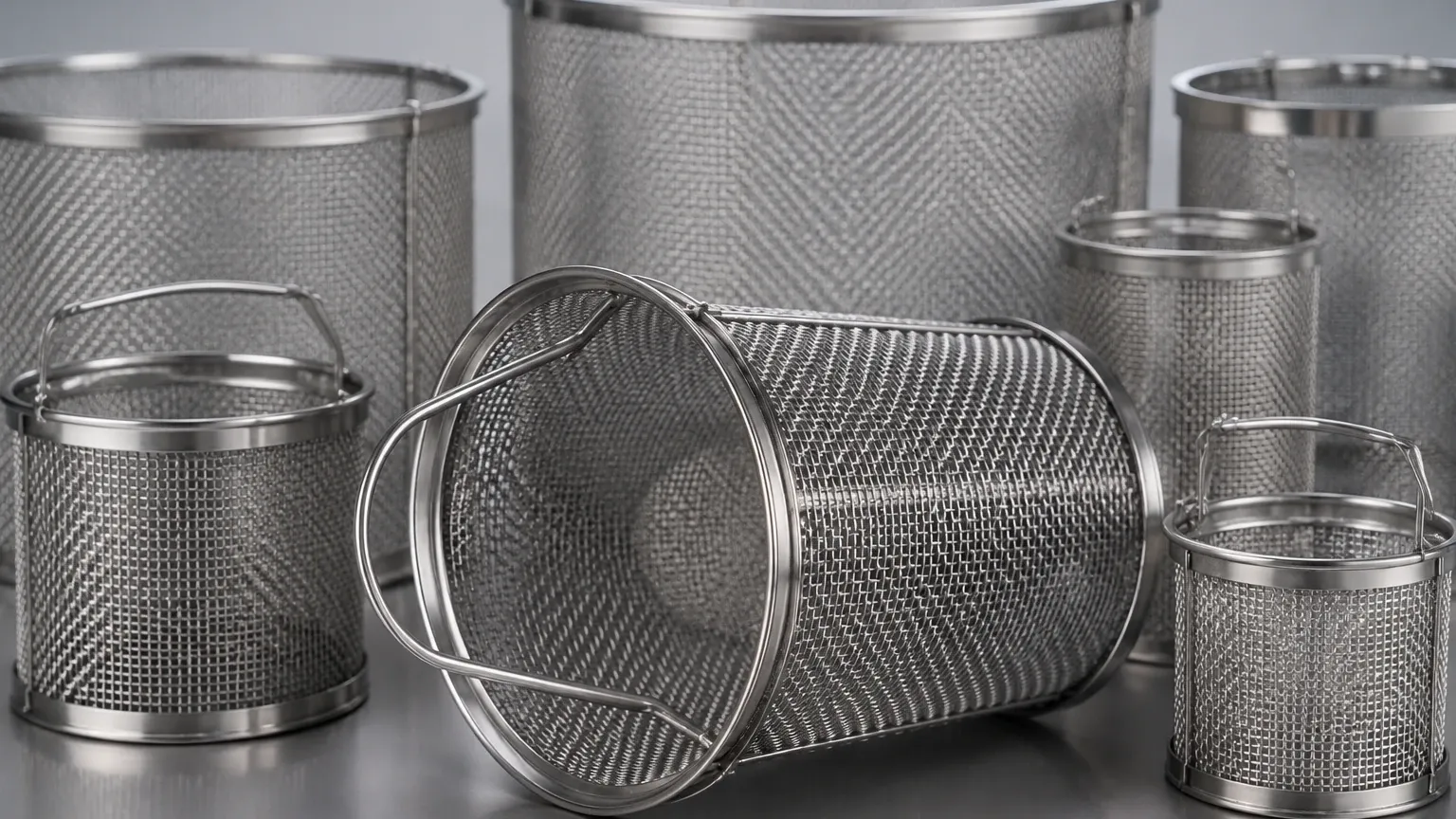
* Handle and Mounting Configurations: Baskets can be fitted with custom lifting lugs, bails, or flanged rims to interface with specific overhead hoists or centrifugal dewatering machines. The orientation of these handles must allow for ergonomic manual handling where necessary, while also fitting the tolerances of robotic pick-and-place systems.
* Variable Micron Ratings: Depending on whether the basket is used for primary product handling or secondary wastewater treatment (recovering starch and solids), the filtration rating can be customized from several millimeters down to 50 microns. This ensures that the same basket design can be adapted for different stages of the factory line.
* Reinforced Bottoms and Wear Plates: For applications involving heavy agitation or high-pressure water jets used for cleaning, the bottom of the strainer basket can be reinforced with a thicker plate or a double-layered mesh to prevent sagging and extend the service life of the component.
Total Cost of Ownership and Selection Criteria for Procurement
When purchasing Strainers & Baskets, procurement teams and engineering managers should look beyond the initial purchase price and consider the Total Cost of Ownership (TCO). A lower-quality basket may save on upfront costs but can lead to significant expenses through frequent replacements and operational inefficiencies.
Evaluating Manufacturer Expertise
A reliable manufacturer should be able to provide detailed material certifications (MTRs) and documentation of welding procedures. They should also offer engineering support to help determine the optimal open area and mesh size for specific pasta shapes. For specialized needs, such as a strainer basket pasta solution tailored to a specific extrusion or drying line, working with an OEM manufacturer like Kaifil allows for the development of components that meet exact hydraulic and mechanical specifications.
Long-Term Performance Metrics
Key performance indicators (KPIs) for industrial strainer baskets include the time required for complete dewatering, the frequency of manual cleanings required between CIP cycles, and the average lifespan of the basket before structural fatigue occurs. By tracking these metrics, facilities can justify the investment in higher-grade materials and precision-engineered designs that reduce labor costs and improve overall equipment effectiveness (OEE).
Conclusion
Selecting the right industrial strainer basket for pasta processing requires a deep understanding of the interaction between the product, the process fluid, and the mechanical environment. From choosing the correct stainless steel grade to withstand chloride-rich boiling water to calculating the optimal open area for rapid dewatering, every engineering decision impacts the efficiency of the production line. For technical teams, the goal is to implement a filtration solution that balances durability, hygiene, and performance, ensuring that the separation process remains a seamless and reliable part of the manufacturing chain.
