


Strainer Basket Seal
In industrial filtration systems, the efficiency of a strainer is frequently measured by its micron rating or flow capacity. However, from an engineering perspective, the performance of any filtration unit is fundamentally limited by the integrity of its internal sealing. The strainer basket seal is the critical component that ensures all fluid passes through the filtration media rather than bypassing it. Without a reliable seal, particulates can enter downstream equipment, leading to premature wear, valve damage, and system downtime.
For engineers and procurement professionals managing complex fluid systems, understanding the technical nuances of seal selection, material compatibility, and design integration is essential. This guide examines the mechanical role of the strainer basket seal and provides actionable insights for optimizing Strainers & Baskets in demanding industrial environments.
The Critical Role of the Strainer Basket Seal in Industrial Filtration
The primary function of a strainer basket is to remove unwanted solids from a liquid or gas stream. This process relies on a pressure differential that forces the fluid through the mesh or perforated metal. However, fluid naturally follows the path of least resistance. If there is a gap between the basket flange and the strainer housing, a portion of the fluid will bypass the filter media entirely.
This phenomenon, known as "bypass," renders the specified micron rating of the basket irrelevant. For example, a high-precision 50-micron stainless steel basket cannot protect a downstream pump if a failing strainer basket seal allows 500-micron particles to leak through the perimeter. Therefore, the seal is not merely an accessory but a primary functional component of the filtration circuit.
In high-pressure applications, the seal must also withstand significant hydraulic forces. As the basket accumulates debris, the differential pressure increases, putting additional stress on the sealing surface. A properly engineered seal maintains its shape and contact force under these varying loads, ensuring consistent performance throughout the cleaning cycle.
Types of Sealing Mechanisms for Industrial Baskets
Depending on the housing design and the required filtration precision, several types of seals may be employed. Choosing the right configuration depends on the operating pressure, temperature, and the frequency of basket removal for cleaning.
O-Ring Seals
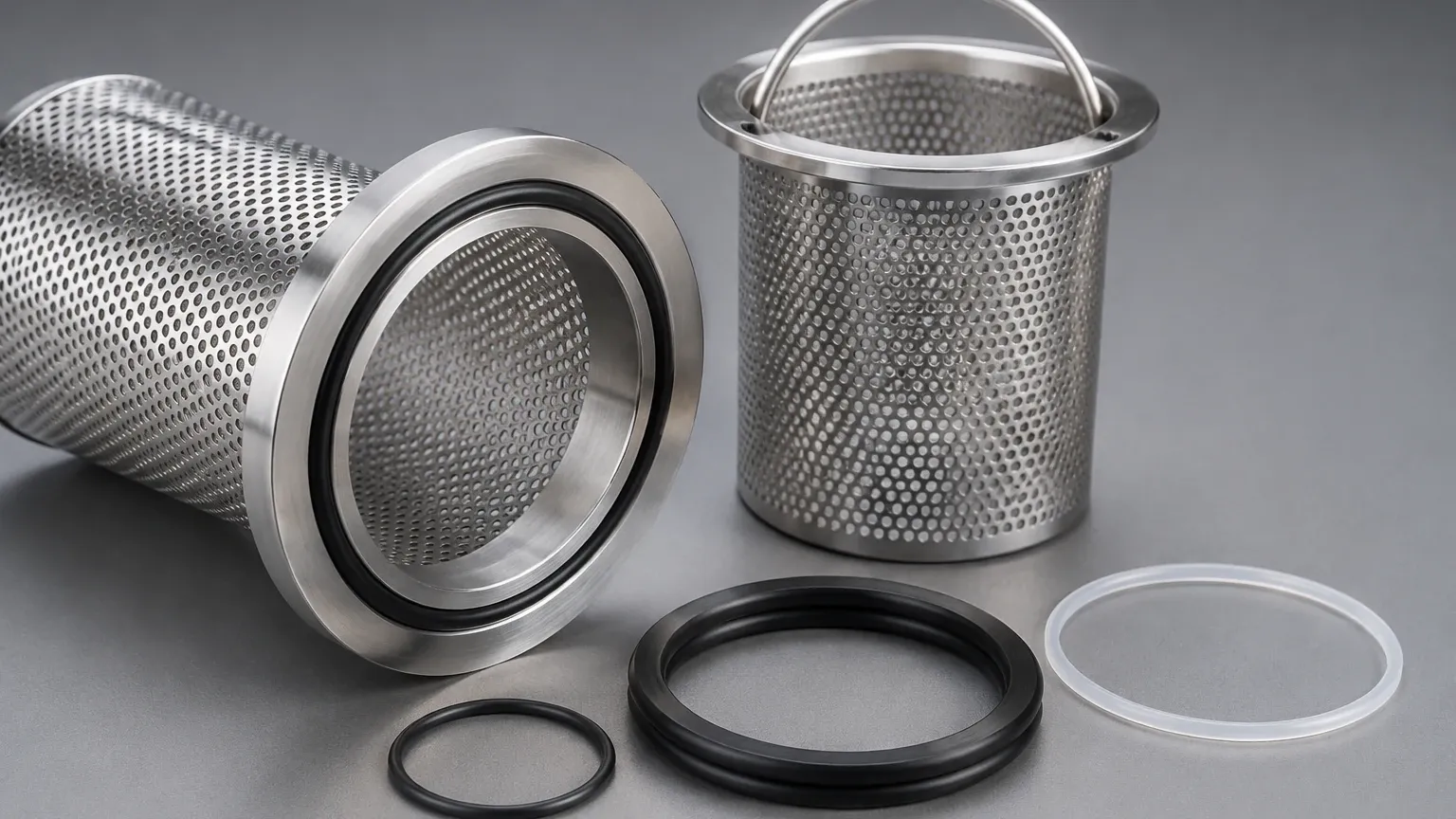
O-rings are perhaps the most common sealing solution for high-pressure strainers. They are typically seated in a machined groove either on the basket flange or within the housing body. When the housing cover is tightened, the O-ring is compressed, creating a robust circular barrier. This design is highly effective at preventing bypass even in systems with significant pressure fluctuations.
Flat Gaskets
Flat gaskets are often used in lower-pressure applications or in large-diameter strainers where a wider sealing surface is required. These are typically made from reinforced elastomers or PTFE. While they are cost-effective, they require uniform bolt torque across the housing cover to ensure that the strainer basket seal provides an even 360-degree contact area.
Machined Metal-to-Metal Seats
In extreme temperature environments where elastomers would degrade, some heavy-duty strainers utilize precision-machined metal seats. While these do not provide the zero-leakage performance of an elastomer, they are designed with tight tolerances to minimize bypass to an acceptable level for coarse straining. In these cases, the weight of the basket or a heavy-duty spring is used to hold the metal surfaces in contact.
Material Selection for Chemical and Thermal Compatibility
The longevity of a strainer basket seal is dictated by its chemical and thermal compatibility with the process fluid. Selecting the wrong material can lead to swelling, hardening, or chemical degradation, all of which result in seal failure.
| Material | Temperature Range | Chemical Compatibility | Common Applications |
| :— | :— | :— | :— |
| Buna-N (Nitrile) | -40°C to 100°C | Petroleum oils, water, hydraulic fluids | General industrial, oil and gas |
| EPDM | -50°C to 150°C | Steam, water, ketones, dilute acids | Food & beverage, water treatment |
| Viton™ (FKM) | -20°C to 200°C | Aromatics, fuels, aggressive chemicals | Chemical processing, high-temp oil |
| PTFE (Teflon) | -200°C to 260°C | Almost all chemicals, high purity | Pharmaceutical, semiconductor |
| Silicone | -60°C to 230°C | Low toxicity, high temperature | Medical, food grade |
When specifying a strainer basket seal, engineers must consider the "worst-case" scenario. For instance, a seal might handle a process fluid at 80°C during normal operation, but if the system undergoes a Steam-In-Place (SIP) cleaning cycle at 130°C, a standard Buna-N seal will fail. Similarly, in the chemical industry, even trace amounts of certain solvents can cause an elastomer to swell, making it impossible to remove the basket for cleaning without damaging the seal or the housing.
Engineering Considerations for Bypass Prevention
Beyond material selection, the mechanical design of the basket seating area determines the effectiveness of the seal. There are three primary design approaches to ensuring a secure fit:
1. Gravity Seating: In vertical basket strainers, the weight of the basket and the fluid column help hold the basket against the seal. This is common in low-pressure, large-volume water systems.
2. Spring-Loaded Compression: Many high-performance strainers use a heavy-duty spring located under the housing cover. When the cover is closed, the spring applies constant downward pressure on the basket flange, ensuring the strainer basket seal remains compressed even if there are slight mechanical vibrations or thermal expansions.
3. Bolted Flange Design: For the most critical applications, the basket itself may be bolted into a secondary internal flange. This is common in high-pressure gas filtration where bypass must be strictly eliminated.
Engineers should also evaluate the "Durometer" or hardness of the seal. A softer seal (lower Durometer) conforms better to surface irregularities but is more prone to extrusion under high pressure. A harder seal (higher Durometer) resists extrusion but requires higher clamping forces to achieve a tight seal.
Identifying and Troubleshooting Seal Failure
Seal failure is rarely instantaneous; it usually manifests as a gradual decline in filtration quality. Operators should be trained to recognize the following signs of a compromised strainer basket seal:
* Downstream Contamination: The presence of particles larger than the basket's micron rating is a definitive sign of bypass.
* Low Differential Pressure: If the pressure drop across the strainer remains unusually low even after long periods of operation, fluid is likely bypassing the basket through a damaged seal.
* Physical Deformation: During routine maintenance, seals should be inspected for "compression set" (flattening), cracking (ozone or thermal damage), or swelling. A seal that no longer fits its groove properly must be replaced immediately.
* Extrusion: If the seal material appears to be "flowing" out of the seating area, the system pressure exceeds the material's limits, or the gap between the basket and housing is too large.
Maintenance Protocols and Replacement Cycles
To maintain the integrity of Strainers & Baskets, the seal should be treated as a high-priority consumable. Relying on a seal until it visibly fails is a high-risk strategy that can lead to expensive downstream repairs.
Inspection and Cleaning
Every time the basket is removed for cleaning, the seal and the seating surfaces should be wiped down. Debris trapped in the seal groove can prevent the seal from seating correctly, creating a leak path. If using O-rings, a light coating of a compatible lubricant (such as food-grade silicone grease) can prevent the elastomer from drying out and make the basket easier to reinstall.
Scheduled Replacement
Industrial best practices suggest replacing the strainer basket seal at fixed intervals, such as every six months or during every third basket cleaning, depending on the severity of the application. In corrosive environments, the replacement cycle should be more frequent. Keeping a stock of spare seals is a low-cost insurance policy against unexpected system downtime.
Customization and OEM Solutions for Specific Applications
Standard off-the-shelf strainers may not always meet the requirements of specialized industrial processes. In sectors like pharmaceutical manufacturing or high-purity chemical processing, custom-engineered filtration components are often required.
Kaifil specializes in the production of high-performance stainless steel filtration solutions, offering extensive OEM capabilities for custom basket designs. Whether an application requires a unique flange geometry to accommodate a specific strainer basket seal or the use of specialized materials like Hastelloy or Monel for the basket structure, custom engineering ensures that the seal and the media work in perfect harmony.
When designing a custom system, engineers should confirm the following details before finalizing the seal specification:
* Exact Fluid Composition: Including trace chemicals or additives.
* Pressure Spikes: Not just operating pressure, but potential surges.
* Cleaning Procedures: Exposure to caustic washes or high-temperature steam.
* Compliance Requirements: Such as FDA, USP Class VI, or 3-A Sanitary Standards for food and pharma applications.
By focusing on the precision of the strainer basket seal, industrial facilities can significantly improve the reliability of their filtration systems, protect sensitive downstream equipment, and achieve a lower total cost of ownership through reduced maintenance and improved product quality.
