


Strainer Basket Steel
In industrial fluid handling systems, the integrity of downstream equipment—such as pumps, valves, heat exchangers, and spray nozzles—depends heavily on the efficiency of primary filtration components. Among these, the use of strainer basket steel components is fundamental for removing large-scale particulate matter and debris from process streams. Selecting the correct material and design for these baskets is not merely a matter of mechanical fit; it involves a complex evaluation of metallurgy, fluid dynamics, and chemical compatibility.
As a specialized manufacturer of stainless steel filtration solutions, Kaifil provides engineered Strainers & Baskets designed to withstand the rigorous demands of chemical processing, food production, and hydraulic applications. This guide examines the technical considerations essential for engineers and procurement teams when specifying strainer basket steel for industrial environments.
The Critical Function of Strainer Basket Steel in Process Systems
Industrial strainers serve as the first line of defense in a piping system. Unlike fine filter cartridges that are often designed for polishing or sub-micron filtration, a strainer basket is typically utilized for "coarse" filtration, capturing solids that could cause mechanical failure or process contamination.
Strainer basket steel must provide structural rigidity to resist the force of the fluid flow, especially as the basket becomes loaded with debris. When a basket begins to clog, the differential pressure (∆P) across the element increases significantly. If the steel construction is insufficient, the basket may collapse or bypass, allowing contaminants to reach sensitive downstream components. Therefore, the choice of steel grade and the mechanical construction of the basket are the most critical factors in ensuring system uptime.
Material Science: Selecting the Right Grade of Stainless Steel
The term "strainer basket steel" almost exclusively refers to stainless steel in modern industrial contexts due to its superior corrosion resistance and mechanical strength. However, the specific grade of stainless steel chosen can significantly impact the lifespan and performance of the filter.
Type 304 Stainless Steel
Type 304 is the most common grade used for general-purpose industrial strainers. It offers excellent strength and good corrosion resistance in many atmospheric and freshwater environments. It is a cost-effective choice for applications where the fluid is non-corrosive and operating temperatures remain moderate. However, in environments with high chloride concentrations, 304 stainless steel is susceptible to pitting and crevice corrosion.
Type 316 and 316L Stainless Steel
For more demanding applications, Type 316 stainless steel is the industry standard. The addition of molybdenum (2-3%) significantly enhances its resistance to chlorides and acidic environments. This makes 316 steel the preferred choice for chemical processing, marine applications, and pharmaceutical manufacturing. Type 316L (low carbon) is often specified for baskets that require extensive welding, as the lower carbon content prevents carbide precipitation during the welding process, maintaining the material’s corrosion resistance at the weld joints.
Specialty Alloys
In extreme environments involving highly corrosive chemicals or high-temperature steam, specialty alloys such as Duplex stainless steel or Monel may be required. These materials provide enhanced resistance to stress corrosion cracking and are used when standard 300-series steels would fail prematurely.
Engineering Considerations for Basket Design and Construction
The performance of a strainer basket is determined by its physical configuration. Engineers must balance the need for fine filtration with the requirement for high flow rates and low pressure drops.
Perforated Metal vs. Wire Mesh
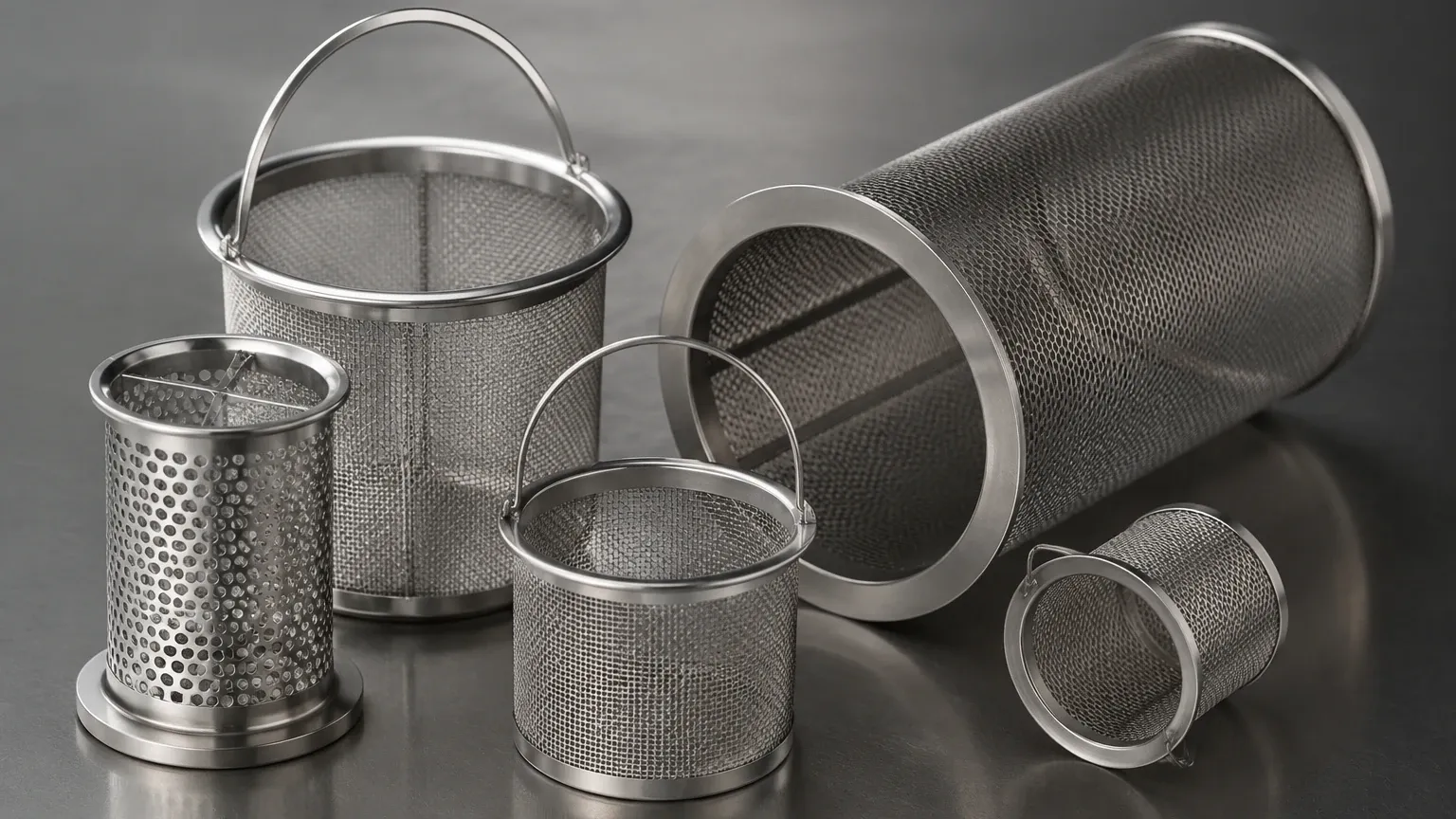
Most industrial strainer baskets use a two-layer or three-layer construction. The outer layer is typically a heavy-gauge perforated metal sheet that provides the necessary structural strength to withstand high differential pressures. The inner lining consists of a fine wire mesh that determines the actual filtration rating.
* Perforated Steel: Available in various hole sizes and patterns (staggered or straight). A common configuration is 1/8" holes on 3/16" centers, providing a balance of strength and open area.
* Wire Mesh: For finer filtration, stainless steel wire mesh is layered inside the perforated basket. This allows for filtration ratings down to 20 microns or finer, depending on the application requirements.
Structural Reinforcement
For high-pressure applications or large-diameter piping, the strainer basket steel may require additional reinforcement. This can include longitudinal support bars, heavy-duty top flanges, and reinforced bottoms. These features prevent the basket from distorting under the weight of captured solids or the force of a high-velocity fluid stream.
Handle and Seal Designs
Ease of maintenance is a key engineering consideration. Baskets are often equipped with heavy-duty handles to facilitate quick removal during cleaning cycles. Furthermore, the interface between the basket and the strainer housing must be perfectly sealed. This is often achieved through a machined flange or a specialized O-ring seat to ensure that no fluid bypasses the filtration media.
Performance Metrics: Flow Rate, Pressure Drop, and Open Area Ratio
When specifying a strainer basket, the "Open Area Ratio" (OAR) is one of the most vital technical metrics. The OAR is the ratio of the total open area of the basket holes to the cross-sectional area of the inlet pipe.
A high OAR is desirable because it results in a lower initial pressure drop and a longer service life between cleanings. Typically, a well-designed strainer basket should have an OAR of at least 6:1 or 8:1. If the OAR is too low, the fluid velocity through the basket increases, which can lead to premature clogging, increased energy consumption for pumps, and potential cavitation issues.
Engineers must also consider the viscosity of the fluid. Higher viscosity fluids require larger open areas and potentially coarser mesh to maintain acceptable flow rates. Kaifil’s engineering team works with clients to calculate these variables, ensuring that the customized strainer basket steel components meet the specific hydraulic requirements of the system.
Customization and OEM Solutions for Demanding Applications
Standard off-the-shelf strainers often fail to meet the unique constraints of specialized industrial processes. Customization is frequently required in the following areas:
1. Dimensional Constraints: In many retrofit projects, the strainer must fit into an existing housing with non-standard dimensions. Custom fabrication allows for the adjustment of basket height, diameter, and flange configuration.
2. Specific Filtration Ratings: While standard mesh sizes are available, some processes require precise micron ratings to protect sensitive equipment without over-filtering the fluid (which would lead to excessive maintenance).
3. Surface Finishes: In food and beverage or pharmaceutical applications, the strainer basket steel must meet strict sanitary standards. This often involves electropolishing the stainless steel to achieve a smooth, non-porous surface that resists bacterial growth and is easier to clean.
4. Magnetic Inserts: For applications involving hydraulic oils or metalworking fluids, magnetic assemblies can be integrated into the basket to capture fine ferrous particles that might pass through a standard mesh.
By leveraging advanced manufacturing capabilities, Kaifil provides reliable OEM and customized filtration solutions, ensuring that every component is optimized for its specific industrial environment.
Industry-Specific Applications for Steel Strainer Baskets
The versatility of stainless steel allows these baskets to be utilized across a wide spectrum of industries, each with its own set of challenges:
* Chemical Processing: Baskets must resist aggressive solvents and acids. 316L stainless steel is the standard here to prevent corrosion and ensure long-term structural integrity.
* Food and Beverage: Compliance with FDA and 3-A sanitary standards is mandatory. Baskets must be constructed from food-grade stainless steel with smooth welds and polished surfaces to prevent product entrapment.
* Water Treatment: Strainers are used to protect membranes and UV systems from large debris. In these high-volume applications, the durability of the steel and the OAR are the primary concerns.
* Hydraulic Systems: High-pressure environments require exceptionally strong strainer basket steel to prevent collapse during sudden pressure spikes or cold-start conditions.
Maintenance and Lifecycle Management
The total cost of ownership (TCO) for a strainer basket is determined more by its maintenance requirements and lifespan than by its initial purchase price. A poorly designed basket that clogs frequently or fails under pressure will result in significant downtime and labor costs.
Cleaning Protocols
Stainless steel baskets are designed to be cleaned and reused. The cleaning method depends on the nature of the contaminant. For loose debris, a simple high-pressure water wash or air blast may suffice. For sticky or baked-on contaminants, ultrasonic cleaning or chemical soaking may be necessary. It is essential that the cleaning process does not damage the fine wire mesh or compromise the structural welds of the basket.
Replacement Cycles
While stainless steel is highly durable, it is not indestructible. Baskets should be inspected regularly for signs of wire fraying, weld cracking, or corrosion. In high-cycle applications, metal fatigue can occur at the stress points where the handle or flange is attached. Establishing a regular inspection and replacement schedule is critical for preventing catastrophic system failures.
Conclusion: Selecting a Reliable Filtration Partner
Specifying the right strainer basket steel involves a detailed understanding of the material properties, mechanical design, and the specific demands of the industrial application. By focusing on high-quality stainless steel grades and precision engineering, facilities can significantly improve the reliability and efficiency of their fluid handling systems.
Kaifil’s commitment to quality and technical expertise makes us a trusted partner for global customers seeking high-performance filtration components. Whether you require a standard replacement or a fully customized OEM design, our team provides the engineering support necessary to achieve optimal filtration performance. For more information on our capabilities and to explore our range of products, please Review product options and application support to find the ideal solution for your specific industrial requirements.
